
My Take: The grassroots movement against AI data centers is the most bipartisan political coalition in a decade. It is also fighting the wrong battle. The buildings are not the threat. The software running inside them already changed your job, your kids’ homework, and your next doctor visit, and no amount of zoning reform will undo that.
The AI data center backlash is now a Time Magazine cover story. MAGA Republicans, democratic socialists, pastors, nurses, and Indigenous tribal councils are all marching against the same thing: massive compute facilities consuming electricity, water, and rural land at industrial scale.
They have real grievances. Power bills in Georgia climbed after utilities upgraded infrastructure to serve data centers. The Muscogee Nation voted down a hyperscale facility after community town halls.
Wisconsin campaigns defeated proposed builds in Caledonia and Menominee. In Q2 2025 alone, activists stalled $98 billion in data center development across the United States.
The way I see it, every one of those communities had legitimate reasons to push back. But the movement as a whole is aiming at the physical infrastructure while ignoring the software layer that already reshaped their daily lives. The data centers are warehouses. The disruption lives in the models they power, and those models are already deployed.

The Mainstream View and Why It Falls Short
The mainstream anti-data-center argument treats physical infrastructure as the primary threat, but the real disruption from AI is already deployed in software that most Americans use daily. Stopping a building does not stop the model inside it.
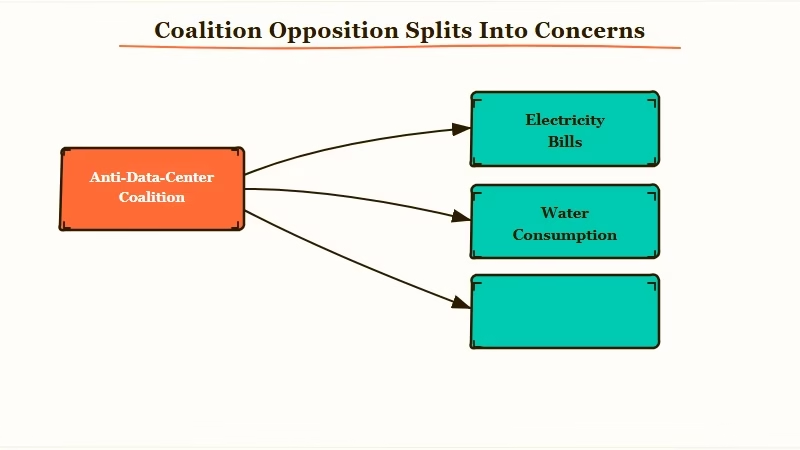
The coalition opposing data centers frames the fight as environmental and economic. Bernie Sanders and Ron DeSantis both oppose data center construction, one of the rarest bipartisan alignments in recent politics. Nurses report AI undermining patient safety.
Parents worry about teenagers consulting AI companions for emotional support. These concerns are not hypothetical. Two-thirds of unionized nurses say AI tools compromise care quality, and a July 2025 Common Sense Media study found 50% of teenagers aged 13 to 17 consult AI companions monthly.
But none of those problems are caused by the physical existence of a data center in Virginia or Texas. They are caused by what the data center runs. The 134,000 people who signed Max Tegmark’s statement calling for a halt to superintelligence development understand this distinction.
The communities blocking construction permits do not. The infrastructure fight gives people something tangible to oppose. A concrete building with cooling towers is easier to march against than an API endpoint.
What Is Actually Happening
The real AI disruption already happened, and it happened through software adoption, not physical construction. Sixty percent of Americans distrust AI according to Gallup, yet the majority of them use AI-powered tools daily without realizing it.
Google search results are AI-generated summaries. Customer service at most major companies routes through an AI layer before reaching a human. Code assistants write production software at companies that employ hundreds of thousands of people.
The Anthropic and SpaceX partnership that just doubled Claude’s rate limits is about serving existing demand, not creating new demand. The infrastructure is a response to adoption, not the other way around. Blocking a data center in San Marcos, Texas does not reduce the number of people using ChatGPT.
It just means the compute runs somewhere else, possibly overseas where environmental and labor regulations are weaker. The movement’s energy would produce more for the people marching if it redirected to three things:
- Liability frameworks for AI systems that give wrong medical advice, legal guidance, or financial recommendations
- Disclosure requirements so people know when they are talking to an AI instead of a human
- Data privacy laws that prevent companies from training models on personal information without consent
None of these require stopping construction. All of them require legislation that the bipartisan coalition already has the political power to push through.
The irony is worth sitting with. A movement with enough political force to stall $98 billion in development is spending that capital on zoning fights instead of regulatory fights.
The buildings they stop will get built in the next county. The regulations they could pass would change how every AI system in the country operates.
Here is where the fight is landing versus where it should land:
| What the movement is fighting | What it should be fighting |
|---|---|
| Data center construction permits | AI liability frameworks for bad advice |
| Utility grid upgrades for compute | Disclosure rules: AI vs. human contact |
| Land use and zoning for server farms | Data privacy: consent before training |
| Water cooling consumption locally | Market concentration in frontier AI |
| Foreign ownership of compute facilities | Algorithmic transparency requirements |
The Part Nobody Wants to Admit
The uncomfortable truth is that most people opposing data centers are already dependent on the AI services those centers power. The fight is internally contradictory, and nobody in the movement wants to say it out loud.
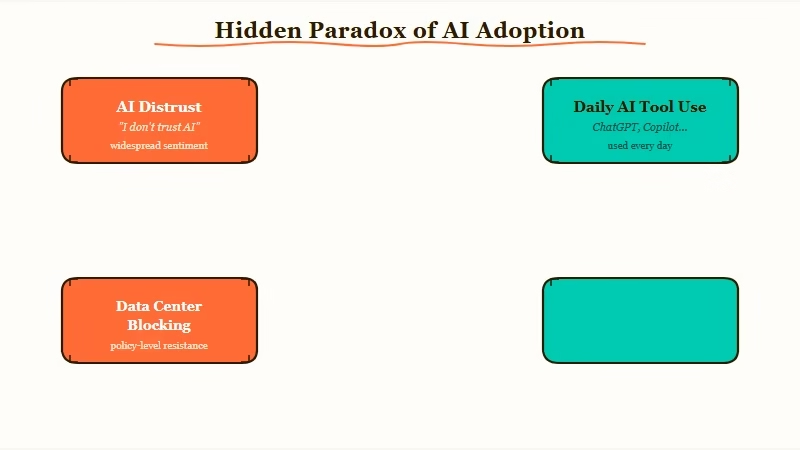
Gallup says 60% of Americans distrust AI. YouGov says 77% worry AI could eventually threaten humanity. At the same time, ChatGPT alone has over 300 million weekly active users.
Claude, Gemini, and Perplexity are growing at comparable rates. The distrust and the usage are happening simultaneously, in the same households, often on the same devices.
People are marching against the buildings that power the tools they used to organize the march. The flyers were designed in Canva (AI-powered). The social media posts were boosted by AI recommendation algorithms.
The route was planned on Google Maps (AI-optimized). The contradiction is total, and nobody on stage is mentioning it.
This is not hypocrisy. It is a category error. People correctly sense that something about AI is threatening, but they are channeling that anxiety toward the most visible physical manifestation instead of the invisible software layer doing the work.
The broader question of whether Americans trust AI is one we have covered before, and the answer keeps getting more complicated. Trust is declining while usage is rising. That gap is where the real political energy should be directed.
For anyone watching the AI agent infrastructure buildout, this movement matters. If the backlash succeeds at the infrastructure level without touching the software layer, the result is not less AI. It is more expensive AI running on fewer, larger facilities in jurisdictions that can resist community pressure.
Before and after: how this argument should shift your thinking
Before reading this: the data center fight is an environmental and economic issue where communities are defending themselves against Big Tech encroachment.
After reading this: the data center fight is a misdirected political energy problem. The communities winning zoning battles will still use ChatGPT tomorrow. The communities that push for liability and disclosure laws will actually change what AI systems are allowed to do to them.
Hot Take
The most powerful grassroots tech coalition in a decade is about to win the wrong fight and leave the real battlefield untouched.
The AI data center backlash is the most politically powerful grassroots movement in tech since the net neutrality fight. It will accomplish less than net neutrality did because it is fighting the container instead of the contents. In five years, every community that blocked a data center will still be using the AI services that data center was built to power.
