
The Verdict: Perplexity wins if you need accurate, cited answers from the live web. ChatGPT wins if you need to create, code, or reason through complex problems. Both cost $20/month at the paid tier, so this comes down to whether you search more or build more.
Perplexity vs ChatGPT is the $20 question that most AI users face in 2026. Both tools charge the same entry price for their paid plans, and both have improved dramatically since last year.
The overlap between them has grown. Perplexity added creative writing features. ChatGPT added web search. On the surface they look interchangeable.
They are not. From what I’ve seen after months of daily use across both platforms, they solve fundamentally different problems.
Perplexity is a search engine that talks. ChatGPT is a creative engine that sometimes searches. The tool you pick depends on whether your day revolves around finding information or producing it.
What Does Perplexity Do Better Than ChatGPT
Perplexity beats ChatGPT at real-time web search, source citation, and factual accuracy for anything that happened in the last 24 hours.
It was built as a search tool first, and that architecture shows.
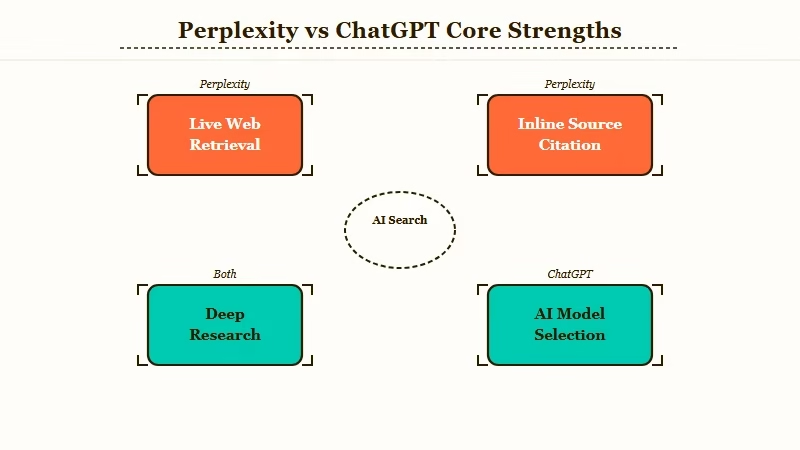
What is Perplexity: An AI-powered search engine that retrieves live web results, synthesizes them into a direct answer, and cites every source with inline links. Launched in 2022, now valued at $20 billion, 45 million users.
The way I see it, Perplexity’s core advantage is trust. When it answers a question, you can click the citation and verify the claim in 10 seconds. ChatGPT’s web search mode does cite sources, but the citations feel bolted on rather than native to the experience.
Perplexity Pro ($20/month) gives you access to GPT-5.4, Claude Opus 4.6, and Gemini 3.1 Pro for answering queries. You are not locked into one model. The tool picks the best model for your question or lets you choose manually.
Deep Research on Perplexity runs 20 queries per day on the Pro plan. It reads dozens of sources, synthesizes them into a structured report, and shows its research trail. I’d argue this is the single most valuable feature for anyone who does research-heavy work, whether that is market analysis, competitive intelligence, or academic writing.
Where Perplexity falls short: it struggles with multi-turn creative tasks. Ask it to brainstorm 10 product names and refine based on your feedback, and the conversation loses coherence by turn three. It was not designed for that workflow.
What Does ChatGPT Do Better Than Perplexity
ChatGPT beats Perplexity at creative writing, code generation, multi-step reasoning, and any task where you need to produce something rather than find something.
GPT-5.5, launched April 23, 2026, widened this gap.
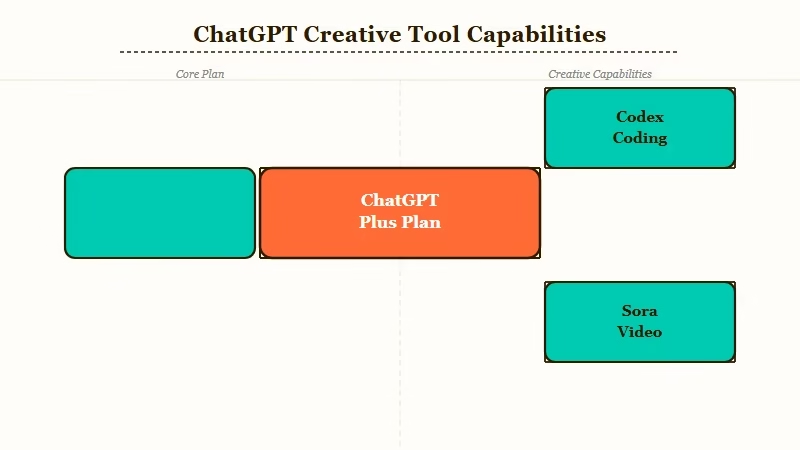
What is ChatGPT: A conversational AI assistant built by OpenAI that generates text, writes code, analyzes documents, creates images, and maintains long conversations with memory. The most popular AI product in the world with over 300 million weekly users.
From my testing, ChatGPT’s strength is the depth of a single conversation. You can start with a vague idea, refine it over 15 messages, and end with a polished output. Perplexity treats each query as mostly independent. ChatGPT treats each message as part of an evolving project.
The Plus plan ($20/month) now includes Agent Mode, which lets ChatGPT take autonomous actions like browsing, running code, and making API calls without you guiding every step. Perplexity has no equivalent.
ChatGPT also ships Sora (video generation), Codex (code assistant), and Deep Research at 10 runs monthly on the Plus plan. The feature surface area is dramatically larger than Perplexity’s.
What I’d recommend keeping in mind: ChatGPT’s web search has improved, but it still hallucinates sources. I have caught it citing articles that do not exist or attributing quotes to people who never said them. For anything where factual accuracy matters, verify through Perplexity or the original source.
How Does Perplexity vs ChatGPT Pricing Compare
Both Perplexity Pro and ChatGPT Plus cost $20/month, but the value equation diverges sharply at higher tiers. ChatGPT’s upgrade path costs less per dollar of capability gained.
| Feature | Perplexity Pro ($20/mo) | ChatGPT Plus ($20/mo) |
|---|---|---|
| Model access | GPT-5.4, Claude Opus 4.6, Gemini 3.1 Pro | GPT-5.5 |
| Deep Research | 20 queries/day | 10 runs/month |
| Web search | Native, every query | Available, not default |
| Code execution | Limited | Full (Codex, Agent Mode) |
| Image generation | No | Yes (DALL-E, Sora video) |
| Memory across sessions | No | Yes |
| Citation quality | Inline, verifiable | Inconsistent |
The pricing gap opens at the premium tier. Perplexity Max costs $200/month and gives you unlimited advanced model access with no usage caps on the web interface. ChatGPT Pro starts at $100/month with GPT-5.5 Pro and 5x the Plus usage limits, or $200/month for 20x limits and roughly 1 million tokens of context.
The way I see it, the $20 tier is where the real comparison happens. Most individual users will not pay $100 or $200 per month. At $20, Perplexity gives you better search and more Deep Research runs. ChatGPT gives you better creation tools and a wider feature set.
For anyone already exploring how Claude compares to ChatGPT, the three-way dynamic matters. Claude wins on long-context coding and agentic tasks, ChatGPT wins on breadth and creative range, and Perplexity wins on search accuracy. No single tool covers all three well.
Where Each Tool Fails in Practice
Perplexity fails at creative production and long conversations. ChatGPT fails at factual reliability and source transparency. These weaknesses are structural, not bugs that will be patched.
From what I’ve seen, Perplexity’s biggest practical failure is the conversation memory gap. There is no persistent memory across sessions. You start fresh every time.
If you are working on a multi-day project and need the AI to remember your context from yesterday, Perplexity cannot do that. ChatGPT can.
ChatGPT’s biggest practical failure is overconfidence. It will present fabricated information in the same confident tone as verified facts.
The web search mode reduces this, but does not eliminate it. I have had ChatGPT generate a “source” URL that returned a 404 more than once in the last month.
Example scenario: You need to find out which AI coding tools raised funding in Q1 2026. On Perplexity, you get a sourced list with links to each press release in under 30 seconds. On ChatGPT, you get a list that looks authoritative but may include companies that raised in 2025, or funding amounts that are slightly wrong. You have to verify each item manually.
For the reverse scenario: you need to write a 2,000-word blog post outline with SEO structure, internal linking suggestions, and a content brief. ChatGPT produces a usable first draft in one conversation. Perplexity gives you scattered research fragments that you have to assemble yourself.
- Perplexity wins when the answer exists somewhere on the web and you need to find it fast
- ChatGPT wins when the answer does not exist yet and you need to create it
- Neither tool replaces the other for its core strength
- Using both together, Perplexity for research then ChatGPT for creation, is the workflow most power users have landed on
Who Should Choose Perplexity Over ChatGPT
Choose Perplexity if your daily work requires finding and verifying information from the live web, and you value cited sources over creative output. Researchers, journalists, analysts, and fact-checkers get the most value here.
The way I see it, Perplexity is the right $20 if:
- You run 10 or more web searches per day for work
- You need to cite sources and cannot risk hallucinated references
- You do competitive research, market analysis, or investment due diligence
- You want access to multiple frontier models (GPT-5.4, Claude, Gemini) in one interface
- Your work is finding answers, not generating new content
If you fall into this category and have been paying for both, drop ChatGPT Plus and keep Perplexity Pro. The free tier of ChatGPT still handles basic creative tasks when you need them.
For anyone evaluating Perplexity alternatives, the main competitors in the search-first category are Google’s AI Overviews (free but less detailed) and You.com (similar model but smaller user base).
Who Should Choose ChatGPT Over Perplexity
Choose ChatGPT if your daily work involves writing, coding, brainstorming, image creation, or any task where you produce output rather than find it. Creators, developers, marketers, and students get the most from ChatGPT Plus.
From my experience, ChatGPT is the right $20 if:
- You write content, emails, or copy daily and use AI as a drafting partner
- You code and want inline assistance, debugging, and code review
- You need image or video generation built into the same tool
- You value conversation memory across sessions (ChatGPT remembers your preferences and past conversations)
- Your work is creating something new, not finding something that already exists
The Agent Mode feature on ChatGPT Plus is what separates it most clearly from Perplexity. It can browse the web, execute code, call APIs, and chain multiple actions together without you managing each step. Perplexity has no agentic capability.
If you are considering switching from ChatGPT to Claude for coding tasks specifically, that is worth exploring. But for general-purpose creative work, ChatGPT Plus remains the broadest single tool at its price point.
The Verdict Table
Perplexity and ChatGPT each win three of six categories, making this a genuine tie that breaks on your use case, not on which tool is objectively better.
| Category | Winner | Why |
|---|---|---|
| Web search accuracy | Perplexity | Native search architecture, inline citations |
| Creative writing | ChatGPT | Multi-turn refinement, stronger prose generation |
| Code generation | ChatGPT | Codex, Agent Mode, inline code execution |
| Research depth | Perplexity | 20 Deep Research runs/day vs 10/month |
| Feature breadth | ChatGPT | Sora, DALL-E, Agent Mode, memory, plugins |
| Source transparency | Perplexity | Every claim links to its source |
What I’d recommend for most users: if you can only pay for one, pick the one that matches your primary workflow. If your job title includes “researcher,” “analyst,” or “journalist,” pick Perplexity. If it includes “writer,” “developer,” “marketer,” or “creator,” pick ChatGPT.
If you can afford both, use them together. Start your workflow in Perplexity to gather sourced facts, then move to ChatGPT to turn those facts into something new. This is how the most productive AI users I know operate in 2026, and it is the workflow our ChatGPT workflow guide walks through in detail.
Frequently Asked Questions
Is Perplexity more accurate than ChatGPT?
For factual questions with verifiable answers, yes. Perplexity pulls from live web sources and cites each one. ChatGPT sometimes fabricates sources or presents outdated information as current. For creative or opinion-based responses, accuracy is not the right metric.
Can I use Perplexity for coding?
Perplexity can answer coding questions and explain concepts, but it lacks a built-in code execution environment. ChatGPT with Codex and Agent Mode can write, run, debug, and iterate on code within the conversation. For serious coding work, ChatGPT is the better tool.
Is the free tier of either tool good enough?
Perplexity’s free tier gives you basic search with limited Pro Search access. ChatGPT’s free tier now includes ads (since February 2026) and is limited to GPT-5.3 Instant.
Both free tiers are usable for light, occasional tasks. Neither replaces the paid version for daily professional use.
Does Perplexity have memory like ChatGPT?
No. Perplexity does not maintain memory across sessions. Each conversation starts fresh. ChatGPT remembers your preferences, past topics, and conversation history across sessions on all paid plans. This is a significant advantage for users who return to the same projects repeatedly.
Which tool is better for students?
It depends on the task. For writing research papers and finding cited sources, Perplexity is stronger. For drafting essays, studying with flashcards, and getting tutoring-style explanations, ChatGPT is more versatile. Many students use both, Perplexity for the research phase and ChatGPT for the writing phase.
