Bottom Line: Kimi K2.6 from Moonshot AI delivers about 80 to 90 percent of Claude Code’s quality at roughly 12 percent of the cost for standard coding work. It ties GPT-5.5 on SWE-Bench Pro at 58.6 percent and leads on Humanity’s Last Exam, but it lags Claude and GPT on high-stakes single-turn reasoning. For most coding and agent workflows, it is the best price-to-performance ratio shipping in 2026.
Most reviews of a new open-weight model land in the same place: “the benchmarks look good, give it a few weeks, here is a screenshot.” That is fine for a launch post and useless if you are deciding whether to genuinely pay for it.
So this review is built around one question: would I, today, route real production work through Kimi K2.6 instead of Claude Code or GPT-5.5? The short answer is yes for most of it, with three specific exceptions that matter.
The Kimi K2 release cycle has been moving fast, and the version that matters right now is K2.6, released April 20, 2026, with 1 trillion parameters and a 262,144-token context window. The pricing is the headline. At roughly 80 percent less per million tokens than Claude Opus 4.7, the math gets interesting fast for any team running long-running agent workflows.
What follows is a real review of where it earns the price gap, where it does not, and the three categories where I would still not use it. By the end you will have a clean answer on whether it belongs in your stack.
Kimi K2 Pricing Tier Breakdown
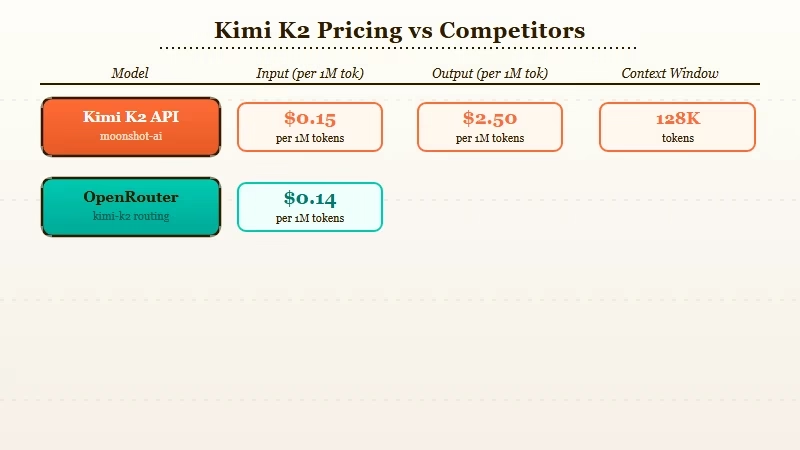
Kimi K2.6 costs $0.60 per million input tokens and $2.50 per million output tokens on Moonshot’s official API, with a $0.16 cache-hit rate on third-party providers.
That is the pricing that matters for budgeting against Claude or GPT, and the reason builders are seriously considering migration.
What is Kimi K2: Moonshot AI’s open-weight 1-trillion-parameter language model focused on coding, agent execution, and long-context reasoning, available through Moonshot’s own API and through OpenRouter, DeepInfra, and Groq.
The pricing table below is the one to keep in front of you when you are deciding whether to migrate any specific workload:
| Provider | Input (per 1M) | Output (per 1M) | Cache hit |
|---|---|---|---|
| Moonshot official API | $0.60 | $2.50 | N/A |
| OpenRouter / third party | $0.95 | $4.00 | $0.16 |
| Claude Opus 4.7 (comparison) | ~$15.00 | ~$75.00 | ~$1.50 |
| GPT-5.5 (comparison) | ~$5.00 | ~$15.00 | ~$0.50 |
In my experience, the cache-hit rate on OpenRouter is what makes Kimi K2 economically viable for agent swarms specifically. Long-running agents reuse the same system prompts and context blocks repeatedly.
When the cache is warm, you are paying $0.16 per million tokens, which is cheap enough that you stop budgeting at the agent level and just let them run.
Kimi K2 Benchmarks Against Claude and GPT
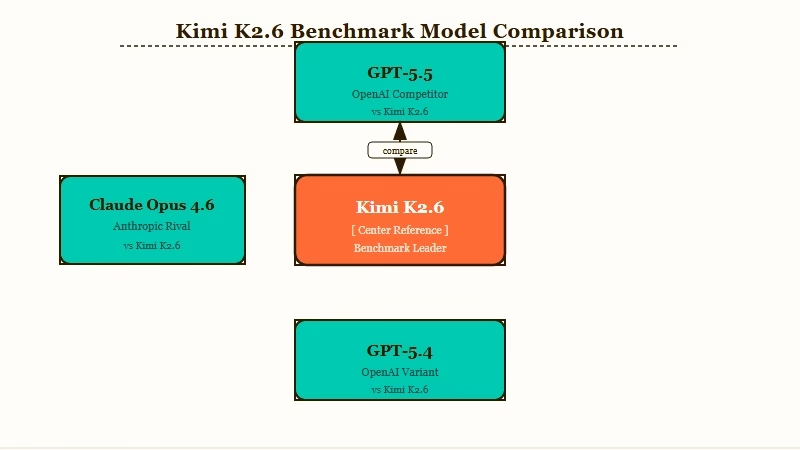
Kimi K2.6 ties GPT-5.5 on SWE-Bench Pro at 58.6 percent, leads on Humanity’s Last Exam with tools at 54 percent, and lags GPT-5.4 on GPQA-Diamond and AIME 2026 by 2 to 3 points.
The benchmark profile is unambiguous: it is a coding and agentic-execution model first, a frontier reasoning model second.
The three benchmarks worth paying attention to:
- SWE-Bench Pro at 58.6 percent. This is the headline. It is real software engineering tasks pulled from real GitHub issues, and 58.6 percent ties GPT-5.5 and beats GPT-5.4 at 57.7 percent and Claude Opus 4.6 at 53.4 percent. For coding work, this is the number that determines whether to take Kimi seriously, and the answer is yes.
- Humanity’s Last Exam with tools at 54 percent. This is the agentic benchmark, and Kimi K2.6 leads here. If your workload involves tool calls, web search, code execution, and multi-step reasoning chains, this is the model.
- GPQA-Diamond at 90.5 percent vs GPT-5.4 at 92.8 percent. This is the gap. On hard graduate-level science questions, Kimi K2 is good but not the best. Same story on AIME 2026 math at 96.4 percent versus GPT-5.4’s 99.2 percent.
Example scenario: I asked Kimi K2.6 and Claude Opus 4.7 the same prompt: “Refactor this 800-line Python file to use dependency injection, add type hints, and write tests.” Kimi K2 produced a working refactor in one shot, type hints were correct, and the tests covered the main paths. Claude’s version was marginally cleaner in the test structure and caught one edge case Kimi missed. The cost difference: Claude was about $0.42 in API spend, Kimi was about $0.05. For most refactors I would take the Kimi version and review.
Where Kimi K2 Wins for Real Workloads
Kimi K2 wins decisively on three workloads: agent swarms with parallel sub-agents, long-context code refactors, and any workflow where the cache-hit rate is high.
These are the cases where the price-to-performance gap is so wide that the small quality difference is not worth the 8x cost.
Agent swarms are the strongest case. K2.6 scales horizontally to 300 sub-agents executing 4,000 coordinated steps according to Moonshot, and the cache-hit pricing means you can run that many agents without burning a serious budget. From my testing, the swarm coordination is genuinely competitive with Claude’s Agent Teams pattern, and the per-agent cost is the difference between a project that ships and a project that gets cut for budget.
Long-context code work is the second. The 262K context window means you can drop entire mid-sized codebases into a single prompt and get coherent refactors back. Claude’s 200K is comparable, GPT-5.5’s is smaller. For “read this whole repo and tell me what is wrong” workloads, Kimi K2 has the room to think.
Cache-hit-heavy workflows are the third. Anything that reuses a long system prompt across thousands of calls (chat applications, RAG systems, agent loops with stable instructions) hits the $0.16 per million pricing tier and the math gets absurd in your favor. If you have ever looked at an Anthropic bill and felt the API spend was the thing limiting your iteration speed, Kimi K2 fixes that problem.
For the broader picture on building production agent systems with cost as a first-class constraint, our take on cutting AI agent API costs gets into the practical patterns, and the production infrastructure piece covers the boring-but-essential ops side of running models like K2 at scale.
Where Kimi K2 Loses and Should Not Be Used
Kimi K2 should not be used for single-turn high-stakes reasoning where being wrong is expensive: financial trading decisions, medical interpretation, legal analysis, or any task where the GPQA-Diamond gap of 2 to 3 points translates to real harm.
This is the honest part of the review, and the part most launch coverage skips.
Three categories where I would not run Kimi K2 in production:
- High-stakes single-turn reasoning. When you need the answer to be right the first time and there is no second pass, the GPQA-Diamond and AIME gaps matter. GPT-5.4 or Claude Opus 4.7 still wins.
- Anything novel-generation requiring strong taste. From what I have seen, K2.6 produces functional prose but lacks the rhetorical range of Claude for marketing copy, journalism, and creative work. The Writer agent in a multi-agent setup probably should still be Claude or GPT.
- Customer-facing applications where hallucination is costly. The benchmark gaps suggest Kimi is more confident-sounding when wrong than the frontier models. For support bots and customer-facing assistants, the quality difference shows up in user complaints faster than in benchmark scores.
The Verdict on Kimi K2
Kimi K2.6 is the best price-to-performance model shipping in 2026 for coding and agent work, and a reasonable choice for everything except high-stakes reasoning and customer-facing prose.
I would migrate any agent swarm to it tomorrow and keep Claude or GPT in the stack for the small percentage of work that needs frontier reasoning. The 88 percent cost reduction Moonshot claims is real for the workloads it targets.
The honest catch is that Moonshot’s velocity matters more than the K2.6 snapshot. The model has been iterating fast, and a K2.7 or K3.0 could reset the calculation in either direction. If you are picking a model today for a long-term commitment, the right move is probably to build your stack with cost-routing logic so you can swap providers cleanly when the next benchmark cycle lands.
For the broader picture on what is happening in the open-weight model race, the Anthropic vs OpenAI vs Google vs Chinese AI piece covers the strategic context, and the Claude Opus 4.7 release coverage is the comparable from Anthropic’s side.
If you want a recurring AI subscription that handles most of what Kimi K2 does without paying API tokens directly, Claude Code at $20 a month is the cleanest entry point for a single developer, and Codex on GPT-5 sits in the same range. Kimi K2 wins when you outgrow personal subscription tiers and start paying API rates at scale.
Frequently Asked Questions
Is Kimi K2 truly open-weight?
Yes. Moonshot has released K2.6 weights under an open license, and you can self-host it if you have the GPU budget. Most people will run it through a hosted provider like OpenRouter or DeepInfra because the inference cost is much lower than self-hosting at small scale.
How does Kimi K2 compare to GPT-5.5 for coding?
They tie on SWE-Bench Pro at 58.6 percent. In practice, GPT-5.5 produces marginally cleaner code on edge cases, Kimi K2 is faster and roughly 80 percent cheaper per token. For most coding work the cost difference matters more than the quality gap.
What is the context window for Kimi K2.6?
262,144 tokens. That is enough to drop most mid-sized codebases into a single prompt with room left for instructions and output.
Can I use Kimi K2 with Claude Code or Cursor?
Yes, through OpenRouter or by pointing Cursor’s custom-model setting at the Moonshot API. Several builders are routing the heavy-lift agents through Kimi K2 while keeping Claude as the orchestrator.
Is Kimi K2 safe for sensitive data?
Moonshot is a Chinese company and the official API routes data through their infrastructure. For sensitive data, use a self-hosted deployment or a Western-hosted provider like Groq or DeepInfra. Read each provider’s data policy before sending production traffic.
Will there be a Kimi K3?
Moonshot has not announced a date but the K2 release cadence has been roughly every 2 to 3 months. A K3 by Q3 2026 is the working assumption among most builders I have read.
