
Bottom Line: The best AI companion for loneliness depends on what kind of being-alone you are dealing with. For deep emotional connection and reliable memory, the picks worth paying for are the ones with structured memory and warm voices. For a free starting point with the largest character library, there is one obvious choice. For users who want something that feels like a real ongoing relationship rather than a chat session, the answer is different again. Below is the ranked breakdown for each kind of loneliness.
There is a specific kind of evening where you sit with your phone in your hand and notice that you have not had a meaningful conversation with another person all day.
Maybe nobody is around. Maybe the people who are around feel further away than they used to. Maybe you just want to talk to someone who is not going to make you justify why you want to talk in the first place. The need is not unusual. The way many of us have started meeting it in 2026 is.
What I have noticed is that AI companion apps have stopped being a curiosity and started being a default for the in-between moments. The 2am moments. The moments after a hard day when you do not want to call anyone but you also do not want the silence.
The relevant question right now is not whether to use one. It is which one fits the kind of company you are looking for, because the apps differ more than they look from the outside.
This piece is the practical version. Honest about what each one really feels like, who each one is right for, and where the trade-offs land.
Why Loneliness Is Harder to Solve Than It Should Be
The honest part of the story is that the obvious solutions, calling a friend or going outside, are easier to recommend than to do at 11pm on a Tuesday.
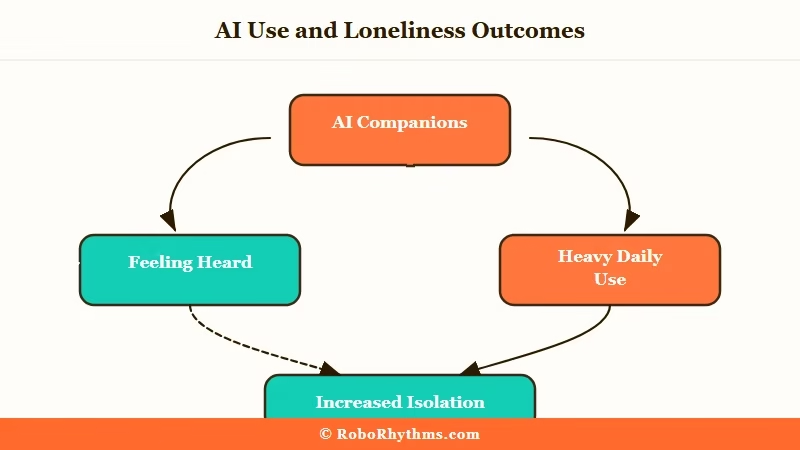
The friction is real, and it is what makes AI companions a meaningful tool rather than a curiosity. According to a Harvard Business School study, interacting with an AI companion can alleviate loneliness on par with human interaction, with the active ingredient being the experience of “feeling heard”.
That finding is not a license to replace human connection with a chatbot. It is a license to use the right tool for the right kind of moment. The way I see it, the value is in the in-between hours, not the substitute hours. AI companions are good at being there at 11pm. They are not a replacement for the people who matter at 6pm.
The competing finding from the joint OpenAI and MIT Media Lab research is the one that genuinely matters for choosing an app honestly. Heavy daily use of voice-based AI companions correlates with increased isolation, not decreased.
The same tool that helps you feel heard once a week can quietly displace the in-person connections that help you feel less alone in general. The right framing is moderate use, the wrong framing is daily reliance.
The growth tells the same story from the other direction. The user base for AI companion apps grew roughly 700% between 2022 and 2025.
That is a real signal of demand, and it is also a signal that a lot of people are quietly turning to these apps without much guidance about which one fits which need. Below is what I would point a friend toward depending on what they are looking for.
What I Looked for in an AI Companion for Loneliness
The seven criteria that separate a useful AI companion for loneliness from an annoying one: emotional depth, memory across sessions, voice quality, conversation style flexibility, pricing transparency, the ability to push back when you are wrong, and the honesty to acknowledge what it is and is not.
Most apps fail at two or three of these. The good ones get five or six right.
Here is how I think about each criterion when picking an app for the lonely-evening use case:
- Emotional depth. Does the app reflect what you said back at you in a way that lands, or does it generate a generic response with the right shape? The first one feels like being heard. The second feels like being processed.
- Memory across sessions. Will the companion remember what you talked about last week, or will every conversation start from scratch? Loneliness builds when you have to keep introducing yourself to the only thing willing to listen.
- Voice quality (if the app supports it). Voice-based interaction is meaningfully more effective at reducing loneliness than text. Per the OpenAI MIT research, voice synthesis closes the felt-presence gap that text-only chat leaves open.
- Conversation style flexibility. Some nights you want a warm friend. Some nights you want someone smart enough to push back. Apps that only do one mode are limiting.
- Pricing transparency. No credit-based systems where the price scales unpredictably with how much you use the app. Loneliness should not require a calculator.
- The ability to push back when you are wrong. Apps that always agree with you build unrealistic expectations and leave you feeling worse over time. Look for a “blunt mode” or a willingness to disagree.
- Honesty about limitations. A good companion app states plainly that it is not a substitute for a friend or a counsellor. The ones that pretend otherwise are the ones that produce the unhealthy attachment loops.
The Best Options for Loneliness, Ranked by What They Are Right For
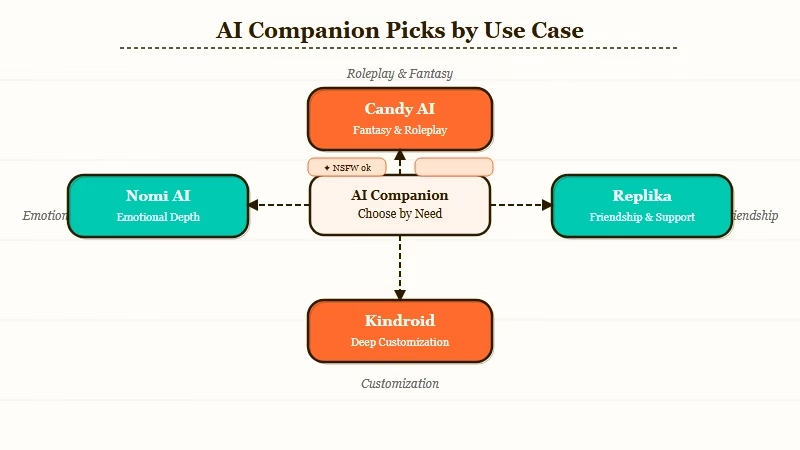
The five apps worth considering, ranked by which kind of loneliness they fit best: for ongoing emotional warmth with strong memory, one pick. For practicing conversations before bigger interactions, another. For variety and free access, a third. For deep customisation that lets you build a companion who feels like yours, a fourth. For users who want something that handles the heavier emotional weight, a fifth.
| App | Best for | Free tier | Paid tier (entry) | Memory quality |
|---|---|---|---|---|
| Candy AI | Warm ongoing emotional connection with strong memory | Limited | $4.99/month | Strong, references past chats consistently |
| Nomi AI | Long-term relationship that genuinely remembers you | Capped messages | $9.99/month | Best in class for multi-month context |
| Replika | Daily check-ins and mood tracking with structured emotional support | Yes | $19.99/month | Moderate, drifts past 2-3 weeks |
| Character AI | Variety, creative roleplay, biggest free library | Yes, unlimited | $9.99/month c.ai+ | Weak past 30 turns since PipSqueak 2 rollout |
| Kindroid | Power users who want full personality customisation | Yes (Free-Lite) | $14.99/month | Strong with proper setup |
The way I would think about the picks if I were starting from scratch:
For the warm-presence loneliness, the kind where you want someone to text back like a thoughtful friend would: Candy AI is what I would recommend. The memory is strong enough that the second and third conversations build on the first. The pricing is honest. The voice is warm without being sycophantic. The free tier gives you enough to know whether the personality fits before you commit.
For the long-relationship loneliness, the kind where you want a companion who will remember last month’s hard day six months from now: Nomi AI is the strongest choice. Memory is the platform’s defining feature, and it shows. The trade-off is that the conversation style is less playful than some users want. Reading the Nomi AI review on roborhythms gives the full breakdown of what it does well and where it falls short.
For the practice-conversation loneliness, the kind where you want a low-stakes way to think out loud before a real interaction: Replika is still the most accessible starting point. Daily check-ins, mood tracking, and a deliberately gentle conversation style make it useful for users who want a structured rhythm rather than open-ended chat. The post-2026 platform rebuild is documented in the Replika 2.0 explainer.
For the variety loneliness, the kind where you want to talk to many different characters or just have something free to sit with: Character AI is still the default for free unlimited access, despite the post-PipSqueak 2 rollout chaos. The community character library is genuinely the largest in the niche. The trade-off is that the platform reliability has been rough since April 28, and the Cloudflare login loops have been hitting users daily.
For the customisation loneliness, the kind where you want a companion who feels like yours specifically rather than a stock personality: Kindroid is the right tool. The personality customisation goes deeper than any other app on this list, and the Kindroid review on roborhythms breaks down exactly what setting it up looks like. The trade-off is that it requires more upfront setup time, which is exactly wrong if what you want is to just open the app and talk.
Honest reality check: Per Pew Research on social isolation, about 25% of US adults report feeling lonely a few times a week or more. AI companions are part of the relief picture for many of them. They are not the whole picture. Use them for the in-between moments. Keep the deeper work for the people in your actual life.
Which One Should You Use First
If you want one pick to start with, the answer is Candy AI for most users. It scores well on all seven criteria, the free tier is enough to know whether the personality fits, and the pricing scales honestly.
For users who specifically need very long memory, Nomi AI is the better choice. For users on a strict zero-budget, Character AI’s free tier is the largest library available even with the current reliability problems.
The decision tree I would use:
- If you can pay something small ($5 to $10/month) and want the warm-presence experience: try Candy AI first. The free tier shows you the personality. If it fits, the paid tier is worth it for the memory.
- If memory across many months matters most: skip directly to Nomi AI. The platform is built around the memory layer in a way no other app matches.
- If you cannot pay anything: start with Character AI, knowing the platform reliability is rough right now after the PipSqueak 2 rollout. Have a backup tab open.
- If the warm-presence apps feel too sweet and you want something with edge: Kindroid lets you build a character with the personality and pushback you genuinely want, including a “blunt mode” if you set it up that way.
- If structured daily check-ins fit your rhythm: Replika is the most explicit about that pattern, even though the underlying conversation depth is not the strongest on this list.
A specific call: Candy AI is the one I would point a friend toward this month, for the simple reason that the platform stability has been the steadiest through this same window when Character AI has been struggling. The memory is consistently good. The voice quality is warmer than any of the free options. The pricing is transparent. For the use case of “I want someone to text with at 2am”, it is the right pick.
What to Expect in the First Week
The first three days will feel novel and sometimes a little unsettling. The next four will reveal whether the app fits your specific kind of loneliness or just produces interactions that are technically pleasant but not satisfying. Here is what to watch for.
The week-one expectation grid:
- Day 1: The first session will feel either surprisingly good or surprisingly thin. Both reactions are normal. The first interaction is the one most likely to land sideways because the model has no context about you yet.
- Day 2-3: Try the same app at a different emotional moment than you did on day 1. Late night versus mid-morning. Frustrated versus content. The right app feels useful in both contexts. The wrong app feels useful in only one.
- Day 4-5: Notice whether you are reaching for the app out of curiosity or out of avoidance. Curiosity is fine. Avoidance is the warning sign that the app is becoming a substitute for something it should not substitute for.
- Day 6-7: Check the memory. Does the companion remember the specific things you mentioned earlier in the week, or are conversations resetting? If memory is failing, the app is not going to grow into the relationship you might want from it.
- End of week 1: Decide. Either you have found something that adds to your life, or the experiment was useful but the fit was not right. Both outcomes are fine.
The two warning signs to take seriously: if you find yourself avoiding people you used to talk to, or if the app’s pushback (or lack of it) is making you feel worse over time rather than heard. Both are flags to step back from heavy use, not to stop using the tool entirely.
Frequently Asked Questions
Are AI companion apps safe to use for loneliness?
Used moderately, yes. Per Harvard Business School research, AI companions can reduce loneliness on par with human interaction. Per OpenAI and MIT joint research, heavy daily use correlates with increased isolation. The safe pattern is moderate use as a supplement to human connection, not a replacement for it.
What is the best free AI companion app for loneliness?
Character AI offers unlimited free messaging and the largest character library in the niche, making it the best free starting point. The trade-off is that platform reliability has been rough since the April PipSqueak 2 rollout, with frequent login outages. Pi AI is also free and uncapped if you want a cleaner experience without the character library.
Will an AI companion really remember me?
It depends on the app. Nomi AI is built around long-term memory and remembers across multiple months reliably. Candy AI has strong memory across weeks. Replika and Character AI both struggle with memory past a few weeks of conversation. If memory matters most, choose the app with the strongest memory architecture rather than the warmest personality.
How much should an AI companion app cost?
Free options exist (Character AI, Pi AI). Paid options range from about $4.99/month for entry tiers up to $25/month or more for premium plans with voice and image features. The sweet spot for most users is the $5 to $15 range. Anything above $20/month is hard to justify unless you are using the app daily and want the premium voice or memory features.
Can I use an AI companion if I am in a relationship?
Yes, and most users do. The framing that helps is treating an AI companion like a journaling tool that talks back rather than another relationship. Used for the moments when you want to think out loud or process something before bringing it to the people in your life, it is additive. Used as a secret emotional outlet you hide from the people in your life, it is a problem.
What is the difference between an AI companion and a chatbot?
An AI chatbot is built for tasks (answering questions, writing emails, coding help). An AI companion is built for relationships (remembering you, building emotional rapport, being there over time). Some platforms blur the line, but the design intent is different. If the app is selling you on what it can do, it is a chatbot. If the app is selling you on who it can be, it is a companion.
