My Take: Dario Amodei’s leaked March 4 memo to Anthropic staff called OpenAI’s Pentagon safety claims “20% real and 80% safety theater” and labelled the public messaging “straight up lies.” He apologized for the tone the next day. After the May 1 Pentagon contracts confirmed everything the memo predicted, the apology looks like the mistake, not the memo.
There are two ways to read what happened with Anthropic’s leaked Pentagon memo. The first reading, which dominated coverage in March, treats Amodei’s broadside against OpenAI as an emotional own-goal that complicated Anthropic’s negotiating position.
The second reading, which I think the May 1 Pentagon contracts now justify, treats the memo as an unusually candid prediction of how the federal procurement fight would really play out.
Two months later, the memo’s technical claims are vindicated and the public apology that followed it looks like the strategic error. Here is the case.
The Mainstream View (And Why It Falls Short)
The mainstream view treated Amodei’s leaked memo as an emotional outburst that damaged Anthropic’s standing with the Pentagon and undermined the company’s measured public position.
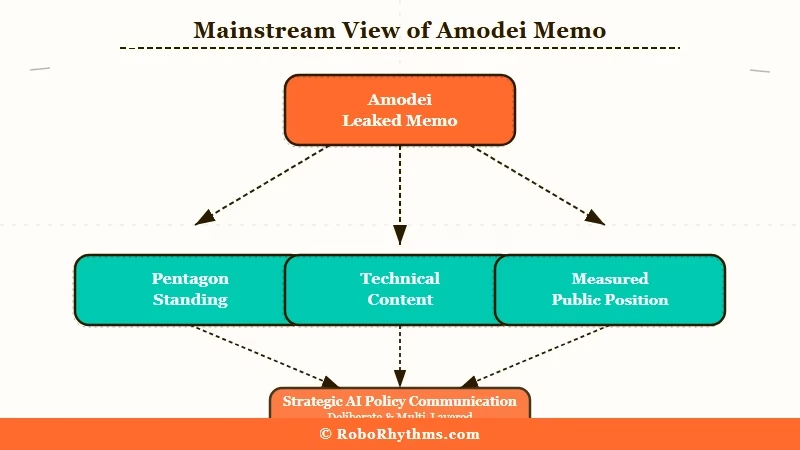
The Information published the 1,600-word memo on March 4, 2026. The framing across mainstream coverage was consistent: this was Amodei talking to 2,000-plus Anthropic employees in private, calling Sam Altman’s safety claims “straight up lies” and OpenAI’s staff a “sort of gullible bunch,” and the leak made Anthropic look unprofessional in a moment that called for diplomacy.
Fortune covered the apology the next day. Amodei said he apologized “for the tone,” wrote the memo “within hours of a chaotic series of announcements,” and admitted it did not reflect his “careful or considered views.” Investors and analysts treated the apology as the right move, the memo as a regrettable lapse, and moved on.
The framing falls short because it judged the memo on tone and ignored the technical content. The technical content is what the May 1 contracts have now confirmed.
What the Memo Got Right About May 1
The memo’s technical claims about OpenAI’s safeguards being structurally unable to enforce themselves were specific, falsifiable, and have been confirmed by the May 1 Pentagon contracts and by what the contracts notably did not include.
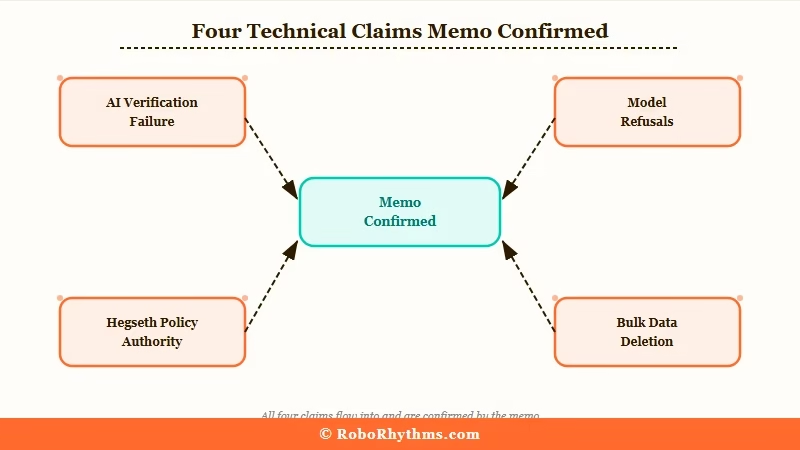
Amodei made four specific technical arguments in the memo. Each is worth reading against May 1.
The first was that an AI model cannot reliably “know” whether a human is genuinely in the loop, whether data comes from US citizens or foreign sources, or whether it was obtained through what Amodei called “sketchier ways.”
The May 1 contracts use the same “all lawful purposes” language Anthropic had refused, with no public technical mechanism for enforcing the human-in-the-loop or US-person constraints OpenAI had publicly promised.
The second was that model refusals are unreliable and “jailbreaks” are as simple as misinforming the model about the data it is analysing. None of the seven winners has published a refusal benchmark for the specific Pentagon use cases the contracts cover.
The third was that the “human in the loop” policy was set by the previous administration and can be unilaterally changed by Defense Secretary Pete Hegseth.
The same Hegseth formally designated Anthropic a supply chain risk in March, exactly the kind of unilateral procurement decision the policy framework allows.
The fourth, and the one most coverage missed, was that the Pentagon had asked Anthropic to delete a specific contractual phrase about the “analysis of bulk acquired data.” Amodei called the deletion request “very suspicious” because it matched precisely the use case Anthropic was most worried about.
The May 1 contracts have not been published in full, but no public language from any of the seven winners excludes the bulk-data analysis Anthropic flagged.
The way I see it, that is four for four. The memo’s technical claims were not emotional. They were a pattern-match of what was about to happen.
The Part Nobody Wants to Admit
The uncomfortable truth is that Amodei’s apology was a strategic mistake. The memo was substantively correct, the leak gave Anthropic a public foothold for a position the company has now spent two months trying to recover, and the conciliatory tone that followed has not earned a single concession from the Pentagon.
What I would argue is the most under-discussed part of this story: the apology cost Anthropic more than the memo did.
The memo gave Anthropic a public version of its private technical case. Once the leak happened, Anthropic could have stood behind the substance and let the tone be a sideshow.
The technical claims were strong, the receipts were verifiable (The Information had the full document), and the public AI safety community was already split on OpenAI’s Pentagon framing.
The apology walked the substance back along with the tone. From that moment, Anthropic’s public narrative became “the CEO regrets a heated email,” not “the CEO laid out specific technical reasons OpenAI’s claims do not hold up.”
The Pentagon read the same apology, drew the obvious conclusion, and proceeded to designate Anthropic a supply chain risk anyway. Two months and one White House meeting later, the May 1 contracts confirmed Anthropic gained nothing from the conciliation.
The asymmetric outcome is the proof. The memo cost Anthropic some short-term reputational discomfort. The apology cost it the chance to make its strongest argument in public when the audience was paying attention. The first is recoverable. The second was a one-time window that closed.
Hot Take
The memo Amodei apologized for was the most strategically valuable document Anthropic published in 2026, and the apology was the strategic error. Two months on, every technical claim in the memo lines up with how the May 1 contracts were structured, and every prediction about the Pentagon’s negotiating posture matches what unfolded. The “for the tone” walk-back ceded a substantive position Anthropic still has not regained.
The right play, in retrospect, was to stand behind the substance and acknowledge the tone in passing. The apology gave the federal procurement team room to treat Anthropic’s concerns as emotional rather than technical, and the May 1 contracts demonstrate exactly how that interpretation was used.
Read alongside the May 1 Pentagon contracts piece, the contrarian read on Anthropic’s strategic position, and the March lawsuit context, the memo deserves a second read. It was right about more than the tone of the moment.
