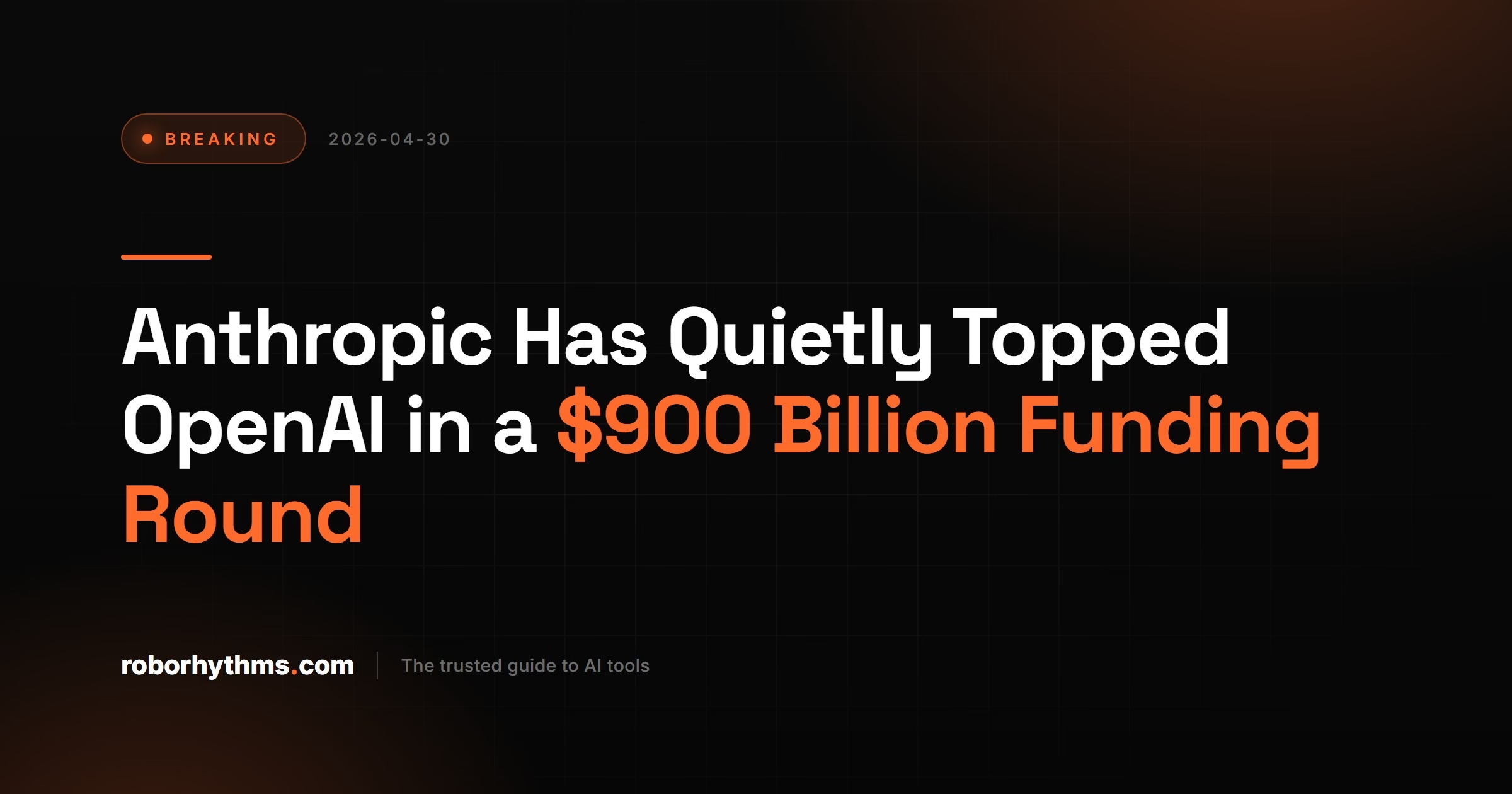
What Happened: Anthropic is weighing fresh funding offers at a valuation exceeding $900 billion, on a round of $40 to $50 billion. That tops OpenAI’s $852 billion mark from February. The company was valued at $350 to $380 billion just three months ago, and the $48 billion gap is the first time a private AI lab has surpassed OpenAI on paper.
Anthropic just leapfrogged OpenAI on paper. Per CNBC and TechCrunch reporting on April 29, the company is weighing preemptive offers at a valuation between $850 and $900 billion, with a round size between $40 and $50 billion in fresh capital.
The number to focus on is the move from $380 billion three months ago. That is roughly a 2.5x valuation jump in February-to-April, on the back of annualized revenue run rate (ARR, the annual figure projected from current monthly revenue) climbing from around $9 billion at the end of 2025 to over $30 billion now.
For most of the last two years, OpenAI was the default bet. The funding rounds were larger, the model launches were louder, the consumer brand was unavoidable.
The way I see it, that script just inverted. Anthropic is now the more valuable company on paper, the faster grower on revenue, and the one with the deeper compute partnership.
The reason this matters for the tools you use day to day is straightforward. Pricing power, model release pace, infrastructure stability, and developer ecosystem investment all flow downstream from which lab is winning the funding race. The leader does not stay the leader by accident, and the laggard does not stay funded indefinitely.
The Claude Opus 4.7 review covers one slice of this shift. The valuation flip is the wider context that explains why those changes keep landing.
What Happened With Anthropic’s New Round
Anthropic is weighing a $40 to $50 billion funding round at a valuation between $850 and $900 billion, which would top OpenAI’s $852 billion mark set in February.
CNBC and TechCrunch broke the story on April 29 citing investors briefed on the talks. The round is still being negotiated and the figure could shift before close.
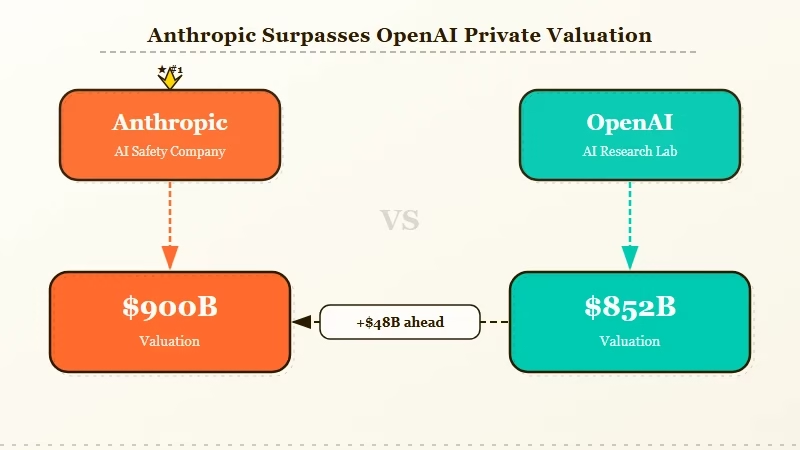
What the story names directly is the gap. OpenAI closed a record $122 billion funding round earlier this year at $852 billion.
Anthropic is now in conversations targeting a number $48 billion higher, which would make it the most valuable private AI lab in the world.
The “quietly” framing in the headline is doing real work. Anthropic had previously resisted multiple inbound proposals at $800 billion or more before this round began moving, per CNBC.
The company’s CFO has reportedly been hard to even get a meeting with, with one institutional investor prepared to commit $5 billion still unable to lock down a call.
The revenue context behind the round was already in motion three weeks ago. Anthropic crossed $30 billion ARR on April 10, surpassing OpenAI’s $25 billion mark, and the enterprise vs. consumer business model story explains why investors are now bidding the valuation up. Some sources cited by TechCrunch put the current run rate even higher, closer to $40 billion.
What the new round adds is the multiple. The $900 billion mark prices Anthropic at roughly 22 to 30x current ARR, well above OpenAI’s effective multiple at $852 billion on $25 billion ARR.
Valuation talks are a lagging indicator of revenue that already happened, and they are also a leading indicator of what investors think the next eighteen months will deliver.
Why This Is a Bigger Deal Than It Sounds
The valuation flip signals a structural shift in which AI lab developers and enterprises are betting on, not just a vanity metric.
Funding rounds price the future cash flows of a company. A $900 billion mark says the smart money expects Anthropic to capture a larger slice of the AI market over the next decade than OpenAI.
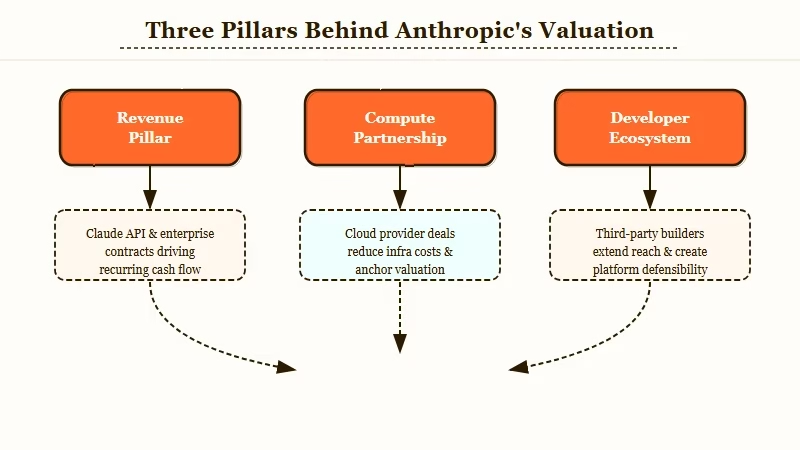
Earlier this month Google committed up to $40 billion to Anthropic, with $10 billion deployed immediately at a $350 billion valuation and $30 billion contingent on performance milestones. Amazon committed a separate $25 billion total, $5 billion at $350 billion plus another $20 billion to follow.
That two-hyperscaler commitment is the part that does not get enough attention. Anthropic now has both Amazon Web Services and Google Cloud locked in as backers, which means the compute supply for Claude is hedged across the two largest cloud providers in the world.
From what I have seen, that compute commitment matters more than the cash. The gating constraint on every frontier lab right now is power and chips, not engineers.
The split inside the AI tools community is showing up in real time. Anthropic’s revenue is now driven primarily by Claude Code and the newer Cowork agentic-coding platform, per TechCrunch.
The Anthropic developer ecosystem, including Claude Code, Skills, and the new Managed Agents API released earlier in April, is what the valuation is pricing in.
OpenAI is not collapsing, but it is reportedly missing several internal targets for revenue and user growth this year, and is streamlining its product portfolio to focus more heavily on AI agents.
ChatGPT remains the largest consumer destination, but the developer-and-enterprise crowd is treating Anthropic as the safer long-term bet, and a $48 billion valuation gap is a loud answer.
| Metric | Anthropic | OpenAI | Gap or note |
|---|---|---|---|
| Latest valuation | $850-900B (talks, April 2026) | $852B (February 2026) | Anthropic ahead by ~$48B |
| Prior valuation | $350-380B (February 2026) | No prior round in 2026 | Anthropic 2.5x in 3 months |
| Annualized revenue | $30B+ (some sources say $40B) | $25B (April 2026) | Anthropic ARR ahead by ~$5B |
| Strategic backers | Google ($40B) + Amazon ($25B) | Microsoft (legacy partnership) | Anthropic hedged across two hyperscalers |
| Latest flagship | Claude Opus 4.7 + Mythos preview | GPT-5.5 | Both shipping every 4-6 weeks |
| Developer momentum | Claude Code, Cowork, Managed Agents | Codex, Computer Use, Agent Builder | Anthropic shipping faster on dev tools |
What This Means for You as a Claude or ChatGPT User
If you are already paying for Claude Pro, Claude Code, or any product that runs on the Anthropic API, you just got a stronger guarantee that the platform will be around in five years.
That is the practical translation of a $900 billion valuation. The lab is not going to run out of money, lose its compute deal, or be forced to slash R and D to chase short-term revenue.
For ChatGPT and OpenAI API users, the valuation flip is not catastrophic, but it is a signal. The pricing pressure on consumer subscriptions is going to keep increasing as the funding gap widens.
From my testing through April, GPT-5.5 has been shipping smaller incremental improvements while Claude Opus 4.7 has been making larger jumps on coding and agentic benchmarks. That gap is what investors are pricing in.
What I would recommend doing this week is concrete. Audit which AI lab your stack runs on.
If you are running automations, agents, or production code through one provider’s API, you are now exposed to that provider’s funding and compute trajectory. Diversifying across providers stopped being optional once one of them pulled $48 billion ahead.
- List every paid AI subscription and API key in your stack right now.
- Note which lab each one routes to underneath the wrapper.
- For any production workflow on a single provider, identify the closest equivalent on the other lab and document the migration path.
- Pin your most important prompts and skills to a provider-neutral format if you can, plain markdown is the cheapest insurance.
The diversification math is easier when you can see your exposure mapped to the risk of each path. Here is the quick reference I use:
| Workflow type | Risk if your provider stalls | Mitigation this month |
|---|---|---|
| Production agents | High, replacement cost is large | Build a fallback path on the other lab |
| Personal automations | Low to medium | Document prompts, reproduce on the other lab |
| Coding assistant | Medium, productivity hit | Keep both Claude Code and Codex in rotation |
| Consumer chat (Claude Pro / ChatGPT Plus) | Low | Cancel and re-subscribe based on monthly leader |
If you want a way to verify the funding-race story for yourself rather than taking it from any one outlet, the prompt below is the version I use to cross-check the public reporting against what each lab has actually disclosed.
Vague: “Help me research the AI funding landscape.”
Specific: “Compare Anthropic’s and OpenAI’s most recent funding rounds, valuations, and lead investors as of April 2026. Cite sources for each figure. Note which lab has more compute committed for 2027 and why that matters for API stability.”
The point is not that OpenAI is sinking. The point is that “I will just use whatever is most popular” stopped being a strategy the moment funding flows started favoring a different lab. The Anthropic revenue piece covers the enterprise-vs-consumer split that is feeding this valuation gap.
What Comes Next After the Round Closes
Anthropic is expected to make a definitive decision on the round at a board meeting in May, and an IPO as early as October 2026 is reportedly on the table. The number could move up or down by 10 to 15 percent before final terms are signed.
The harder question is whether OpenAI raises again at a higher mark to retake the lead. From what I have seen, that is the more likely scenario than a permanent reordering.
Both labs are growing fast enough that the valuation crown will probably trade hands a few more times in the next eighteen months. What does not flip is the underlying revenue trajectory and developer momentum, and on those measures, Anthropic is currently winning.
The other story to watch is what the hyperscalers do next. Amazon’s $25 billion plus Google’s $40 billion is not a passive arrangement.
Both clouds are positioning themselves as the backbone for the lab now valued at $900 billion, which has its own implications for AWS vs Google Cloud market share, search competition, and the Gemini roadmap. The Anthropic Managed Agents API coverage from earlier in April is the kind of release that becomes more interesting in this funding context.
For most readers, the practical version is simple. Pay attention to which lab is funding the tools you depend on. The valuation gap is a leading indicator for which platform will get the better roadmap, the more reliable infrastructure, and the cheaper API pricing in the next twelve months.
