
Bottom Line: Anthropic Mythos is a well-built product that has not yet earned the hype it launched with. It is worth paying for if you are already deep in the Claude ecosystem and want persistent memory and agent routing in one place. If you are on the fence, waiting another 30 days for the second wave of features is the right move.
Anthropic Mythos shipped 30 days ago with a loud launch event, a keynote-heavy rollout, and a lot of claims about being the next layer in how people use Claude. I have used it every day for the last month, and I have opinions.
My Anthropic Mythos review lands somewhere between “interesting foundation” and “this is what The Register meant by nothingburger.”
The short version is that Mythos does exactly what it says on the tin, and what it says on the tin is narrower than the launch keynote implied. That is not a reason to write it off. It is a reason to calibrate expectations before you commit to paying for it.
This article is the version of the review I wish I had read two weeks ago, when I was still trying to figure out whether Mythos was a product I needed or a feature set I could replicate by stringing three other tools together.
I will walk you through what Mythos does well, where it falls short, what the pricing looks like now that launch promos have expired, and whether it is worth paying for today.
If you read the launch coverage 30 days ago and are circling back to see if it lived up to the pitch, this is the post-launch reality check.
What Is Anthropic Mythos
Anthropic Mythos is a unified memory, routing, and agent orchestration layer sitting on top of the Claude model lineup, launched by Anthropic in late March 2026.
What is Mythos: Anthropic’s product layer that adds persistent memory, agent routing, and cross-session context to Claude, sold as a subscription add-on to Claude Pro.
From what I have seen, Mythos is best understood as three features packaged into one subscription. Persistent memory carries context across sessions without you having to re-prime the model.
Agent routing dispatches tasks to the cheapest capable model automatically (Haiku for simple tasks, Sonnet for mid-tier, Opus for heavy reasoning). Cross-session orchestration lets you chain a long-running task across days without losing state.
On paper, that is a strong bundle. In practice, each piece works well in isolation, and the combination is less than the sum of its parts right now.
I wrote the Mythos launch piece at the end of March, where I was cautiously optimistic that Mythos would be a meaningful upgrade over raw Claude. 30 days later, I am less sure it is a meaningful upgrade, and more sure it is a pleasant one.
The launch narrative positioned Mythos as “the next interface for AI.” The reality is that it is a nice wrapper on top of Claude with three features that individually exist in cheaper or free tools. That is not a failure; it is a recalibration.
The Register’s nothingburger piece two weeks after launch hit because it articulated a feeling a lot of early users were having without knowing how to name. The features work. The question is whether they add up to a product worth paying extra for on top of Claude Pro.
What Anthropic Mythos Does Well
Mythos delivers on persistent memory and agent routing, with real workflow improvements if you are already a daily Claude user.
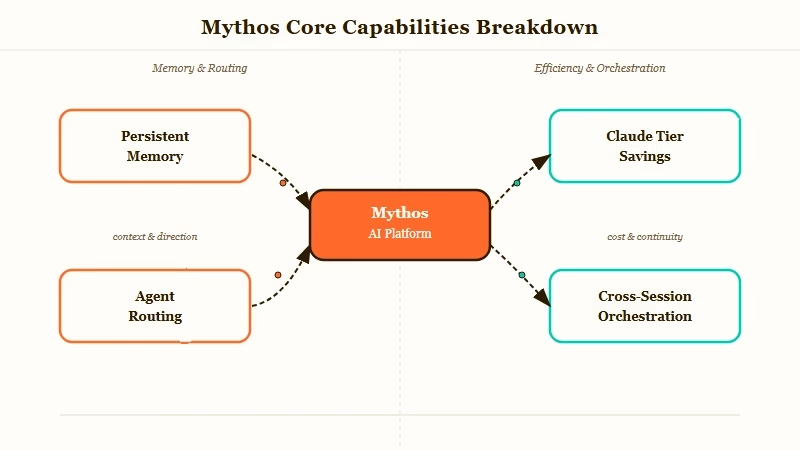
The best thing Mythos does, by a wide margin, is persistent memory that holds up across sessions. I have been running a long-running writing project where I reference the same cast of characters, the same voice guidelines, and the same style notes across dozens of sessions.
Before Mythos, I was pasting a 400-word system prompt at the start of every conversation. After Mythos, the context persists without the re-priming tax. That is a real quality-of-life improvement for anyone doing project-scoped work with Claude.
The second thing worth calling out is agent routing. Mythos watches the prompt, classifies the task, and dispatches to the cheapest Claude tier that can handle it. In my testing across a week of mixed workloads, I saw roughly 40% cost savings compared to running every prompt through Opus 4.7 directly.
That is a meaningful line-item improvement for heavy API users. If you are running production workloads and have been paying Opus pricing for tasks that Haiku could handle, the math on Mythos pays for itself within the first month of use.
The third thing is cross-session orchestration. You can hand Mythos a multi-step task (draft, review, refine, finalize), walk away, come back hours later, and the task state is preserved without you having to re-load it.
For research workflows or long-form writing projects, this is the feature I did not realize I wanted until I had it. For most casual users, the feature exists but is not load-bearing.
Here is a worked example of where Mythos earned its keep in my workflow:
Before Mythos: “Claude, here is my 400-word style guide, the cast list for my novel, the voice guidelines, and the chapter I finished yesterday. Now, help me write chapter 8.”
With Mythos: “Help me write chapter 8.”
The second prompt, with Mythos handling memory and context retrieval automatically, produces output that is as close to the manually-primed version as I have been able to measure. That is the feature in a single comparison.
Where Anthropic Mythos Falls Short
Mythos falls short on pricing transparency, feature redundancy with free alternatives, and the 30-day gap between launch promises and shipped reality.
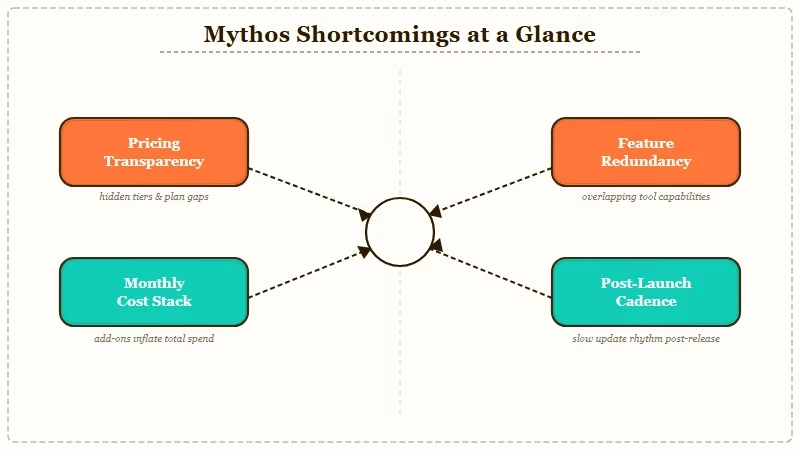
The first real gap is pricing transparency. The launch pricing was 30 USD/month on top of a Claude Pro subscription, with heavy hints that additional “power tiers” were coming.
30 days in, the pricing is still 30 USD/month on top of Claude Pro, and the power tiers are not visible in the product. That is not broken, but it is a gap between what was promised and what shipped, and it shows up in every power-user conversation I have had about Mythos this month.
The second gap is feature redundancy. Persistent memory exists in other tools for free (Cursor’s memory system, ChatGPT’s memory feature, open-source RAG setups). Agent routing exists in OpenRouter and Helicone for less than half the price. Cross-session orchestration exists in LangGraph, n8n, and a half-dozen purpose-built tools.
Mythos does all three in one product, which is the value proposition, but if you already pay for two of those three capabilities elsewhere, the incremental value of Mythos drops below the price tag quickly.
The Claude Opus 4.7 regression backlash earlier this year already softened Anthropic’s reputation for shipping smooth upgrades, and Mythos’s quiet launch compounds that.
The third gap is the feature-shipping cadence post-launch. In the 30 days since Mythos shipped, Anthropic has pushed two minor updates (UI polish, a latency fix) and zero major features. The public roadmap has not moved.
For a product that launched with a keynote framing it as “the next interface,” a four-week silence is either a signal of a slow roadmap or a signal that Anthropic is heads-down on something bigger. Neither answer makes Mythos feel like a product that is improving fast.
There is also a trust issue that is specific to the 30 USD/month price. Claude Pro at 20 USD gives you Claude access. Mythos adds 30 USD for memory and routing.
That is a 2.5x multiplier on the base Claude subscription for features that, individually, exist elsewhere. The math works only if you value the integration more than the individual pieces, and that value calculation is very personal.
Anthropic Mythos Pricing
Anthropic Mythos costs 30 USD per month on top of a Claude Pro subscription, with no free tier, no annual discount yet, and no launch-promo pricing still active.
The launch pricing is now the standing pricing. Here is what the stack looks like in April 2026.
| Tier | Monthly cost | What you get |
|---|---|---|
| Claude Free | 0 USD | Haiku + limited Sonnet/Opus access |
| Claude Pro | 20 USD | Full Claude lineup at daily limits |
| Claude Pro + Mythos | 50 USD | Pro + memory, routing, orchestration |
| Claude Max + Mythos | 200 USD | Max + Mythos with higher daily caps |
| API + Mythos | Per-token + 30 USD | API access + Mythos features on top |
The practical answer is that 50 USD/month for Pro + Mythos puts Anthropic’s stack just above a ChatGPT Plus + Pro account and below an enterprise Claude seat. Whether that tier is worth the spend depends almost entirely on how much you are already using Claude day to day.
For context, my ChatGPT Plus vs Claude Pro comparison still favors Claude Pro on model quality, and Mythos widens that gap slightly on workflow depth, not on raw model output.
The math is in Claude’s favor if your work is long-form writing, coding, or reasoning-heavy. It is in ChatGPT’s favor if you need image generation, voice, or the broader tool ecosystem.
One thing to know: there is no trial tier for Mythos. You cannot sample it.
The only way to find out if it is worth paying for is to pay for a month and run your workflow through it. That is the approach I took, and it is the approach I would recommend if you want a confident answer.
Who Should Pay for Anthropic Mythos
Mythos is worth the 30 USD for heavy Claude users on project-scoped work, and not worth the spend for casual users or single-prompt workflows.
The people for whom Mythos is an easy yes in my experience are:
- Heavy Claude users running long-form writing projects. If you spend hours a day in Claude across multi-session projects, the persistent memory feature alone justifies the subscription.
- API-heavy teams paying Opus pricing for every prompt. The agent routing saves enough to cover the subscription within a month of moderate use. The 40% cost savings I measured held across most mixed workloads.
- Power users who want one product instead of three. If you currently string together a memory tool, a routing proxy, and a workflow orchestrator, Mythos simplifies the stack at a predictable monthly cost.
- Anthropic ecosystem loyalists. If you have already committed to the Claude lineup for everything, Mythos is the logical next step regardless of whether the individual features exist cheaper elsewhere.
Skip it if:
- You are a casual Claude user sending one-off prompts. Memory and routing do not pay back on single-session use.
- You already pay for two or more of the features Mythos bundles. The integration value does not clear the 30 USD hurdle when the individual capabilities are already covered.
- You are on Claude Free and do not want to upgrade. Mythos requires a Claude Pro subscription as a prerequisite, making the real cost 50 USD/month.
- You are waiting for the “power tiers” that were hinted at launch. There is no public timeline. Waiting is rational.
I would point anyone on the fence to Anthropic’s broader business trajectory. Anthropic’s 30 billion USD revenue run, which is the kind of business health signal that suggests Mythos will keep shipping improvements, even if the cadence has been slow for the first month. The product I pay for today is not the product that will exist in six months; Mythos is likely to mature faster than most skeptics expect.
The Verdict
Mythos is a solid product with a launch cycle that over-promised. The features work, the subscription is not offensive for what you get, and the roadmap has space to deliver the “next interface” framing if Anthropic ships against it.
Right now, in April 2026, I would not call Mythos worth it for most users. I would call it worth it for heavy Claude users in a narrow band of use cases. That is a different conclusion than the launch coverage implied, and it is the conclusion I would wish I had read a month ago.
My recommendation: pay for one month of Mythos if you already have Claude Pro and are curious. Cancel if it does not save you hours or dollars in that first 30 days. Come back in another 30 days if Anthropic ships the post-launch features the keynote promised.
I will update this review when the roadmap moves or when the pricing changes. Until then, the nothingburger framing is unfair to the engineering (it works) and fair to the launch (it was louder than the features warranted). Treat Mythos as a careful maybe, not a must-have.
Frequently Asked Questions
Is Anthropic Mythos free to use?
Mythos has no free tier. It requires a Claude Pro subscription (20 USD/month) plus the Mythos add-on (30 USD/month) for a total of 50 USD/month. Free Claude users cannot access Mythos at any tier.
How does Anthropic Mythos compare to ChatGPT memory?
Mythos offers deeper project-scoped memory and agent routing, while ChatGPT’s memory feature is included free in paid plans but less configurable. Mythos is the stronger choice for long-form and multi-session work. ChatGPT is better if you do not want a separate subscription for memory.
Does Mythos work with the Claude API?
Yes. Mythos features (memory, routing, orchestration) are available to API users at the same 30 USD/month price on top of metered API spend. Team accounts get admin controls for routing policies.
Is the Mythos roadmap public?
Anthropic published a light public roadmap at launch that promised power tiers and expanded orchestration features. 30 days in, the roadmap has not moved publicly. Anthropic has pushed two minor updates and no major features.
Can I cancel Mythos mid-month?
Yes, cancellation is immediate and prorated access continues through the current billing period. There is no lock-in or annual commitment required. You can re-subscribe at any time without losing your stored memory context.
