
My Take: Character AI addiction is real enough to take seriously, even though it is not a clinical diagnosis yet. When I first wrote this page in April 2026, I argued that “addiction” was the wrong word for heavy use, and two studies presented that same month changed my mind. I still think the way out depends on what pulled you in.
In April 2026 two research teams presented Reddit studies at CHI, the ACM’s main conference on human-computer interaction, and both found the classic components of behavioral addiction, including withdrawal and relapse.
The same research also shows which fixes worked for which users. Among roleplay-driven users, 18 of 19 who tried a replacement outlet or a hobby said it helped. Cutting down or quitting outright was the fix people tried most, and across the whole study it helped only 13 of the 28 users who rated it.
This page covers what the studies found, the warning signs, and the fixes that match each kind of pull. It also explains how the AI psychosis reports in the news differ from compulsive use.
Is Character AI Addiction Real?
Yes, as a behavioral pattern: a Drexel University team found all six core components of behavioral addiction in teens’ Reddit posts, though AI addiction is not yet a recognized clinical diagnosis. The six components come from Mark Griffiths’ model of behavioral addiction: salience, mood modification, tolerance, withdrawal, conflict and relapse.
Drexel University’s team analyzed 318 posts from users who identified as 13 to 17 and wrote about their own Character AI use. The paper counts 60 posts (18.9%) from teens frustrated by their own use and 40 (12.6%) from teens who put Character AI ahead of school, friends or self-care.
One teen reported 89 hours of screen time in a single week. Our write-up of the Drexel teen study covers its wider findings.
A University of British Columbia team read 334 posts across 14 subreddits, ChatGPT users included, and 197 of them described symptoms. UBC’s announcement says AI addiction “is not yet a clinical diagnosis”, while the paper argues the pattern is distinct enough to study as a behavior of its own.
Why Character AI Is So Addictive
The UBC researchers call the core pull the “AI Genie” effect: a chatbot gives you exactly the story, character or attention you want, instantly, for almost no effort. Endless characters, deep customization and one-line prompts stack into a loop that is hard to put down.
Design choices feed that loop. The UBC paper quotes the pop-up Character AI showed in 2025 to users trying to delete their accounts, and one user in the dataset called it “weirdly manipulative”:
“…you sure about this? You’ll lose everything. Characters associated to your account, chats, the love that we shared, likes, messages, posts, and the memories we have together.”
Loneliness is the other half of the picture. Both teams list it as a contributing factor, and 24 of the Drexel posts (7.6%) came from teens who started using Character AI because they were lonely. We looked at what the loneliness studies measure in a separate piece.
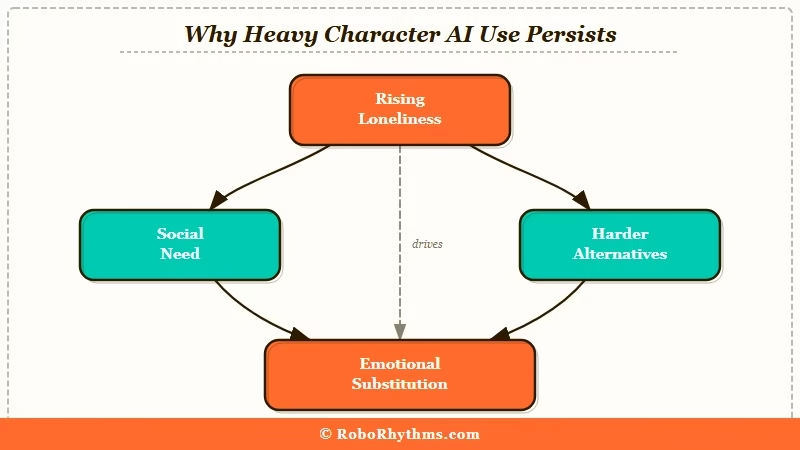
This is the part of my original argument that holds up. For a lonely user, the app meets a real need cheaply, so texting a friend or joining a group starts to feel expensive by comparison. I called that emotional substitution, and both studies found it too: Drexel coded 25 teen posts (7.9%) as bots filling a gap left by people, and the UBC team made it one of three distinct patterns.
The Three Kinds of Character AI Addiction
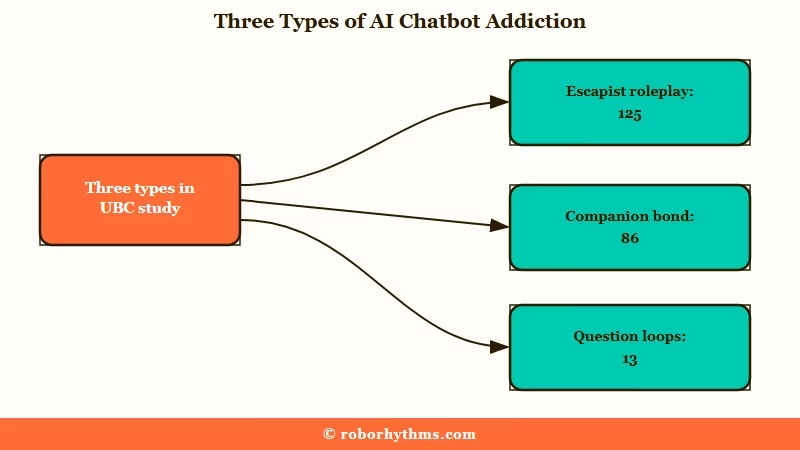
The UBC team sorted its cases, drawn from Character AI, ChatGPT and other chatbot users, into three types: escapist roleplay (125 cases), pseudosocial companion (86) and epistemic rabbit hole (13). Each type has its own hook, and recovery strategies worked differently for each.
| Type | What it looks like | What helped most in the study |
|---|---|---|
| Escapist roleplay (125 cases) | Living in stories and characters you build, and preferring that world to your own | Replacement outlets and hobbies such as writing, roleplay without AI, drawing and gaming: 18 of 19 who rated them said they helped |
| Pseudosocial companion (86 cases) | Treating a bot as a partner, best friend or family member | Rebuilding real relationships: all 4 companion-type users who rated it said it helped |
| Epistemic rabbit hole (13 cases) | Endless question-and-answer loops | The paper reports no type-specific fix for this small group |
The roleplay type is the one I underrated in the first version of this page. For those users the story itself is the draw, and all three roleplay-type users who rated “making real connections” said it did not help. The UBC authors call these recovery results exploratory because the counts are small, so read them as a starting point.
Signs Your Character AI Use Has Become a Problem
The warning signs are the six components the researchers coded, turned into a checklist you can hold your own use against. Neither study offers a cut-off score, so use them as a self-check.
- Salience: the bots take up more of your thoughts and feelings than the people around you.
- Conflict: you are frustrated with how much you use it, or school, work, sleep and friends are slipping. In the Drexel teen posts, 18.9% voiced the frustration and 12.6% described putting Character AI above everything else.
- Withdrawal: you feel sad, anxious or incomplete when you cannot open the app, including when an update or outage cuts you off.
- Tolerance: you need longer sessions to feel the same, like the teen who logged 89 hours of screen time in a week.
- Relapse: you have deleted the app or your account and come back within days or weeks.
- Mood modification: you reach for it mainly to escape stress or loneliness, and nothing else seems to work.
How to Stop Being Addicted to Character AI
Start by naming which pull you are fighting, because the most-tried fix in the UBC data, cutting down or quitting outright, helped only 13 of the 28 people who rated it. Replacement strategies reported far better results for the roleplay type.
- Replace the story if roleplay is your hook. Put the same energy into writing, a roleplay server with real people, drawing or gaming, the outlets behind the 18 of 19 success reports.
- Rebuild one real connection if the bot has become your partner or best friend. One user wrote that deleting the app for good worked once they started “reaching out to old friends, spending more time socializing”.
- Plan for relapse if you quit outright. Relapse was among the most common symptoms in the UBC data, so treat a return as a setback to plan around. If you delete your account, be ready for a last-minute appeal like the 2025 pop-up quoted above, and read how Character AI handles account deletion first.
- Use the time alerts you already have. Character AI’s December 12, 2024 safety post introduced a notification after an hour-long session, so treat that alert as your cue to stop for the day. For a firmer limit, your phone’s own app timers (Screen Time on iPhone, Digital Wellbeing on Android) can pause the app once you reach a daily cap you set.
- Get support from people. r/character_ai_recovery is a peer community for people quitting, and if your use is hurting sleep, school or work, a doctor or therapist is a reasonable next step.
If the person hooked is your partner, this piece on a boyfriend addicted to Character AI is written from that side.
AI Psychosis and How It Differs From Character AI Addiction
AI psychosis is a label researchers use for rare cases where heavy chatbot use becomes tangled up with delusions, beliefs that stay fixed even against clear evidence. Most people addicted to Character AI still know the bots are software, even if the line blurs at times, and they struggle to stop. The psychosis reports describe beliefs changing, such as feeling that the AI is sending special messages.
A December 2025 viewpoint in JMIR Mental Health by Alexandre Hudon and Emmanuel Stip uses the term “strictly as a descriptive and heuristic label rather than a proposed diagnostic entity”. It names loneliness, trauma history, schizotypal traits and “nocturnal or solitary AI use” as possible risk factors.
In May 2026 the Journal of Behavioral Addictions published a case that sits between addiction and psychosis. A 30-year-old software developer with no psychiatric history came to rely heavily on a chatbot during a stressful period, then developed paranoid psychosis, including a fixed belief that her husband was secretly generating the chatbot’s messages.
The authors, Tamás Treuer and Adrienne Incze, stress that “causal relationships cannot be inferred from current evidence”. They describe psychotic symptoms appearing “in rare cases” among vulnerable users, so heavy use by itself is not a sign of psychosis.
Hudon and Stip list these early warning signals:
- Growing certainty in beliefs that formed inside AI conversations
- A sense of “special communication” with the chatbot
- Derealization, the feeling that the world around you is not quite real
- Compulsive checking, secrecy about the chats, or sleep lost to them
The last item overlaps with ordinary compulsive use. The first three, changes in what you believe and in how real the world feels, are what set the psychosis reports apart.
If you notice those changes in yourself or someone close to you, talk to a doctor or mental health professional soon and mention the chatbot use directly. Hudon and Stip argue that clinicians should ask about AI use as routinely as they ask about sleep or substance use, so bringing it up yourself is reasonable. In the US, call or text 988 to reach the Suicide & Crisis Lifeline at any hour if things feel unsafe.
Outside the US, findahelpline.com lists free crisis lines by country.
What Character AI Has Changed Since 2024
Character AI has added time notices, parental insights and an under-18 chat ban since late 2024, while its own delete flow leaned on guilt as recently as 2025. Its December 12, 2024 update also promised parents a view of time spent and the characters their teen talks to most.
On October 29, 2025 it announced it would end open-ended chat for users under 18 no later than November 25, with chat time capped at two hours a day at first, then shrinking in the weeks before that deadline. Its September 3, 2026 safety post calls that “one of the most significant safety decisions we have ever made”, and our take on the ban covers why.
When I first wrote this page, I predicted that platforms would start shipping break reminders within a year, but Character AI had already shipped one in December 2024. UBC’s lead author, Karen Shen, calls guardrails like these “a step in the right direction” but, given the design elements and loneliness behind the pull, “not enough”. Our coverage of the AI companion regulation wave tracks where outside pressure is heading.
