
Bottom Line: GPT-5.5 for roleplay is surprisingly good at storytelling and natural dialogue, and a chunk of r/ChatGPT users now prefer it over Claude Opus 4.7 for creative writing. The catch is filter unpredictability and thin persistent memory. For pure storytelling, GPT-5.5 wins the prose. For long-running characters and no-filter creative scenarios, Opus 4.7 or a dedicated roleplay platform still wins.
Is GPT-5.5 worth it for roleplay? I have been A/B testing it against Opus 4.7 for a week, and the short answer is that it is genuinely good enough to shift the conversation.
One r/ChatGPT post titled “I hate that I like GPT-5.5 storytelling more than I do Opus-4.7’s” captured the mood perfectly. The “I hate that I like” framing tells you exactly where users landed.
The trickier question is whether the storytelling quality is worth the trade-offs. GPT-5.5 ships with different filter behavior, lighter adult mode, and a different memory model than Opus 4.7.
For anyone who builds characters across weeks or months of chat, the model quality is half the story. The infrastructure around it is the other half.
What Makes GPT-5.5 Different for Creative Writing
GPT-5.5 for roleplay is OpenAI’s April 2026 release of the 5.5 model, which users are finding produces more novelistic prose and better natural dialogue than Opus 4.7 for short-to-medium storytelling scenarios.
The r/ChatGPT community has been testing it hard since the launch on April 23.
From what I have seen in my own testing, the prose quality is the first thing that stands out. GPT-5.5 writes dialogue that feels closer to how a novelist would draft it, with fewer “GPT-isms” like “his eyes danced with mischief” that broke immersion in earlier models.
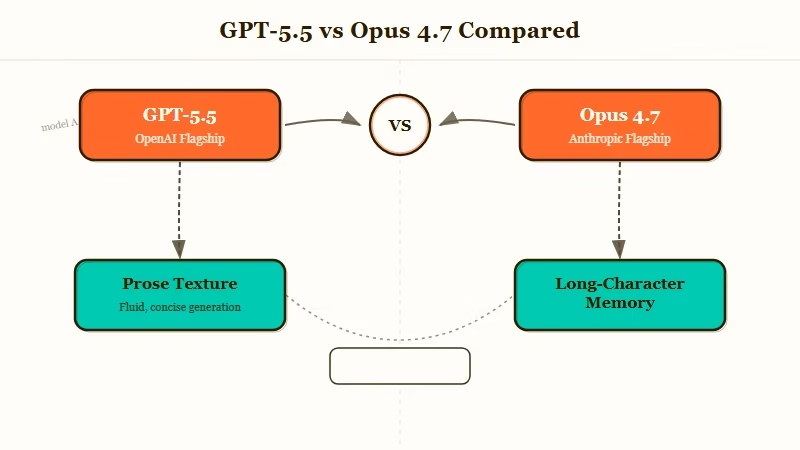
Opus 4.7 is still a stronger reasoner and better at maintaining long-running character logic, but GPT-5.5 wins the paragraph-by-paragraph texture.
What is GPT-5.5: OpenAI’s April 2026 language model, positioned as a storytelling and general-purpose upgrade over GPT-5, with a lighter default filter and an “adult mode” toggle that loosens content restrictions.
The “adult mode on 5.5” thread on r/ChatGPT pulled 35 comments in its first few hours. Users reported that the mode is real, loosens some filter triggers, but still clamps down unpredictably on scenes that worked in GPT-4. This is the infrastructure gotcha. You cannot fully trust the mode to stay consistent across a long scene.
Here is how the two models compare across the criteria that matter for creative writing:
| Criterion | GPT-5.5 | Opus 4.7 |
|---|---|---|
| Prose texture | Novelistic, varied, less clichéd | Consistent but more formal |
| Long-character memory | Limited without Memory feature | Stronger with 1M context |
| Filter behavior | Lighter default, adult mode toggle | Stricter default, no mode toggle |
| Speed | Faster tokens per second | Slower but steadier |
| Roleplay stamina | Excellent for 5k to 20k tokens | Excellent for 50k+ tokens |
| Price | ChatGPT Plus $20/mo | Claude Pro $20/mo |
In my week of testing, the model I reached for depended on the session length. Under 10 messages, GPT-5.5 every time. Past 50 messages with a consistent character, Opus 4.7.
Where GPT-5.5 Really Shines for Roleplay
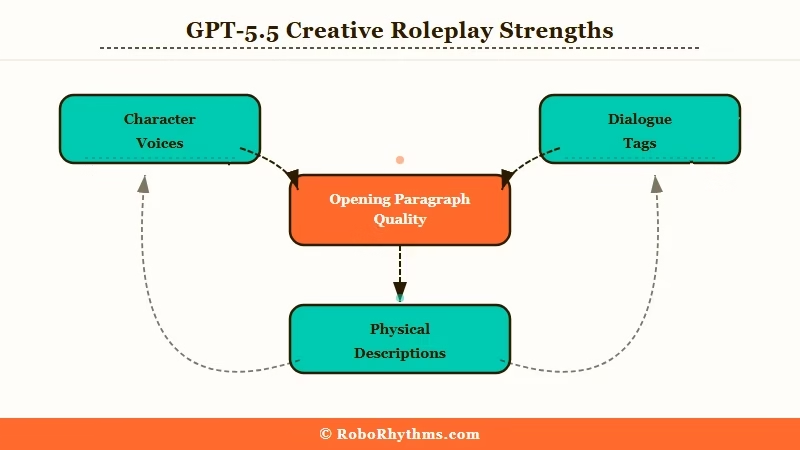
GPT-5.5 is strongest at the first-impression layer of a scene. The opening paragraph, the first reaction, the first piece of dialogue from a new character. It reads like prose you would buy, not prose you would generate.
What surprised me is how much this matters in practice. A big chunk of roleplay sessions never get past the first 20 messages because the opening does not hook you. GPT-5.5’s opening quality is a genuine lift.
I found myself enjoying scene setups that would have felt flat on older models.
The specific wins I noticed:
- Character voices diverge more naturally; two characters in the same scene do not sound like the same narrator
- Dialogue tags rotate (“murmured”, “hissed”, “whispered”) without falling into the “gazed” and “chuckled” loop that plagued GPT-4
- Physical descriptions include texture and temperature, not just sight
- Scene transitions feel paced rather than listed
Here is a concrete comparison that made me sit up:
Before (GPT-4 style): “She looked at him with her green eyes and smiled mysteriously. ‘I have a secret,’ she said.”
After (GPT-5.5 style): “Her eyes caught the light from the hallway, held it, and then she let a slow, narrow smile crease the corner of her mouth. The kind of smile that meant she had something to tell me and was already calculating how much to share.”
That is a real quality gap. The second version is not just longer, it is doing work.
For users who run into filter walls on ChatGPT and want a no-filter creative platform, Candy AI and SpicyChat AI are the two I would point at.
Both have persistent memory tuned for roleplay and no filter to fight mid-scene. Our broader review of Candy AI covers the memory architecture in more detail.
Where GPT-5.5 Breaks Down for Longer Sessions
GPT-5.5 loses steam past 50 messages if you are building a continuous character. The persistent memory feature helps, but it is not as deep as Opus 4.7’s 1M context or a dedicated roleplay platform’s vector memory.
The way I see it, this is the big caveat. If your roleplay style is a single long scene (2 to 3 hours, character building within that scene), GPT-5.5 is excellent. If your style is a character you return to across weeks, the memory thins out and you will notice consistency drift.
From my testing, the drift pattern is specific:
- Around message 30, character quirks start softening toward a generic “friendly interlocutor” voice
- Around message 50, the model forgets secondary details (names of side characters, locations, plot beats from earlier)
- Around message 80, the character’s core voice is retained but their motivations feel thinner than the session started with
What I would recommend if you are committed to GPT-5.5 for long characters is to keep a character bible in a separate note, and paste the relevant section every 20 messages to re-anchor. It is a pain, but it works.
Character AI’s lorebook feature in Pipsqueak 2 solves this natively; OpenAI does not have an equivalent yet.
Example scenario: You build a detective character on GPT-5.5 over a Saturday afternoon. By message 25, her voice is sharp and her backstory is specific. You come back on Wednesday. She remembers roughly who she is, but she has lost the specific tic (she taps her pen while thinking) and the name of her partner from the original scene. On Opus 4.7 with the same scenario, both details persist.
Pricing Breakdown
Here is how the pricing stacks up across the two models and the alternatives worth considering:
| Plan | Model | Price | Roleplay fit |
|---|---|---|---|
| ChatGPT Free | GPT-5.5 (rate-limited) | Free | Casual users, filter-heavy |
| ChatGPT Plus | GPT-5.5 + memory | $20/mo | Short creative sessions |
| Claude Free | Opus 4.7 (rate-limited) | Free | Testing only |
| Claude Pro | Opus 4.7 + 1M context | $20/mo | Long continuous characters |
| Candy AI Pro | Dedicated roleplay | $12.99/mo | No-filter persistent characters |
From what I have seen, the $20 ChatGPT Plus tier is worth it purely for the Memory feature. Without it, you are starting fresh every session. But if your use case is serious roleplay with long continuous characters, the money is better spent on a dedicated platform.
Who Should Use GPT-5.5 and Who Should Skip It
GPT-5.5 fits users who write scenes, short stories, and one-off creative sessions. It is not the right pick for persistent character relationships or no-filter roleplay.
Pros I landed on after a week:
- Genuinely better prose than GPT-4 and most open-source models
- Adult mode toggle is a real shift for users who ran into filter walls on previous models
- Memory feature makes cross-session continuity possible for short-running characters
- Speed is noticeably better than Opus 4.7 on comparable prompts
Cons I landed on:
- Filter is still unpredictable once scenes get spicy; it flips without warning
- Persistent memory is shallower than Opus 4.7 or a dedicated platform
- Character drift past 50 messages requires manual intervention
- Pricing is only worth it with the Plus tier; the free tier rate-limits roleplay hard
For AI companion users who found Character AI’s filters frustrating and want a persistent-memory alternative that does not fight you mid-scene, Nectar AI is the pick I would make. It is tuned specifically for creative roleplay with no filter wall, which removes the biggest GPT-5.5 friction point entirely.
The users I would send to GPT-5.5: writers working on a novel or short story who want a collaborator, DMs writing prep for a tabletop game, anyone doing creative writing exercises where the output goes into a document rather than staying in the chat. For anyone weighing ChatGPT Plus against Claude Pro for creative writing specifically, the $20 tier decision depends entirely on session length.
According to a TechCrunch report on OpenAI’s subscriber growth, creative writing is now OpenAI’s fastest-growing use case, which is partly why GPT-5.5’s storytelling quality jumped so visibly.
The users I would send elsewhere: roleplayers who return to the same character across weeks, users who ran into ChatGPT filter walls in 2024 and do not want to hit them again, anyone building a persistent AI companion rather than a one-off scene.
Verdict
GPT-5.5 is worth trying if your creative writing fits the short-to-medium session shape. The prose quality is a real upgrade and the adult mode toggle is the right concession for creative users. If your use case is long continuous characters or you have been burned by OpenAI’s filters before, Opus 4.7 or a dedicated roleplay platform is a safer bet. I would rate it 7.5 out of 10 for creative writing in general, and 6 out of 10 for sustained roleplay specifically.
For users who want the no-filter creative roleplay experience with persistent memory, Nectar AI is the recommendation that fits the widest set of use cases. It is tuned specifically for this niche, and the filter wall that frustrates GPT-5.5 users simply is not there.
Frequently Asked Questions
Is GPT-5.5 better than Opus 4.7 for roleplay?
GPT-5.5 is better for short creative sessions and prose texture. Opus 4.7 is better for long continuous characters because of its 1M context window and steadier memory. For sessions under 10k tokens, GPT-5.5 wins; past 50k tokens, Opus 4.7 wins.
Does GPT-5.5 have an adult mode?
Yes, ChatGPT 5.5 includes an adult mode toggle that loosens default filters. It is not fully unrestricted and the filter can still trip mid-scene, but it is a meaningful shift from GPT-4’s default behavior.
How much does GPT-5.5 cost for roleplay?
GPT-5.5 is included in the ChatGPT Plus plan at $20 per month. The free tier includes limited access but rate-limits roleplay sessions heavily. For serious creative use, Plus is the minimum viable tier.
Can GPT-5.5 remember characters across sessions?
GPT-5.5 supports the ChatGPT Memory feature, which stores selected facts across sessions. It is shallower than Opus 4.7’s 1M context or a dedicated roleplay platform’s vector memory, but adequate for short continuous characters.
What are the best alternatives to GPT-5.5 for creative roleplay?
Claude Opus 4.7 for long character continuity, Candy AI or Nectar AI for no-filter persistent roleplay, and SpicyChat for community-character chat. Each fits a different session length and filter preference.
