
Bottom Line: Roomote is a cloud-native coding agent that delivers work through PRs rather than through your editor, billed at $20/mo plus $5 per agent-hour on Pro. It is worth the money for 5-to-50 person engineering teams that live in Slack and GitHub. It is overkill for solo developers who would be better served by Kilo running locally.
Roomote is the new product from the team that made Roo Code, and it is not a direct replacement. Where Roo Code was a free VS Code extension, Roomote is a paid cloud agent that lives in GitHub, Slack, Linear, and a web dashboard. The workflow model is fundamentally different.
I have spent about a week with Roomote on a small-team repo. The experience is solid once you reframe what you are paying for. If you go in expecting a cloud version of Roo Code, you will be confused. If you go in expecting an async engineering teammate, the pricing suddenly makes sense.
This review covers what I tested, where it shined, where it was frustrating, and the clearest answer I can give on who should really pay for it.

What Roomote Is Trying To Do
Roomote is a cloud-based AI coding agent that runs in isolated containers, operates on pull requests, and extends engineering leverage to non-engineers like PMs and support staff who can ask repo-grounded questions.
It replaces “pair with an AI in your editor” with “delegate to an AI that commits through PRs.”
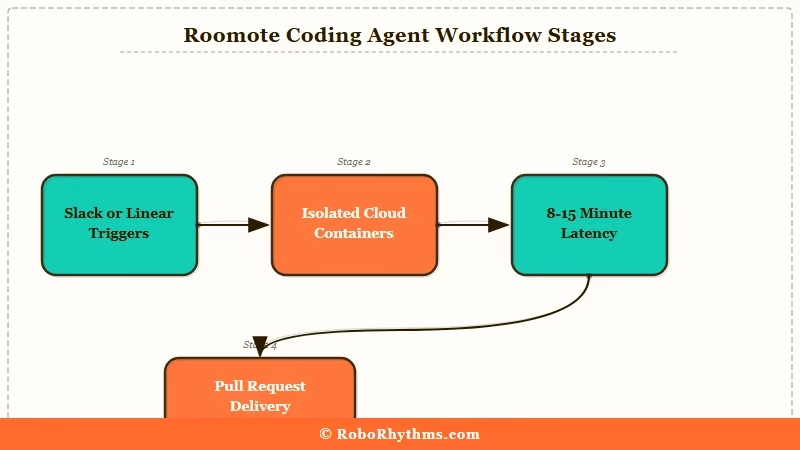
The product’s core insight is that the pull request is the right delivery unit for AI-written code. Reviews happen in GitHub, CI runs on the PR, and the human stays in a review role rather than a writer role. This is a different workflow than the editor-resident agent pattern that Roo Code, Cursor, and Claude Code follow.
From what I have seen in a week of use, the PR-based model has two real advantages. The first is that the existing review culture in engineering orgs transfers cleanly; nobody has to change how they code-review. The second is that non-engineers can trigger work. A product manager asking “can we add a toggle for Feature X” gets a PR without anyone writing code manually.
The downside is latency. An editor-resident agent responds in seconds. Roomote takes minutes because it spins up a container, clones the repo, does the work, self-reviews, and opens the PR. For tight iteration loops, it is too slow to replace what you have.
Roomote Pricing and What You Pay In Practice
Roomote Pro costs $20 per month plus $5 per cloud agent-hour, and Team costs $99 per month plus $5 per agent-hour with unlimited seats.
The per-hour rate is where the real cost shows up, so understanding the typical agent-hour usage matters more than the base subscription.
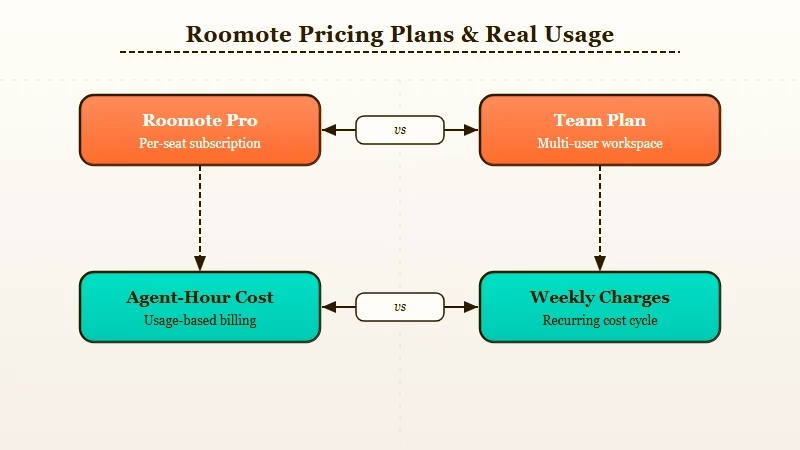
| Plan | Base fee | Per agent-hour | Seats | Free trial |
|---|---|---|---|---|
| Pro | $20/month | $5/hour | 1 | 14 days |
| Team | $99/month | $5/hour | Unlimited | 14 days |
| Enterprise | Custom | Custom | Custom | Sales call |
In my testing, a typical task ran 8 to 15 minutes of agent time. Small tickets like “add a migration for this field” were closer to 5 minutes. Refactors that touched 10+ files ran 25 to 40 minutes.
A week of moderate use across a small team came out to about 6 hours of agent time, or $30 in per-hour charges on top of the $99 Team base.
For context, Claude Code Pro at $20 a month with moderate use ran me about $60 a month in API overage last month. Roomote on the Team plan for similar output volume was closer to $130 a month. The gap is real. You pay for the cloud execution, the container isolation, and the async delivery model.
The other cost to factor in is human review time. Roomote PRs are decent but not zero-review. Budget 5 to 10 minutes of human review per agent PR. For a team shipping 10 PRs a week, that is about an hour of engineering review time, which has a real cost.
The Workflow That Earns the Subscription
Roomote is most effective when you use Slack to kick off work, let the agent finish async, and review the PR in GitHub without ever leaving your normal review flow.
The editor side of the product is secondary; the delivery-through-PRs side is the point.
Here is the loop I settled into by day three:
- Get an idea or ticket during a meeting or while on mobile
- Message
@roomotein Slack with a one-line description and a repo pointer - Agent spins up, does the work, opens a PR, pings Slack when done
- Review the PR in GitHub when back at a desk, approve or request changes
- Merge or iterate; Roomote can iterate on the same PR based on review comments
Steps 1 and 2 are the leverage point. You are spending 30 seconds of context switch to delegate work that would take 30 minutes of focused coding. For a PM or founder without time to sit in an editor, this is genuinely a new capability.
Example scenario: A support ticket comes in on Monday morning. A customer wants an exported CSV of their usage data. You ping Roomote from Slack with “add an endpoint at /api/usage-export that returns a CSV for the authenticated user, covering last 30 days.” The agent opens a PR within 12 minutes with the endpoint, tests, and a short rationale. You review, it looks right, you merge. Total human time: about 8 minutes across triggering and review.
The workflow breaks down for exploratory work. If you do not know what you want built, Roomote is the wrong tool. Use an editor-resident agent for exploration and Roomote for execution after the design is clear.
Pros of Roomote
- PR-based delivery slots into existing engineering review workflows with zero retraining
- Slack and Linear integrations mean non-engineers can trigger real code changes on their own
- Isolated cloud containers mean agents cannot break your local machine or leak secrets
- Self-review step catches the most obvious agent mistakes before the human sees the PR
- Works while you sleep; overnight refactors that finish by 8am are a real productivity lever
Cons of Roomote
- $5 per agent-hour adds up fast if you are not disciplined about triggering only concrete work
- Not suitable for exploratory coding; too slow and too expensive for rapid iteration
- Requires GitHub, Slack, and repo setup before you can start; 20-30 minute onboarding cost
- Context quality depends on repo hygiene; messy monorepos give the agent trouble
- Cloud-only means you cannot run it against a private network repo without setup work
Who Should Pay for Roomote
Choose Roomote if you are a small to mid-size engineering team (5-50 people) that already uses Slack, GitHub, and Linear and wants to delegate routine coding work async. The Team plan at $99 a month with unlimited seats becomes reasonable once you have more than 3 engineers using it.
Choose Roomote also if you are a technical founder or PM who needs to ship code without a full-time coding habit. The Pro plan at $20 a month plus per-hour usage is the right shape for someone who triggers 5-10 tasks a week.
Who Should Skip Roomote
Skip Roomote if you are a solo developer who works primarily in an editor and does not have a team to share the platform cost across. Kilo as the Roo Code successor gives you roughly equivalent local control for free.
Skip it if your work is primarily exploratory, research, or tightly iterative. Editor-resident agents like Claude Code or Cursor are faster and cheaper for those loops. The Claude Code versus Cursor question is still the more relevant one for solo devs.
Skip it if your team does not already use GitHub and Slack as primary work surfaces. The integrations are where the value comes from. Without them, you are paying for cloud containers and a worse developer experience.
The Verdict
Roomote is a well-built product that solves a specific problem: delegating execution work to async agents on the PR-based workflow most engineering teams already use. At $20 a month for Pro or $99 a month for Team, plus $5 per agent-hour, the math works for teams shipping real volume and non-engineers who need to produce code without writing it.
For me personally, as a solo developer who lives in an editor, the value was not there this week. I would sign up again if I joined a team that already used it. I would not pay out of pocket to keep it running.
If you are the kind of person who reads about the broader coding agent landscape and wants to understand how these products fit together, Roomote is the clearest cloud-first bet in the category right now. That bet looks good. Whether you are the right buyer for it depends entirely on whether you have a team to share the platform cost with.
Frequently Asked Questions
Is Roomote better than Claude Code or Cursor?
Roomote is not better or worse than Claude Code and Cursor; it is a different category. Claude Code and Cursor are editor-resident agents that pair with you. Roomote is an async agent that delivers through PRs. Most teams will use both: editor agents for exploratory work, Roomote for execution on well-defined tasks.
Can I use Roomote without Slack?
You can. The web dashboard and GitHub integration cover the core workflow even without Slack. That said, the Slack integration is where the “async teammate” value really shows up, so teams already on Slack get the most out of Roomote.
Does Roomote work on private repos?
Roomote works on private GitHub repos after you grant the GitHub App access. For self-hosted GitHub Enterprise or network-restricted repos, contact sales for the Enterprise tier. The Pro and Team tiers assume public or standard-private GitHub repos.
How does Roomote bill per agent-hour?
Agent-hour billing counts active cloud compute time, from when the container spins up to when the PR is opened or the task is abandoned. Idle time between messages does not count. Self-review and verification steps do count toward the hour total.
Is there a way to cap monthly spend?
Roomote Pro and Team do not expose a hard spend cap in the default UI. The Enterprise tier includes budget controls. For smaller accounts, the practical cap is setting a team budget and reviewing usage in the dashboard weekly.
Does Roomote replace the Roo Code VS Code extension?
Roomote does not replace Roo Code as a like-for-like product. Roo Code was a free editor extension; Roomote is a paid cloud agent. If you want a Roo Code successor for editor work, install Kilo. If you want cloud agents for PR delivery, Roomote is the current best fit.
