
The Verdict: If you live inside VS Code and want a free open-source coding agent, install Kilo and walk away from the Roo Code archive. If you want cloud agents that work from Slack or GitHub while you are off your laptop, Roomote is the new product the same team is betting on. Most solo developers should pick Kilo.
The Roo Code team announced this week they are archiving the VS Code extension on May 15 and going all-in on Roomote, the cloud agent product.
Three million installs is a real milestone to walk away from, so the decision is worth understanding before you pick a path.
I have used Roo Code on and off for the last six months. The extension was good. The shutdown is not surprising once you read the migration post and notice where the team is putting its commercial weight.
This is the comparison most Roo Code users care about right now. Do you stay on the legacy extension, switch to a community fork like Kilo, or pay for Roomote? I will walk through it.
What Is Roo Code Right Now
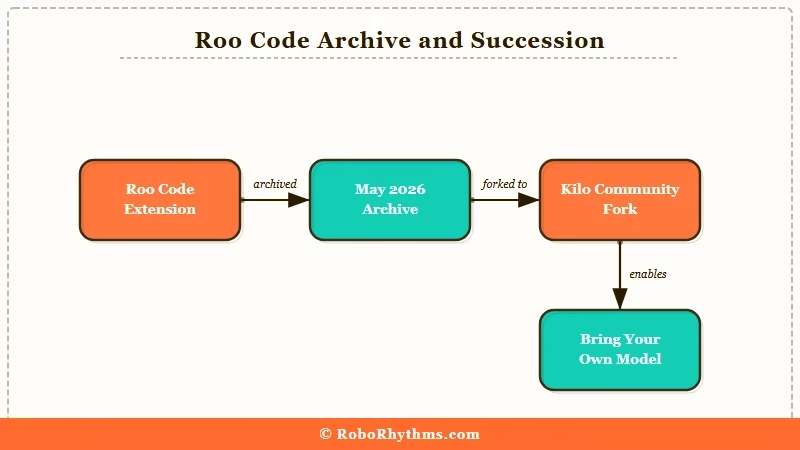
Roo Code is the free open-source VS Code extension that hit 3 million installs and is being archived on May 15, 2026.
It still works today and will keep working on the day after archive, but no new features are coming and the team is no longer fixing issues.
The extension started life as a Cline fork. It introduced custom modes, the Architect/Code/Debug split, and diff-based editing, all of which the rest of the AI coding tool category copied within months.
From what I have seen, the appeal was always the same. You bring your own model, you stay in your editor, and you do not pay anyone a per-seat fee.
That model worked great for solo developers and small teams who already had Anthropic or OpenAI API credit they wanted to spend.
The thing the extension never did well was orchestration across machines. If you walked away from your laptop, the agent stopped. If you wanted a teammate to pick up where you left off, you sent them a Slack message and hoped.
What Is Roomote and Who Is It For
Roomote is the same team’s new cloud agent product, billed as $20 a month plus $5 per agent-hour, and it runs from the web, Slack, or GitHub instead of from your editor.
It is not a feature added to Roo Code. It is a different product with a different shape.
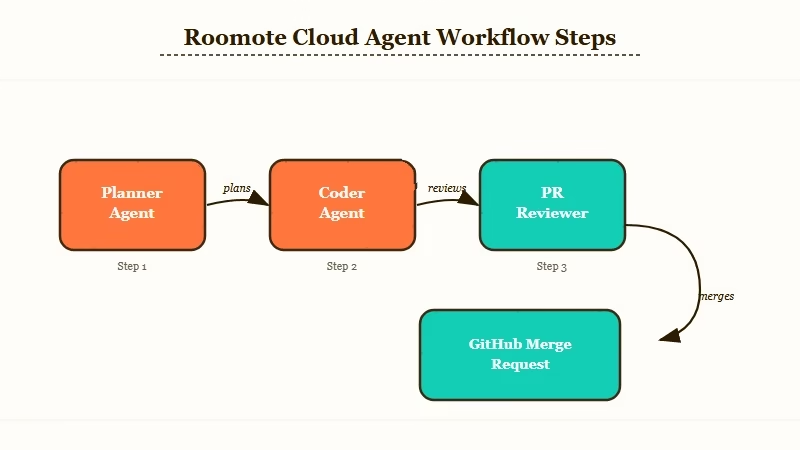
The pitch is that you delegate coding tasks to autonomous agents that spin up isolated cloud environments, clone the repo, do the work on a branch, and open a PR. You can kick off a refactor from your phone, get notified when the PR is ready, and review it from GitHub.
The Slack integration adds team workflows on top.
The agent lineup includes a Planner, Coder, Explainer, Reviewer, and Fixer. The PR Reviewer agent is the one I would expect most teams to adopt first, because it slots into existing GitHub workflows without requiring anyone to change their editor.
The Pro plan at $20 a month plus $5 per cloud-agent-hour is reasonable for individual use if you offload real work to it. The Team plan at $99 a month plus the same per-hour rate is where it gets interesting for organizations that want shared sessions and unlimited seats.
Roo Code vs Roomote at a Glance
| Criterion | Roo Code | Roomote |
|---|---|---|
| Where it runs | VS Code extension on your machine | Cloud agents triggered from web, Slack, GitHub |
| Cost | Free, bring your own model API key | $20/mo + $5 per agent-hour (Pro), $99/mo + $5/hr (Team) |
| Status | Archived May 15, 2026 | Active product, the team’s new focus |
| Best for | Solo devs who want local control and zero subscription | Teams that want cloud-first agent workflows |
| Setup time | Install extension, paste API key, done | Connect GitHub, install Slack app, set up cloud env |
| Async work | Stops when laptop sleeps | Runs 24/7 in cloud, finishes while you are out |
| Code review fit | Manual, in editor | Auto PR reviews on GitHub merge requests |
| Migration friction | Switch to Kilo (Roo’s recommended fork) for continuity | New product, learn new workflows |
Who Should Choose Roo Code (and Kilo as Its Successor)
Choose Roo Code if you want to keep coding inside your editor with no subscription, and switch to Kilo for ongoing maintenance.
Kilo is the active fork that the Roo team has been quietly cross-pollinating with for months, so the migration is roughly a one-click affair.
The profile this fits is a solo developer or small team that already has API credits with Anthropic, OpenAI, or a local model running on a workstation. You want the agent in front of you while you code, you want to control the loop, and you are not interested in handing tasks off to run async in someone else’s cloud.
The downside to acknowledge: you are betting on a community fork to keep up with frontier model changes. Kilo has been doing that well so far. If that stops, you are stuck on whatever the last working version was.
Example scenario: You are debugging a Rust service at 11pm and want the agent to refactor an error handling module while you watch. With Kilo, you stay in your editor, see every diff, accept or reject inline, and pay only the model API fee. With Roomote, you would push the branch, kick off a cloud agent, wait for the PR notification, then review on GitHub. The local loop is faster for that specific work.
For someone migrating right now, the practical step is to install Kilo, paste in your existing model API key, and confirm your custom modes carry over. That takes about five minutes. The coding agent shake-up is a separate question, and Kilo is just the cleanest local successor to Roo Code today.
Who Should Choose Roomote
Choose Roomote if your team works in PRs, lives in Slack, and you want agents to grind on tasks while nobody is watching. This is a different shape of work than what Roo Code optimized for, and the price tag reflects that.
The profile that fits is a 5-to-50 person engineering team where async coding agents would replace bottleneck humans. The PR Reviewer alone can save senior engineer time on routine reviews. The Roomote Control feature, where you start a refactor from your phone and come back to a finished PR, is genuinely useful for context-switching between meetings.
The honest tradeoff: $5 per agent-hour adds up fast if you are not careful. A team running ten parallel agents for an afternoon can burn $200 in hours. The free trial is 14 days, which is enough to figure out whether the workflow fits your team.
Example scenario: You are in a 90 minute architecture meeting and a Linear ticket comes in to refactor a routing module. With Roomote, you message the bot from Slack, the cloud agent spins up, does the work on a branch, opens a PR, and pings you when it is ready. You review the PR after the meeting ends. Roo Code cannot do that without your laptop being open.
The same logic applies to overnight work. Cloud agents that finish a refactor by 8am while you slept are a different productivity lever than agents that block your editor.
The Migration Decision Most People Will Get Wrong
The default mistake will be treating this as a forced upgrade from Roo Code to Roomote. It is not. Roo Code’s real successor for most users is Kilo, and the team running Roo Code knows it, which is why their migration post points there.
Roomote is a separate product targeting a different buyer. If you were a happy free Roo Code user, Roomote is probably not what you want next. If you were a team lead who always wished Roo Code had cloud and PR review, Roomote was built for you.
I would also flag this: the Claude Code vs Cursor race is shifting fast, which means whatever you pick today is probably not what you will be using in twelve months.
That is fine. Pick the lowest-friction option for your current workflow and accept that you will reassess by Q4 when the next cohort of agent products ships, including the Claude Code Skills vs Custom GPTs split that is reshaping the workflow side.
Frequently Asked Questions
Will Roo Code stop working after May 15?
Roo Code will keep functioning after May 15, 2026. The team is archiving the repo, not pushing a kill switch. New features stop and bug fixes stop, but the version installed on your machine will run as long as your model API endpoint accepts requests.
Is Kilo really a drop-in replacement for Roo Code?
Kilo is the closest drop-in replacement available. The Roo team officially recommends it in their migration post, custom modes carry over, and most workflows transfer with no changes. The only friction is reauthenticating your model API key.
Does Roomote require a subscription to try?
Roomote includes a 14-day free trial on both the Pro ($20/mo + $5/hr) and Team ($99/mo + $5/hr) plans. You need a credit card to start the trial. The cloud agent hours during the trial are still billed at $5 per hour after the trial converts.
Can I use my existing Anthropic or OpenAI API key with Roomote?
Roomote runs on the team’s own model infrastructure for cloud agents, so you do not bring your own key for those. The local extension component still supports BYO model keys, but the cloud-side billing is separate and is what the $5/hr covers.
Why is Roo Code shutting down if it had 3 million installs?
Free open-source extensions do not pay for the team’s salaries. Roomote is the commercial product the same team is betting on, and maintaining a free extension that competes with their paid product was no longer something they could justify. The decision is rational, even if the timing stings.
Is Roomote worth it compared to Claude Code or Cursor?
Roomote competes on a different axis than Claude Code or Cursor. Those are editor-resident agents like Roo Code was. Roomote is a cloud agent for async PR work. If you want both, you can run Cursor or Claude Code locally and use Roomote for the async cloud work, and they do not conflict.

only price i got was 899 a month. what a joke.
Yeah, $899 is Enterprise tier territory, well above the published Pro ($20/mo + $5 per agent-hour) and Team ($99/mo) plans. Sounds like sales routed you straight into a custom quote, which is rough if you just wanted to try it as a solo dev.
If that’s the only number on the table, Kilo is the better move. It’s the fork that picked up where Roo Code left off, MIT licensed, and your existing Roo config carries over. No subscription, no per-agent-hour meter.