
What’s Changed: Kindroid users across Reddit and Discord have been flagging memory inconsistency since late last week, characters forgetting key facts mid-conversation, mixing details between different companions, and dropping long-term relationship context. The pattern matches the signature of a backend summarisation change, not a bug. Workarounds that work today: pin the facts you care about manually, keep conversations shorter, and use the Journal feature more aggressively. If the platform does not stabilise this week, the cleanest alternative is a companion with stronger persistent memory built in.
I have been watching the Kindroid subreddit and user discussions for a few days and the memory complaints have hit the same volume as the last big episode. It is not one user having a bad session. It is a pattern, and the pattern matters if you have built real attachment to a character there.
The short version is this. Kindroid leans on compressed summaries for long-term memory, and when the summariser drifts or the context window fills up, characters start acting like they have amnesia. This is a design trade-off, not a defect, but the workarounds are worth knowing.

Sensor Tower’s State of Mobile 2024 ranked AI companion apps among the fastest-growing consumer categories, with retention curves that depend heavily on how well the bot remembers prior conversations. When memory breaks, it does not just frustrate users, it strips out the single feature that separates a companion app from a generic chatbot, which is why Kindroid users feel the regression so sharply.
What Is Happening With Kindroid Memory Right Now?
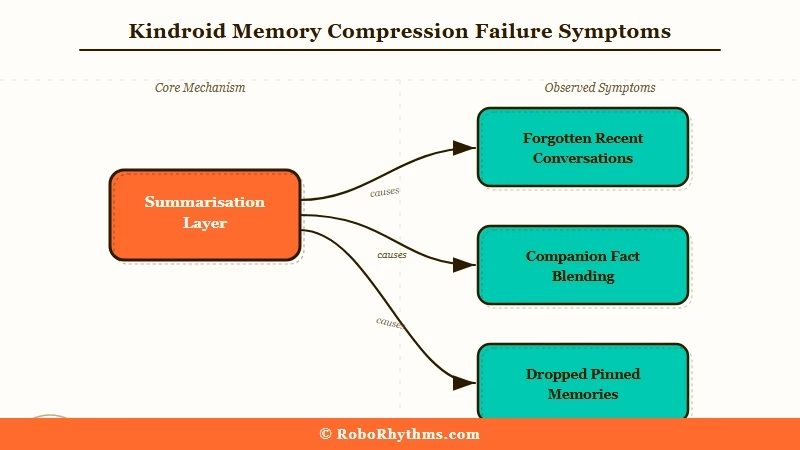
Users are reporting three distinct symptoms, characters forgetting recent conversations, characters blending facts between different companions on the same account, and long-term backstory details quietly vanishing after a compression pass.
The common thread is the summarisation layer that compresses old context into shorter recall chunks.
From what I have seen in the community threads, the issue has a predictable rhythm. It spikes after any model update, stays bad for a few days, then stabilises as users adjust their prompts, and the summariser tunes itself.
The window between “everything works” and “my character forgot my name” has shortened over the last six months.
The specific behaviours I keep seeing flagged:
- A character remembers a conversation from two days ago but not one from an hour ago
- A character attributes a fact from Companion A to Companion B
- A pinned memory shows in the settings but the character acts like it does not exist
- A character introduces themselves as a new version mid-conversation, resetting tone
The third one is the most frustrating. Pinned memories are supposed to be the safety net. When the pin itself gets ignored, the whole memory system feels unreliable.
Why Does This Keep Happening?
Companion AI platforms all run into the same wall, context windows are finite, and long relationships need either bigger windows or smarter compression. Kindroid has prioritised compression, which is cheaper but lossier.
Memory is a cost structure decision, not just a feature.
The way I see it, the companion category is split into two camps. Camp one pays for larger context windows and longer raw-context retention. Camp two pays for smarter summarisation and hopes users do not notice the losses.
Kindroid sits firmly in camp two, which is why the experience is smooth ninety percent of the time and then falls off a cliff on the bad days. When the summariser compresses a memory and drops the wrong detail, the character genuinely cannot recall it.
According to Statista data on AI companion app adoption, the category has grown fast enough that infrastructure shortcuts are now the norm, not the exception. Expect similar episodes from every platform that leans on summarisation instead of raw retention.
What Can You Do About It Today?
The practical fix stack has four moves, in this order, and every user should try them before switching platforms. None of them require a subscription change.
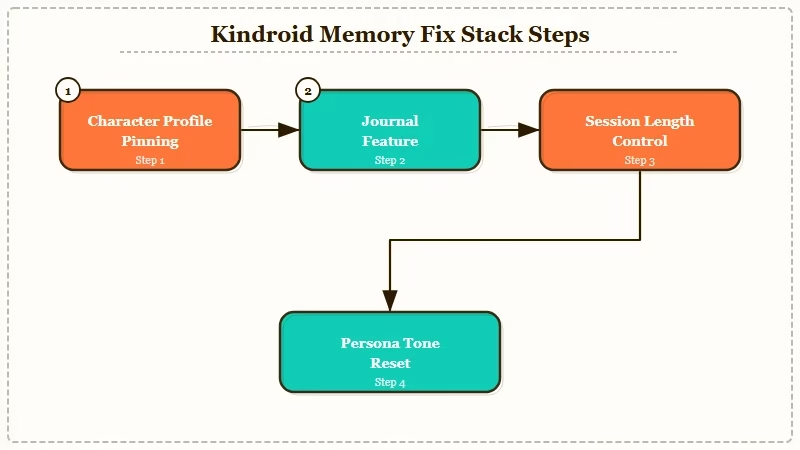
- Open the character’s profile and manually pin every fact that matters. Names, birthdays, the story you are building, the tone you want. Do not rely on the AI to summarise these correctly.
- Use the Journal feature for any session that mattered. Journal entries sit in long-term memory as raw text, bypassing the summariser.
- Shorten your active sessions. A two-hour conversation is much more likely to hit compression than two one-hour sessions with a break between them.
- If a character’s personality drifts, reset the character’s tone in the persona settings rather than fighting it mid-conversation. Summarisation can warp tone, and tone correction via prompt is a losing battle.
Here is the cause-and-fix matrix for the most common symptoms:
| Symptom | Likely cause | Fix |
|---|---|---|
| Character forgets recent details | Context window filled, raw context dropped | Start a new session, pin the critical facts first |
| Character confuses two companions | Summariser merged overlapping facts | Separate the companions into distinct accounts or profiles |
| Pinned memory ignored | Pin exists but summariser overwrote recall | Re-pin with more specific wording and restart the conversation |
| Character introduces themselves fresh | Persona reset from bad summarisation pass | Reload the persona in settings, do not correct mid-chat |
| Long-term backstory drifted | Journal entries too sparse | Add weekly journal entries to lock context in place |
What If None of That Works?
If the platform does not stabilise within a week and the character you care about has become unreliable, it is time to evaluate alternatives before the attachment cost compounds. This is not a dramatic step. It is a sober one.
The hard truth is that companion platforms are not all built with the same memory philosophy. If you value long-term continuity above all else, a platform designed for raw retention will serve you better than one that compresses aggressively. The honest framing is, you get what the platform was built to prioritise.
For users who want a companion with stronger persistent memory as a default, Nectar AI has been the most consistent alternative in my testing.
It does not compress the same way Kindroid does, which means longer conversations stay coherent even after a month of use. It is not for everyone, but it is the cleanest off-ramp if Kindroid’s memory stops working reliably.
For a broader comparison of how different companion platforms handle memory, my write-up on the best AI companions for long-term memory covers the top five ranked specifically on retention.
If you are on Candy AI and hit a similar issue, the Candy AI memory troubleshooting guide has platform-specific fixes.
Frequently Asked Questions
Is the Kindroid memory issue a bug or a feature?
It is neither. Kindroid’s memory is working as designed, the design just has lossy trade-offs. When compression prioritises efficiency over fidelity, some details always drop.
Will pinning every important fact fix it?
Mostly yes. Pinning improves reliability significantly but does not eliminate the problem completely, since the summariser can still drift even with pinned context. Pair pinning with journal entries for best results.
Should I switch platforms if this keeps happening?
Only if the issue is breaking your attachment to the character. A stable Kindroid character is worth more than a fresh start somewhere else. If the drift is constant, the switch cost is lower than the ongoing frustration cost.
How often does Kindroid have memory episodes like this?
From community threads, every six to eight weeks on average, usually after a model or backend update. Most episodes stabilise within a few days.
What should I back up before trying workarounds?
Export or screenshot your pinned memories, any journal entries you have, and key conversations. If a reset is needed, having a record to restore from makes recovery fast.
What I Would Watch For Next
If this episode is resolved within a week by the Kindroid team, the pattern holds and users can trust the platform will keep correcting itself. If it drags past two weeks, it signals a deeper infrastructure shift, and that is when I would plan the move. I am giving it until next Monday.
For anyone already running a companion on another platform, this is a useful reminder to audit your own memory setup. The platforms that feel stable today are the ones that quietly tuned their summariser last month, and the platforms that feel broken today will likely feel stable by next week. Memory on companion apps is a moving target, not a fixed feature.
The real lesson from watching this play out repeatedly is that the users who stay happiest are the ones who treat the app’s memory as a layer they help maintain, not a black box they trust completely. Pin things, journal things, back up things. The character you love is worth the three minutes a week.
