
What Happened: OpenAI pushed a major update to Codex on April 17 that lets it control macOS apps in the background, browse pages inside its own window, remember context across tasks, and tap into more than 90 new plugins. The changes roll out to ChatGPT-signed-in desktop users now. The framing is obvious, this is aimed squarely at Claude Code.
What is Codex: OpenAI’s coding agent, available inside the ChatGPT desktop app on macOS, that now reaches beyond the terminal into the rest of the operating system.
OpenAI dropped a fat Codex update on April 17, and the product shifted meaningfully. What used to be a code generation surface is now closer to a general-purpose desktop agent that happens to be very good at code.
I have been using Claude Code daily for months, and this release is the first time OpenAI has made me think about switching.
The big four additions are Computer Use, an in-app browser, memory, and a plugin library that just grew by more than 90 integrations.
Each of those is a product in its own right. Stacked together, they tell you where OpenAI thinks coding agents are going: out of the IDE, into the whole machine.
What Did OpenAI Ship in the Codex Update?
The April 17 Codex release adds four headline features: Computer Use for macOS app control, an in-app browser, persistent memory, and 90 plus new plugins including Atlassian Rovo, CircleCI, GitLab Issues, and Microsoft tools.
It rolls out to desktop users who sign in with their ChatGPT account, initially US-first with EU and UK expansion coming soon.
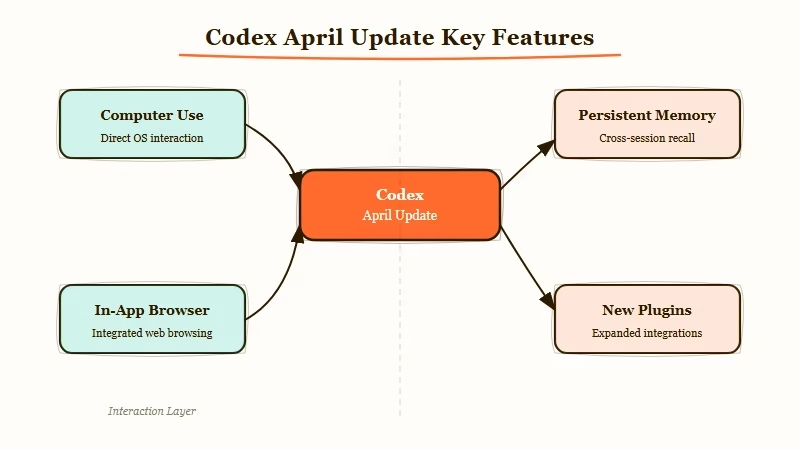
Computer Use is the part that reframes the product. Codex can now operate macOS apps in the background, run test suites against live tooling, open a simulator, poke at a design file, click through a flow. From what I have seen in the early demos, it feels closer to OpenAI Operator than to a plain code assistant.
The in-app browser is the second big one. Instead of bouncing between Codex and Chrome, you comment directly on a page to give the agent precise instructions, and it acts on what you highlight.
OpenAI has hinted that browser control will expand beyond localhost apps, which is where things get interesting for anyone prototyping web flows.
Memory is the quieter feature but probably the one with the longest shelf life. Codex now retains useful context across sessions, personal preferences, past corrections, project conventions. That saves the daily ritual of re-explaining your stack every time you open a new thread.
Plugins are the volume play. OpenAI bundled skills, MCP servers, and app integrations under one umbrella and shipped 90 plus of them at once.
Atlassian Rovo connects Jira and Confluence. CircleCI and GitLab Issues pull your pipeline state in. Microsoft tools bridge into Office and Azure.
The strategy tracks with Anthropic’s managed agents release, just at a larger pluggable scale.
Why This Is a Bigger Deal Than It Sounds
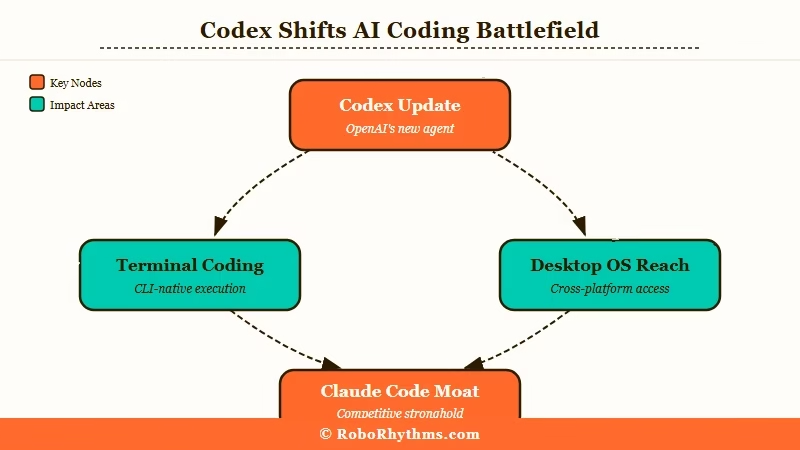
This update turns Codex from a coding assistant into a desktop-level agent, and it does so a day after Anthropic launched Claude Design. The two releases together mark the moment coding agents stopped pretending to stay inside the terminal.
The way I see it, Computer Use is the line that matters. A coding agent that can only read and write files is bounded by whatever your IDE can do.
An agent that can drive your operating system, click through a test harness, open Figma, pull a log file out of a support tool, is bounded only by what a junior engineer could do on the same laptop.
That changes the shape of the competition. Claude Code has dominated the “inside the terminal” category since late 2025, and its moat has been Anthropic’s sharper coding benchmarks plus tighter CLI ergonomics.
Codex with Computer Use moves the fight out of that box entirely. You cannot win a war over terminal ergonomics if your competitor is now also your screen recorder.
The 90-plus plugin drop is the quieter signal. OpenAI effectively said MCP is now table stakes and bundled an ecosystem on top of it.
That is a direct response to Anthropic making MCP the backbone of its agent story. Expect Anthropic to reply within the quarter.
What Does This Mean for Developers Using Claude Code or Codex Today?
For heavy Claude Code users, this is the first release that makes “try Codex again” a reasonable weekend project. For Codex users already on ChatGPT Plus or Pro, the update ships free with no quota changes announced. Nothing forces a switch, but the opportunity cost of staying single-vendor went up.
From what I have seen in my own workflow, the features matter in different ways depending on what you are building:
- Engineers doing front-end work get the biggest lift. The in-app browser plus Computer Use means you can prototype a UI, screenshot it, feed it back into Codex, and iterate without switching windows.
- Backend engineers working in polyglot stacks benefit most from plugin integrations. Pulling CircleCI build state or GitLab issue context into the agent trims the context-stuffing overhead.
- Solo founders and indie devs get memory as the real unlock. The agent stops forgetting your architecture every Monday morning.
- Agency and contract devs should wait a cycle. Computer Use is macOS-only on day one and flaky new features on billable hours is a bad bet.
Here is how the current lineup stacks up for someone deciding which agent to put at the center of their workflow this week:
| Capability | Codex (Apr 17 update) | Claude Code | Cursor |
|---|---|---|---|
| Terminal/CLI workflow | Strong | Strongest | Strong |
| Control the OS beyond the terminal | Yes (macOS) | No | No |
| In-app browser with commenting | Yes | No | Partial |
| Persistent memory across sessions | Yes (preview) | Limited | No |
| Plugin/MCP ecosystem | 90 plus integrations | Strong (MCP native) | Moderate |
| Image generation inside the agent | Yes (GPT-Image-1.5) | No | No |
The plugin gap is the part that will close fastest. Anthropic built MCP, the standard is shared, and most Codex plugins will get Claude Code equivalents within weeks. The OS-level Computer Use gap is harder to close, and that is where the real differentiation sits.
What Comes Next for OpenAI Codex and the Coding Agent Market?
The short term play for OpenAI is a Linux and Windows rollout of Computer Use, followed by an expansion beyond localhost in the browser. The medium term bet is that Codex becomes the default agent for non-coding desktop automation too. That is the only reading that justifies the scale of the ship.
I expect Anthropic’s counter within 60 days. Claude Code already has a stronger MCP story and a better grounded reputation on pure coding benchmarks.
What it lacks is the OS-level reach Codex just shipped. The fastest way to neutralize that is to release a desktop companion for Claude Code that mirrors Computer Use, probably tied to the recent Claude Opus 4.7 release.
The quieter loser here might be Cursor. Cursor’s wedge was “the best agent-in-IDE experience” and both Anthropic and OpenAI now sell agents that step outside the IDE entirely. Cursor has to either compete on the same terrain, which is expensive, or retreat to a tighter IDE-native story.
According to gHacks’ coverage of the launch, OpenAI framed this release as the start of a multi-year push toward agents that “operate across your work, not just inside one app.” Translation, expect another major update on a 30 to 60 day cadence.
For anyone running a serious engineering workflow on a single agent, the right move this week is to install the new Codex, run a real task through Computer Use for an afternoon, and compare the output quality against whatever you were already using. My own take, nobody wins this race on a single release, but the gap between “dominant” and “fighting for relevance” just got a lot narrower.
