
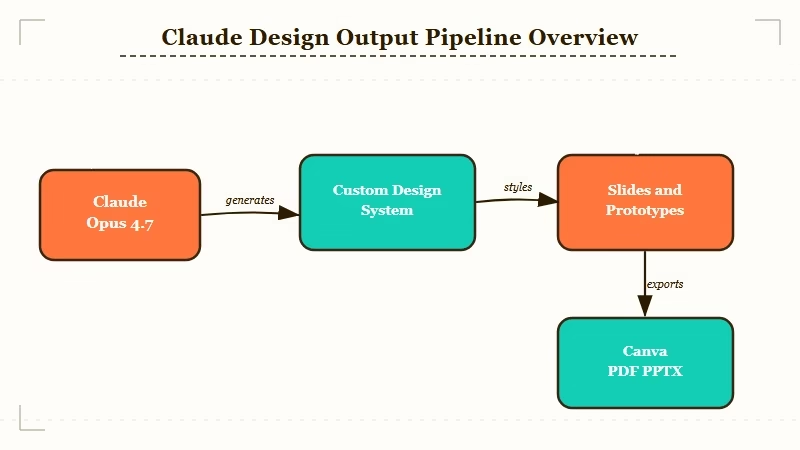
What Happened: Anthropic launched Claude Design on April 17, a research-preview tool that turns text prompts into slides, prototypes, and marketing assets. It reads your codebase during onboarding, builds a design system on the fly, and exports to Canva, PDF, PPTX, and HTML. Figma’s stock dropped about 7 percent the same day.
What is Claude Design: A research-preview tool from Anthropic Labs that turns text prompts into polished slide decks, app prototypes, and marketing assets, powered by Claude Opus 4.7.
Anthropic rolled out Claude Design on April 17 and the design tools world noticed immediately. Figma’s share price fell around 7 percent the same day, and Adobe took a smaller hit.
I have been watching Anthropic quietly edge into adjacent product territory for months, and this is the first release that felt genuinely pointed at someone else’s market.
The tool lives inside Anthropic Labs, the same incubator that shipped Claude Opus 4.7 the day before. It takes a text prompt and returns a finished visual, not a rough first draft. And it is available right now to anyone already paying for Claude Pro, Max, Team, or Enterprise.

What Did Anthropic Ship With Claude Design?
Claude Design is a text-to-visuals tool that generates slides, prototypes, one-pagers, and marketing assets from simple prompts.
It is powered by Claude Opus 4.7 and available in research preview for all paid Claude tiers, with its own usage allowance separate from chat and Claude Code.
From what I have seen in the early demos, the onboarding flow is the part that makes this feel like more than a wrapper.
During setup, Claude Design ingests your codebase and existing design files to build a design system on the fly. Colors, typography, spacing tokens, logo treatments: the whole visual language comes from what you already have.
Export options cover the four formats teams reach for most: Canva, PDF, PPTX, and standalone HTML files. No need to rebuild a deck in a separate tool to present it. You generate it in Claude, export to PPTX, and hand it off.
The tool has its own weekly usage cap, which sits alongside your existing chat and Claude Code limits. That matters for heavy users who were already bumping into agent quotas on the Max plan.
Why Did Figma’s Stock Drop 7 Percent?
Figma fell because Claude Design is a direct shot at the non-designer workflow where Figma captures most of its upsell revenue.
Slide decks, quick prototypes, and marketing one-pagers are exactly the use cases Figma has been monetizing through Figma Slides, Figma Sites, and the AI tier.
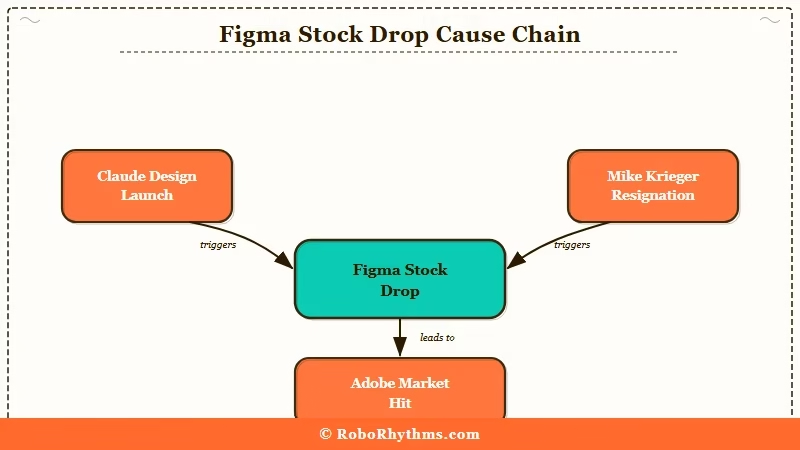
The way I see it, there were two signals that told the market this was serious. First, Mike Krieger, Anthropic’s chief product officer, resigned from the Figma board on April 14, three days before the launch. That is not a coincidence, it is a fiduciary move that telegraphed the conflict.
Second, The Information reported the product a day before Krieger’s resignation. The sequence tells you Anthropic knew the narrative was going to be “Anthropic is coming for Figma” and priced the launch around it.
Adobe dropped on the news too, though less sharply, because the overlap with Adobe Express and Creative Cloud is less surgical.
Anthropic’s $30 billion revenue was already public by early April, up from $9 billion at the end of 2025. A company growing that fast has the cash and the distribution to pick fights with incumbents, and Claude Design is the first proof they intend to.
What Does Claude Design Mean for Designers and Non-Designers?
For non-designers, Claude Design removes the friction of turning an idea into a shareable visual. For designers, it is a drafting partner that speeds up low-stakes work while still needing human polish on client-facing output.
In my experience with similar text-to-visual tools, the output is solid for internal decks, status updates, and early-stage prototypes. It is weaker when the brand has strict visual rules the AI has not been trained on, though the codebase ingestion onboarding is Anthropic’s attempt to close that gap.
Here is the real difference in workflow, before and after Claude Design lands on your desk:
Before: A PM needs a quarterly review deck. They write an outline, hand it to design, wait three days, iterate twice, and ship on Friday. Total time: five hours of design work, eight hours of PM back-and-forth.
After: The PM opens Claude Design, pastes the outline, gets a brand-consistent deck in four minutes, tweaks copy, exports to PPTX. Total time: roughly 20 minutes end-to-end.
Here is how I would think about who should try it this week:
- Product managers who need internal decks fast and want to stop bothering their design team for quarterly reviews
- Founders and solopreneurs building a landing page mockup or investor one-pager on a deadline
- Engineering teams prototyping a feature who want a visual before committing design time
- Designers running concept sprints who want to generate ten variations in the time it takes to build one
| Use case | Who wins with Claude Design | Who still needs Figma |
|---|---|---|
| Internal slide decks | Product and ops teams | Design-heavy brands |
| Rapid prototypes | Engineers and PMs | Agencies on client work |
| Marketing one-pagers | Founders and solopreneurs | Teams with strict design systems |
| Client deliverables | No one yet | Every agency and in-house team |
For anyone already living inside Claude Code, Claude Design feels like the natural next thing to bolt on. The output quality is not going to replace a senior designer on a brand refresh, but it is going to replace the five hours a PM spent fighting Figma to make a quarterly review deck.
What Is Anthropic Likely to Ship Next?
Anthropic looks like it is moving from foundation model provider to full-stack product company, and Claude Design is the first release that proves it.
The pattern I am watching for is more vertical products built on top of Opus 4.7 in the next 90 days.
From what the early coverage keeps repeating, the internal framing at Anthropic is Labs as an incubator for Claude-native products. That lines up with the recent Conway agent launch and the earlier managed agents release. Design, research agents, managed agents: these are three distinct product surfaces in 60 days.
According to TechCrunch’s coverage of the launch, Anthropic’s chief product officer framed Claude Design as the start of polished visual work as a Claude capability, not a one-off. Translation: expect more.
What I would bet on next is a Claude-native video tool, a replacement for Loom and lightweight explainer decks. The same argument that made Claude Design inevitable applies to video, enough people need short visual content fast and the current tools are clunky.
If Anthropic stays on this trajectory, the incumbents that should be watching their stock are not just Figma and Adobe, but Loom, Gamma, and every slide-tool startup that raised money on AI-powered decks as the whole thesis.
The next 60 days will tell us whether this was a watershed or a one-off. My money is on watershed.
