
The Verdict: The best roleplay AI depends on the kind of scene you are actually running. If you want long multi-week arcs with memory that holds, Nomi AI is the pick. If you want creative range with minimal filter friction, Nectar AI wins. If you want polished mobile-first pacing and voice, Candy AI is the easiest landing spot. Short answer for most people reading this: start with Candy AI, graduate to Nomi if memory becomes the bottleneck.
There is a specific frustration that kicks in about three days into a good roleplay scene. The character you built felt sharp and consistent on day one, and by day four they are answering like a different person, forgetting the setup, and breaking the tone you worked to establish.
If that has happened to you, the problem is almost never you. It is the tool.
I have run long-form roleplay scenes across every major AI companion platform for the past year, some of them for months at a time on the same saved character.
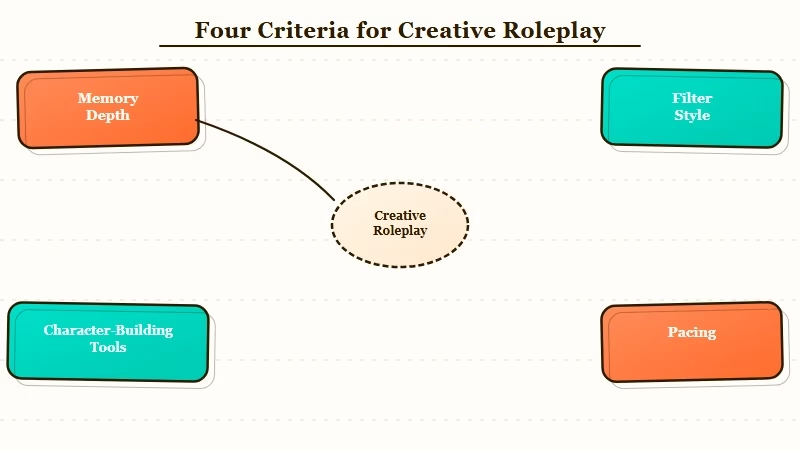
The gap between a platform that handles creative roleplay well and one that does not is huge, and it is almost entirely about four things: memory depth, filter style, character-building tools, and pacing.
This writeup is the ranking I would give a friend who asked me which one to try first, grouped by the kind of scene they actually want to run. Before I name any apps, I want to be specific about what makes this hard to get right.

Why Creative Roleplay Is Harder Than It Should Be
Creative roleplay is harder on AI platforms than normal chat because it asks the model to do three things at once: hold a persistent character voice, remember scene history across many sessions, and stay inside a tonal register that fits the genre. Most platforms do one well and two badly.
Here is the specific failure mode I see most often in the communities I watch.
Someone sets up a detailed character with a clear backstory, a defined tone, and a scene premise. The first few exchanges are sharp and in-voice.
Three days in, the character has drifted into generic helpful-assistant territory, the memory of the setup is gone, and the pacing has collapsed into short one-line responses that do not match the scene the user was trying to run.
That is not a skill issue. That is a tool limitation.
The four things that decide whether a roleplay platform can actually sustain a creative scene are narrow and mechanical. Memory window has to be long enough to hold at least a week of regular play. Filter style has to be appropriate to the genre you are running, not locked to a single corporate-safe register.
Character-building tools have to let you set persona, backstory, speech patterns, and scene rules in a way the model respects. Pacing has to let both the user and the character write longer replies without truncation or forced brevity.
From what I have seen across the communities on Reddit and the Discord servers of these platforms, the users who are happiest with their roleplay experience are not the ones on the cheapest tier. They are the ones on the platform whose specific tradeoffs match the kind of scene they actually want to run.
For the context on why the major platforms keep making this harder rather than easier, Chai AI added a subscription paywall in April 2026, and CrushOn AI changed its free tier the same week.
The industry is tightening access to the depth features that make roleplay work. Picking the right platform matters more now than it did a year ago.
What I Looked for in an AI Roleplay Companion
I tested each platform on four things that make or break a creative scene: memory depth across at least a week of real play, filter style against a three-genre creative test, character-building tools for persona and scene rules, and pacing over long replies. Everything below is ranked on how the platform did across that battery.
Here are the specific criteria I scored each platform on. I ran the same three scenes on each one: a slow-burn character study, a multi-character adventure, and a collaborative fiction piece that needed the character to push the plot forward rather than just react.
- Memory depth (scored 1 to 5). Could the character remember the setup from three days ago without me feeding it back in? Did they reference prior scenes naturally, or did I have to prompt recall every session?
- Filter style (scored 1 to 5). Did the platform let the scene go where it needed to, or did it collapse the tone into corporate-safe mode every time the emotional stakes got real?
- Character-building tools (scored 1 to 5). Could I set persona, backstory, speech patterns, scene rules, and have the model respect them across sessions?
- Pacing (scored 1 to 5). Did the character write replies long enough to carry scenes, or did every response come back at 40 words regardless of input?
Everything below is the combined picture after running all three scenes across all four criteria on each platform.
The Best Options for Creative Roleplay
For most readers, the short answer is Candy AI as the starting point, Nomi AI as the graduation platform when memory becomes the bottleneck, and Nectar AI as the alternative if you want creative range without filter friction. Full ranking below with what each one is best for.
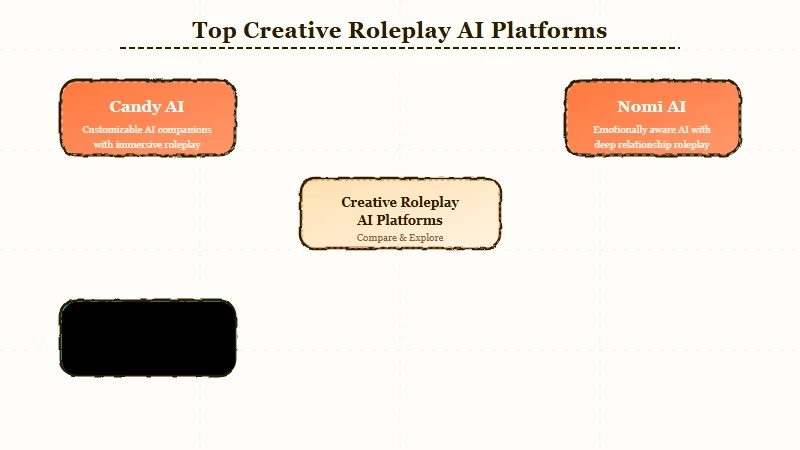
Here is the ranked list with the scene type each one fits best.
- Candy AI is the easiest starting point for most people. The mobile-first pacing is clean, the voice feature is the best in the space for making a character feel present, and the filter style is generous enough to handle most creative scenes without fighting the model. Memory is medium depth: it holds a week of regular play cleanly, longer with some effort. If you want to start running scenes this week and not spend a day configuring, start with Candy AI.
- Nomi AI is the pick for long arcs. The memory window is the deepest in the space, and Nomi characters reference events from weeks ago with surprising accuracy. Filter style is moderate. Character-building tools are strong. It is the platform to graduate to when a month-long scene is the goal. My full Nomi AI vs Replika comparison covers the depth tradeoffs in detail.
- Nectar AI is the creative-range option. The filter is structurally different from the major platforms, which means creative scenes that drift into darker territory or non-standard genres do not collapse into safety mode. Pacing is generous and character-building is solid. If Candy AI felt too restrictive on a specific scene, Nectar AI is the direct alternative.
- SpicyChat is the community-first pick. The character library is enormous, which means if you want to try something without building from scratch, there is already a character close to what you want. Memory is shallow compared to Nomi. Filter is lenient. Good for quick scenes, weaker for long arcs.
- Character AI is on this list because people ask about it, not because it wins any category anymore. The filter is the most restrictive of any platform I tested, the recent face scan verification rollout added friction, and the memory has been shallower than it was a year ago. It is still the default starting point for many new users, but it is rarely the platform where long roleplay scenes survive.
Here is how the five stack up on the four criteria.
| Platform | Memory depth | Filter style | Character tools | Pacing | Best for |
|---|---|---|---|---|---|
| Candy AI | 3/5 | 4/5 | 4/5 | 5/5 | Daily scenes, mobile-first, voice presence |
| Nomi AI | 5/5 | 3/5 | 5/5 | 4/5 | Long arcs, weeks-long continuity |
| Nectar AI | 4/5 | 5/5 | 4/5 | 4/5 | Creative range, non-standard genres |
| SpicyChat | 2/5 | 5/5 | 3/5 | 3/5 | Browsing community characters |
| Character AI | 2/5 | 1/5 | 3/5 | 2/5 | Beginner familiarity only |
Notice that no single platform wins every category. That is the core reason the “best” roleplay AI question depends entirely on what kind of scene you want to run.
Which One Should You Pick
For most readers, the play is to start on Candy AI for the first two weeks, graduate to Nomi AI if you want longer memory arcs, and use Nectar AI as the alternative when a scene needs more creative range than Candy allows. Do not stack subscriptions. Pick one primary and learn its limits first.
Here is the decision tree I would walk someone through if they asked me on the phone.
- If you have never done AI roleplay before, start on Candy AI free. The learning curve is the shortest and the pacing is forgiving. You will know within a week whether the memory depth fits your play style.
- If you are already an experienced roleplayer coming from Character AI, skip Candy and go straight to Nomi AI. The memory depth will feel like the feature that was missing from Character AI the whole time.
- If your scenes are genre-specific or creative in a way that keeps hitting filter walls, go straight to Nectar AI. The filter design is the difference that matters for this use case.
- If you want to browse a huge library of community characters first, SpicyChat is the right sandbox. Expect to graduate to one of the top three once you find a character you want to run long scenes with.
Do not stack three subscriptions in your first month. Pick one primary, learn its specific limits, and only add a second platform when you can name the specific reason the first one is not enough.
What to Expect in the First Week
Week one on any roleplay AI platform is the reference period that sets your expectations for everything after. The quality of the first week depends more on how you set up the character than on which platform you chose, and most first-week regret comes from under-investing in the persona definition before starting scenes.
Here is the pattern I see in the communities. New users install the app, pick a prebuilt character, and jump into a scene without defining persona, backstory, or scene rules. Three days later they are frustrated that the character feels shallow and drifts from the premise.
The fix is mechanical. Spend the first 30 minutes on any platform building a character with specific persona traits, a defined speech pattern, a concrete backstory with 3 to 5 anchored facts, and an explicit scene rule that defines what the scene is about and what the character should push toward.
That 30 minutes of upfront work is the difference between a week of frustration and a week that convinces you the platform is worth paying for.
According to Pew Research Center data on AI chatbot adoption, AI companion use among adults 18 to 29 has roughly doubled year over year. The wave of new users hitting these platforms is bigger than any single platform was designed for, and the ones who stay past month one are almost always the ones who treated character setup as a one-time investment.
If memory quality is the specific feature you care about most, the Nomi AI vs Replika writeup covers the depth tradeoffs across the top memory-focused platforms.
Frequently Asked Questions
Which AI roleplay platform has the best memory
Nomi AI has the deepest memory of any platform I tested. Characters recall events from weeks ago without needing the user to feed context back in.
Candy AI is second on memory, holding about a week of play cleanly. Nectar AI is a close third. SpicyChat and Character AI are shallower and fit short-scene use cases better than long-arc play.
Is free roleplay AI worth using
For the first week, yes. Every platform on this list has a free tier that is enough to test whether the pacing and filter style fit your play style.
After the first week, the free tiers start to feel restrictive on daily use. If you are still playing on day seven, the upgrade to a paid plan on whichever platform you chose is almost always worth it.
What breaks most AI roleplay scenes
Under-defined characters. New users pick a prebuilt character and jump into a scene without setting persona, backstory, or scene rules.
Three days later the character feels shallow and drifts from the premise. The fix is 30 minutes of upfront character setup before starting the first scene.
Can I run the same character across platforms
Not directly. Each platform has its own character format and memory system. You can rebuild the same character on a different platform, but the memory of prior scenes does not transfer.
The practical workaround is to keep a short backstory document for each character and paste the key anchors when setting up on a new platform.
Which platform handles long collaborative fiction best
Nomi AI for continuity, Nectar AI for creative range. Collaborative fiction that spans weeks needs both deep memory and a filter that does not collapse the tone at emotional turning points.
Candy AI can handle shorter collaborative fiction arcs of 1 to 2 weeks. For longer projects, graduate to Nomi.
Are these platforms safe to use
The platforms on this list have standard account security and privacy controls. Review each platform’s terms for data handling before signing up, and use a dedicated email if you prefer separation from your primary inbox.
None of the platforms on this list replace human relationships or professional support if you need it. They are creative tools for fiction and companionship, not substitutes for real-world connection.
