
My Take: AI is not wiping out white collar jobs. It is creating a gap between the people who use it and the people who do not, and that gap is widening faster than anyone in the “it’s fine” camp is admitting. The doom crowd is wrong about the mechanism. The hype-dismissers are wrong about the stakes.
On April 9, 2026, Bloomberg ran an opinion piece with a title to the effect that AI’s white collar job threat is marketing hype. The argument: CEOs use extinction rhetoric to sell their products, productivity data shows no impact, and the doom narrative is a sophisticated PR strategy.
I read it and agreed with almost none of it.
Not because I think AI is going to wipe out half of white collar work the way Anthropic CEO Dario Amodei predicted in early 2025 when he warned of AI eliminating roughly 50% of entry-level white collar positions within a few years. I think that prediction is also wrong about the mechanism.
Both sides are measuring the wrong thing.

The Mainstream View and Why Both Sides Miss the Point
The doom camp says AI will replace white collar workers at scale within a few years. The hype-dismissers say the productivity data shows nothing to worry about yet. Both are staring at employment counts when the real signal is in output-per-person ratios, which are diverging fast in ways that unemployment data cannot capture.
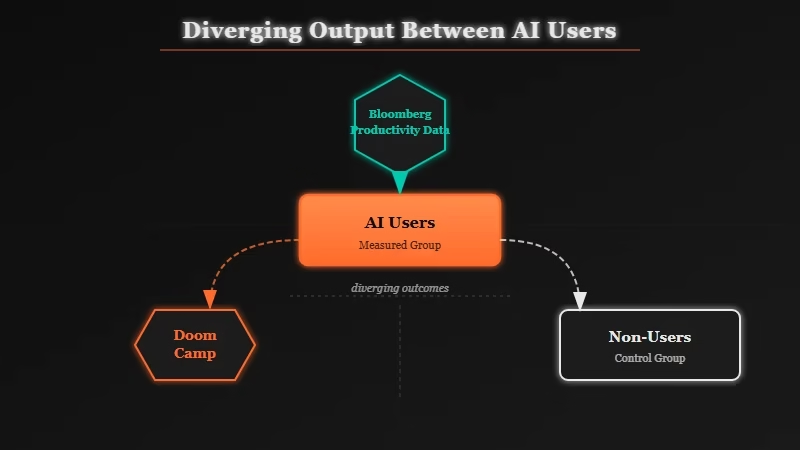
Bloomberg’s April 9 piece makes a real point: companies do use “AI will kill jobs” rhetoric as a marketing strategy. When Sam Altman warns about existential risk, it drives coverage and positions OpenAI as the serious player in the space. When Amodei says 50% of entry-level roles will vanish, it makes Anthropic sound powerful enough to do that.
That observation is correct. The conclusion drawn from it is wrong.
The productivity data shows no macro impact because productivity is measured at the aggregate level. When 10% of workers using AI become 3x more productive and 90% stay the same, the aggregate number barely moves.
That does not mean nothing is happening. It means what is happening is concentrated, not distributed.
The doom camp makes the opposite error. They are predicting a sudden transition that requires mass layoffs and obvious labor market signals. What is arriving is slower, quieter, and more damaging than that.
The Pattern That Is Replacing Jobs Without Replacing Workers
AI is not eliminating white collar work. It is sorting white collar workers into two categories: those who can leverage AI to produce output that previously required a team, and those who cannot. The first group is becoming rarer and more valuable. The second group is becoming interchangeable and cheaper.
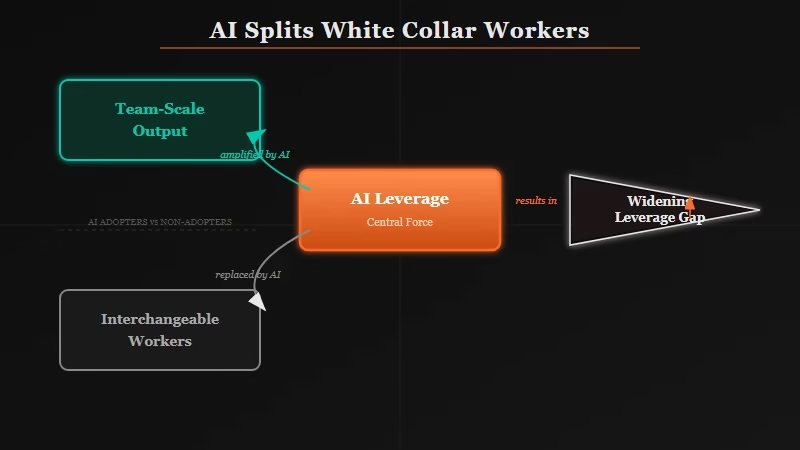
From what I have seen across hiring discussions, this is the practical reality right now. A single developer who knows n8n, Bolt, or Cursor can deliver in a week what used to require two developers and a project manager.
The n8n review covers what that looks like in automation: one person running self-hosted workflows, replacing what agencies previously charged $3,000/month for.
The Bolt vs Lovable comparison is another snapshot of this: two developers, one with AI tooling and one without, working on the same type of project are now operating on different output curves.
The explicit layoff numbers back this up. CNBC reported in 2025 that economists were warning “there’s much more in the tank,” and the data shows why: only 54,836 job losses were explicitly attributed to AI by employers in 2025, while modeling-based estimates place actual AI-displaced positions at 200,000-300,000.
The gap is not a data error. It is companies restructuring headcount through attrition and hiring freezes rather than announcing mass layoffs that would make headlines.
What the Anthropic infrastructure buildout signals is that this dynamic is about to accelerate. When managed agent capabilities move from enterprise-only pricing to developer-accessible tiers, the leverage ratio between a skilled user and an unskilled one gets wider, faster.
The Part Nobody Wants to Admit
The uncomfortable implication of the sorting thesis is that retraining programs are not going to close the gap. The skills that make someone effective at AI leverage are not teachable in a 12-week bootcamp.
What separates the people who 3x their output with AI from the ones who do not is not technical knowledge. It is the ability to decompose a complex problem into tasks, evaluate AI output critically, and iterate quickly when the output is wrong. Those are judgment skills that develop over years of doing hard work, not prompt engineering courses.
This means the people most at risk are not entry-level workers, who have time to develop in an AI-native environment. The most exposed group is mid-career white collar workers who built their value on domain expertise that can now be replicated cheaply, and who have not spent years developing the meta-skill of working effectively with AI tools.
The way I see it, neither side is being honest about this. The doom crowd avoids it because it complicates the “everyone is losing their job” narrative. The hype-dismissers avoid it because admitting that the harm is concentrated and severe for a specific cohort does not fit the “nothing is really happening” framing either.
Hot Take
The white collar recession is not coming. It is already here, in the hiring freezes and changed role expectations that never make the headlines, and the people who will feel it most are the ones who spent the last three years assuming AI was someone else’s problem to figure out.
