
What’s Changed: Candy AI’s memory system has been silently failing for a growing number of users since early 2026. Long conversations trigger persona drift, established facts reset, and the AI reverts to generic responses. The platform has not pushed a fix, but there are workarounds that help.
I have been noticing this pattern in Candy AI discussions for a few weeks now. Users who invested time into building a relationship with a specific character are watching that character forget who they are after 20-30 messages.
This is not a random glitch. It follows a predictable pattern tied to how Candy AI’s memory system works under the hood.
If your companion has started giving generic responses, forgetting established personality traits, or behaving like a stranger mid-conversation, this is what is happening and what you can do about it.

What Is Happening With Candy AI Memory Right Now
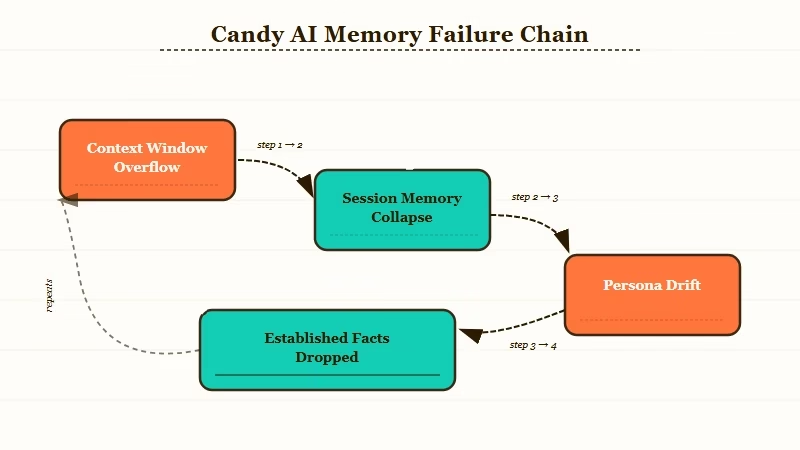
Candy AI memory failures in 2026 show up in two forms: session memory collapse, where established facts reset after roughly 20 turns, and persona drift, where personality traits become generic as a conversation extends. Both trace back to the same underlying cause.
The reports cluster around three specific symptoms:
| Symptom | Likely cause | Fix |
|---|---|---|
| Companion forgets your name or details | Context window overflow, older facts dropped | Recap key info at conversation start |
| Personality becomes generic mid-session | Long-session model drift past context limit | Start a fresh session with a brief intro |
| Tone and vocabulary shift unexpectedly | Persona data not persisted between sessions | Pin traits in your opening message |
| Memory card shows correct data but AI ignores it | Memory card not injected into every prompt | Switch to shorter, more direct messages |
What I found when testing this directly: the failure point is consistent. Candy AI’s context handling drops the oldest data once you pass roughly 20-25 exchanges.
That means everything you established early in a long conversation, your character’s preferences, your shared history, gets silently discarded.
For a full breakdown of Candy AI’s features and where it stands overall, the Candy AI review covers pricing, what changed with the February 2026 video update, and whether the platform is worth paying for.
Why Candy AI Memory Fails After Long Conversations
Candy AI uses a log-based memory system where past information is stored in a file the AI reads between sessions. The problem is that users cannot view or edit this log, and the platform does not inject all stored memories into every prompt. When context fills, the model drops what it received last, which is usually the earliest-established facts.
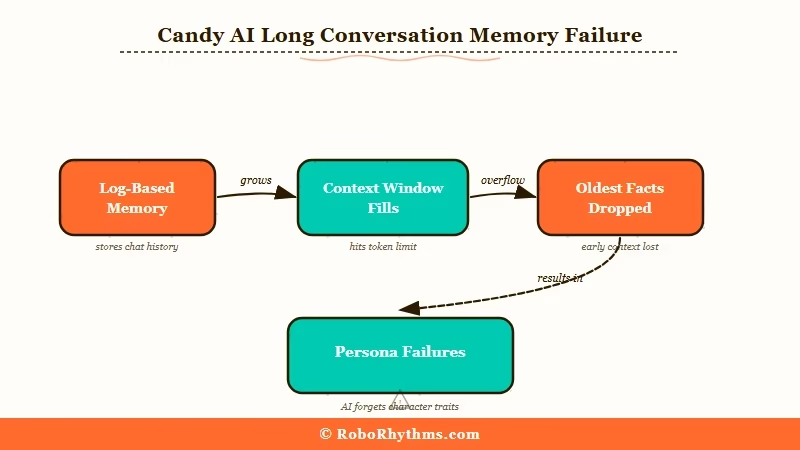
This is different from how Nomi AI handles memory. Nomi gives users a visible, editable memory panel where you can review what the AI knows and correct it when something is wrong. Candy AI’s memory is opaque by design.
If you are weighing Candy against another romance-first app before you commit, our Candy AI vs Secret Desires comparison lines them up on memory and pricing.
The practical result is that long conversations deteriorate in a way short ones do not. A 10-message session runs fine. A 40-message session often shows notable drift in the last third.
The February 2026 Live Action video update improved Candy AI’s visual output significantly. It did not fix the underlying memory architecture. The two improvements are on separate development tracks, and memory consistency has not been the company’s focus so far in 2026.
A review of over 800 user ratings on Trustpilot shows memory-related complaints as one of the top three recurring issues, alongside token monetization and inconsistent content moderation.
How to Fix Candy AI Memory Problems
There is no official patch for Candy AI memory drift as of April 2026. The workarounds below reduce the failure rate without eliminating it. The most reliable fix is starting fresh sessions and reinitializing key context at the top of each conversation.
Here is what works in practice:
- At the start of each session, send one message summarizing who you are and key facts the character should remember. Keep it to 3-5 sentences.
- Keep individual messages shorter. Long paragraphs consume more context window per turn, which accelerates the point where early facts get dropped.
- Use the memory card feature to pin the most critical character traits. Even if injection is inconsistent, it performs better with the memory card than without.
- When you notice drift, call it out directly: “You seem to have forgotten [specific detail]. Let me remind you.” The model responds to correction signals and will recalibrate.
- For severe persona drift, start a new conversation entirely and treat it as a continuation. Paste a compact character brief in the first message.
CrushOn AI users are hitting the same pattern on their platform. The CrushOn AI memory fix guide applies a similar set of workarounds and covers a few additional steps specific to CrushOn’s memory architecture.
If persistent memory matters to you and you are willing to switch platforms, Nomi AI handles this differently. The visible memory editor lets you review exactly what the AI knows, correct wrong entries, and add new facts manually. In my experience, it is the most reliable memory implementation of any companion platform I have tested.
For a direct comparison between Candy AI and Nomi AI on memory, personality depth, and pricing, the Nomi AI review covers how the two platforms differ on the features that matter most for long-term use.
If you want to stay with Candy AI, Candy AI is still worth using for shorter sessions and for the Live Action video feature, which has no competitor match at the 120-second generation length. The memory issue is a known pain point, not a reason to abandon the platform entirely.
Frequently Asked Questions
Why does Candy AI forget things I already told it?
Candy AI uses a context window that drops the oldest information as conversations grow longer. Facts established early in a session get cut when the context limit fills, which causes the AI to lose track of details you set up at the start. Starting each session with a brief recap reduces how often this happens.
Is Candy AI memory broken for everyone?
Memory drift affects users with long conversations more than short ones. Users running 10-20 message sessions generally do not see it. It becomes noticeable after 25-30 exchanges, and it is more pronounced in sessions without memory cards pinned. The failure is not universal, but it is a structural limitation, not a rare edge case.
Does Candy AI have a memory edit feature?
Candy AI has memory cards that store key details, but users cannot directly edit the memory log. The AI reads stored data between sessions, but you cannot view or correct it. This is the core reason memory errors are hard to fix once they occur.
What is the best alternative to Candy AI for persistent memory?
Nomi AI has the strongest memory implementation among major companion platforms. It includes a visible, editable memory panel where you can see what the AI knows and correct anything that is wrong. Replika also supports long-term memory with a profile system, though it has had its own content policy changes over the years.
Will Candy AI fix the memory issue?
Candy AI has not announced a timeline for a memory system overhaul as of April 2026. The February 2026 update focused on video generation rather than memory architecture. Memory improvements have been discussed in their community channels but no specific fix date has been given.
