
What Happened: Anthropic launched its Managed Agents API on April 10, 2026. It handles the infrastructure that used to eat developer weeks: sandboxing, permissions, state management, and error recovery. Notion, Rakuten, Sentry, and Asana are already shipping production products built on it.
Anthropic’s Managed Agents API went live on April 10, 2026. It ships with the infrastructure that used to eat developer weeks: sandboxing, permissions management, state persistence, and error recovery. Notion, Rakuten, Sentry, and Asana are already running production deployments on it.
Most production AI agent failures don’t come from the model. They come from the plumbing surrounding it.
For years, every team building anything agentic had to rebuild that plumbing from scratch. That pattern is exactly what Managed Agents is designed to end.
The 10-point task success improvement Anthropic benchmarks over standard prompting is real, and it comes from exactly the layer most teams get wrong: state management on multi-step tasks. If you’re building anything agentic right now, here’s what changed.
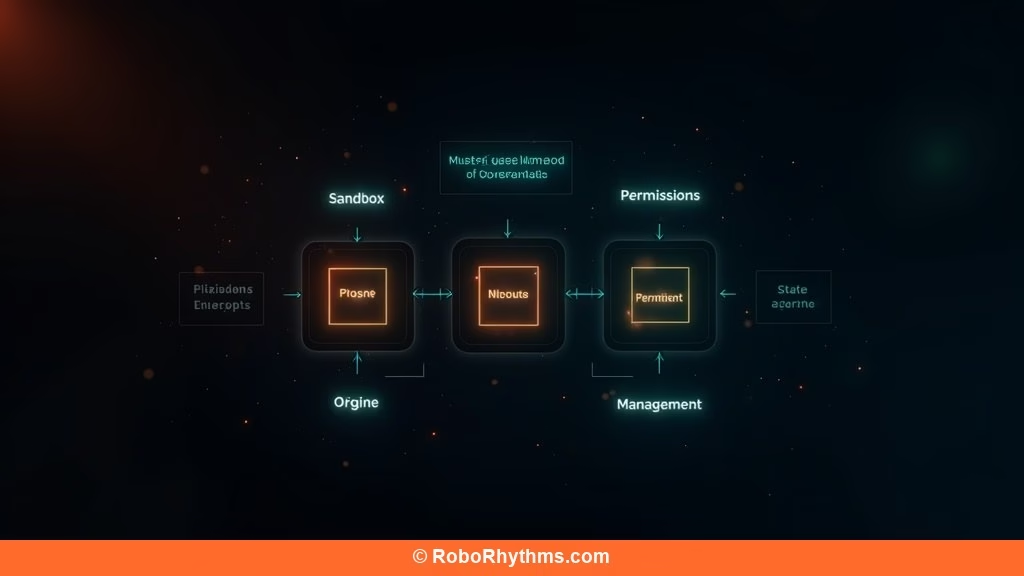
How Does Anthropic Managed Agents Work?
Managed Agents is Anthropic’s hosted infrastructure layer for running AI agents in production. It provides built-in sandboxing, permissions management, cross-step state persistence, and automatic error recovery. These are the four components that typically take weeks to build and months to stabilize.
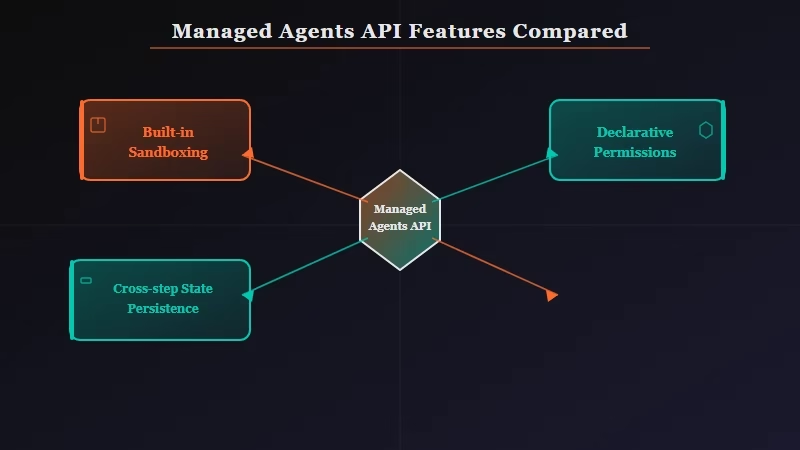
From what I’ve seen, most agent failures don’t come from the model itself. They come from the infrastructure surrounding it. I covered the structural reasons for this in detail in why AI agents keep failing, and Managed Agents addresses most of those root causes directly.
Here’s how I’d frame the shift for anyone building agents the old way:
| What you built yourself | What Managed Agents handles |
|---|---|
| Custom sandbox setup per deployment | Built-in sandboxed execution environment |
| Manual permission scoping for each tool | Declarative permissions layer with scope enforcement |
| Hand-rolled state management between steps | Persistent state across agent steps, managed by the platform |
| Custom retry logic and error handlers | Automatic error recovery with configurable fallback behavior |
Anthropic’s internal benchmarks show task success rates jumping up to 10 percentage points over standard prompting.
The biggest gains came on the hardest multi-step tasks, which is exactly where unmanaged infrastructure causes the most silent failures.
Why Is Managed Agents a Bigger Deal Than It Sounds?
Managed Agents shifts the production AI agent problem from an infrastructure challenge to an application development challenge. That sounds incremental. It is not.
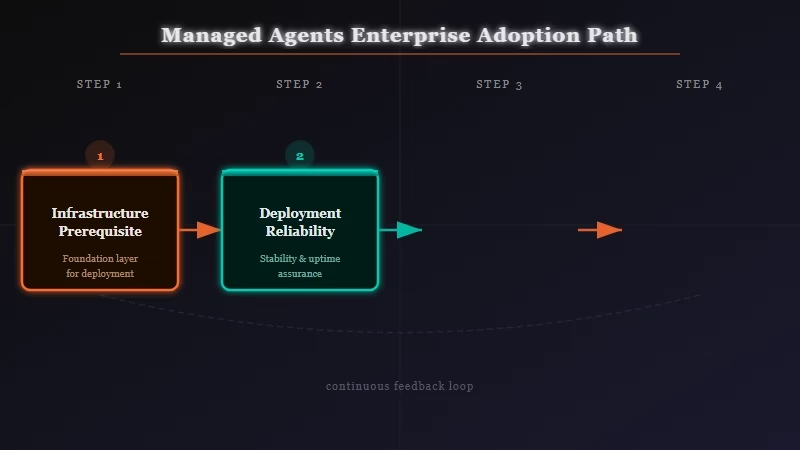
Building reliable production agents currently requires engineering depth most product teams don’t have. You need someone who understands sandboxing, permission models, distributed state, and failure recovery before writing a single line of business logic. Managed Agents removes that prerequisite.
The way I see it, Anthropic is betting that the bottleneck for agentic AI is not model capability but deployment reliability.
The timing is deliberate. Anthropic’s revenue crossed $30 billion ARR earlier this month, with enterprise driving roughly 80% of that. Managed Agents is built for exactly the enterprise customers stuck at the prototype-to-production gap.
This is part of a broader agentic product push that started with Anthropic’s Cowork plugin launch in January 2026.
The validation from the launch roster is not trivial. Notion, Sentry, Asana, and Rakuten don’t ship unproven infrastructure. If these teams have committed production deployments to Managed Agents, it passed their internal reliability bars, which is a meaningful signal.
What Does Managed Agents Mean for AI Builders?
For AI builders, Managed Agents means you can skip the infrastructure phase and ship production agents faster. The practical implications depend on where you are in the build right now.
If you’re still at the prototype stage:
- Build directly on Managed Agents from the start instead of writing infrastructure you’ll later replace.
- The sandboxing and permissions layer ships for free, which means your prototype is already more production-ready than most teams’ v1 deployments.
- The state management layer removes the most common source of flaky agent behavior: context dropped between steps.
If you’re mid-build with your own infrastructure:
- Evaluate whether your current state management and error recovery are the real bottleneck. If you’ve had unexplained failures on complex multi-step tasks, they probably are.
- The migration path is not trivial, but a 10-point task success improvement is worth pricing in.
- Watch what Notion and Sentry ship publicly. Their engineering posts will tell you more than any benchmark.
If you’re already in production:
- Your existing infrastructure still works, but you’re now competing with teams that don’t have to maintain it.
- The real question is how much engineering time your current infrastructure layer consumes each sprint.
On security: Managed Agents handles the execution sandbox, but data handling and PII controls remain your responsibility. The agent data leak prevention guide covers what the platform doesn’t.
A production RAG pipeline is still something you build yourself. Managed Agents handles orchestration infrastructure, not retrieval architecture.
What Comes Next for Managed Agents?
The next frontier for Managed Agents is multi-agent coordination, which Anthropic has signaled but not yet shipped. The current release handles the single-agent case. Running multiple specialized agents that hand off tasks and share state reliably is where enterprise demand is heading.
From my read of the trajectory, Managed Agents will absorb a large share of what teams currently use LangChain and similar frameworks for. Not because those frameworks are bad, but because most teams use about 20% of their surface area in production. Paying for an abstraction that handles that 20% reliably is a reasonable trade.
The open question is pricing at scale. Anthropic has not published Managed Agents pricing beyond enterprise tier access. For teams running millions of agent invocations per month, the cost comparison against self-managed infrastructure will determine whether this is a permanent shift or a transitional convenience.
What’s clear is that the infrastructure gap slowing production agent deployments just got smaller. Whether you build on Managed Agents directly or use the launch to benchmark your existing setup, the bar for what “production-ready” means just moved.
