
What Happened: Meta launched Muse Spark on April 8, 2026, the first model from its Meta Superintelligence Labs unit led by Alexandr Wang. It is proprietary (not open-source), claims benchmark parity with GPT-5.4 and Claude Sonnet 4.6, and will power the AI features inside Facebook, Instagram, WhatsApp, Messenger, and Meta’s Ray-Ban glasses within weeks.
Meta Muse Spark is the most significant AI model launch of April 2026, and not for the reasons most coverage is focusing on.
For years, Meta’s AI strategy rested on open-source releases, including Llama 1, Llama 2, Llama 3, and the Llama 4 series. Tens of thousands of developers built on those models. Startups used them as a foundation.
That era ended on April 8, 2026.
Muse Spark is proprietary. No weights. No fine-tuning access. No community forks. From what I can tell, Meta is not treating this as a temporary pivot. This is where the company is headed.

What Is the Meta Muse Spark AI Model?
Muse Spark is Meta’s first proprietary large language model, developed by Meta Superintelligence Labs and announced on April 8, 2026. It is the first product from the unit that Alexandr Wang oversees, nine months after Zuckerberg brought him on as Chief AI Officer through a $14.3 billion deal with Scale AI.
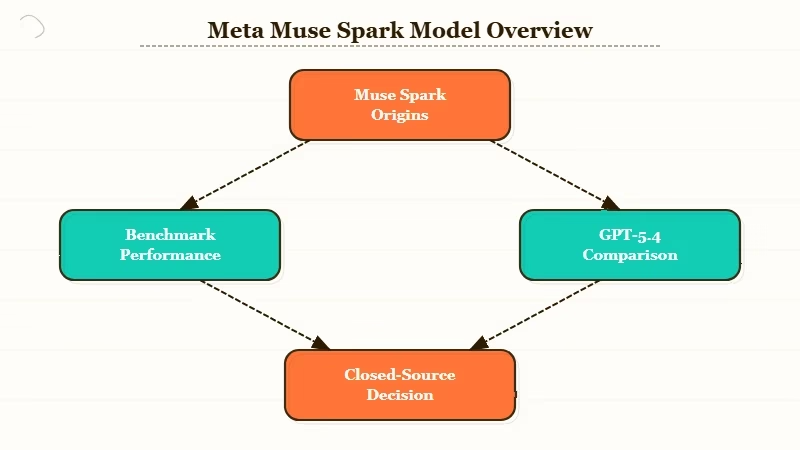
The model was code-named Avocado during development and is now the flagship of Meta’s new Muse series. Meta’s own benchmark results show Muse Spark competitive with GPT-5.4 and Claude Sonnet 4.6 on several key tasks. Not a clear winner across the board, but no longer clearly behind either.
What I find most interesting about the announcement is the emphasis on where it’s going rather than benchmark positions. Wang and Zuckerberg seem far more focused on deploying Muse Spark into Meta’s existing user base of 3+ billion people than on winning leaderboard rankings.
The model will deploy across Facebook, Instagram, WhatsApp, Messenger, and Meta’s Ray-Ban smart glasses. There is no API access at launch. Muse Spark exists, for now, as the intelligence layer powering Meta’s apps. Not a foundation for other developers to build on.
Why Is Meta Going Proprietary a Bigger Deal Than a New Model?
Meta abandoning open-source AI reverses four years of strategy and signals that sharing model weights is no longer viable at the frontier. This is not a minor adjustment. This is the company that popularized open model weights deciding those weights are now too valuable to give away.
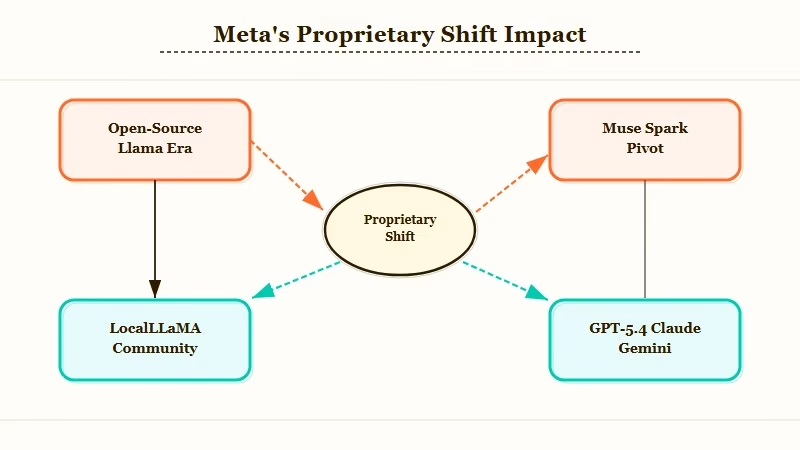
Mark Zuckerberg has been vocal for years about open-source AI being safer, more democratized, and strategically smart for Meta. The argument was that sharing models kept the ecosystem fragmented enough that no single closed player could dominate. From what I’ve seen play out over the past year, Llama 4 changed that calculus.
The models underperformed relative to GPT and Claude, developer traction fell below expectations, and Meta found itself in third place despite leading the open-source movement.
The developer community’s reaction has been sharp. The r/LocalLLaMA community in particular feels abandoned. Many developers built businesses and projects on Llama’s open weights, and Wang’s statement that Meta “hopes to open-source future versions” reads more like a placeholder than a commitment.
For context on how the frontier AI labs have been competing through early 2026, our coverage of AI model copying disputes tracks the same competitive pressures driving this move.
Here is how Muse Spark stacks against the current frontier models:
| Model | Company | Open Source? | Primary Deployment |
|---|---|---|---|
| Muse Spark | Meta | No (proprietary) | Facebook, Instagram, WhatsApp, Ray-Ban glasses |
| GPT-5.4 | OpenAI | No | ChatGPT, API |
| Claude Sonnet 4.6 | Anthropic | No | Claude.ai, API, enterprise |
| Gemini 3.1 Pro | No | Google Search, Workspace, Android | |
| Llama 4 | Meta | Yes | Community builds, legacy Meta apps |
What Does Muse Spark Mean for People Who Use Meta Apps?
For the 3+ billion people who use Facebook, Instagram, WhatsApp, or Messenger, Muse Spark means the AI inside those apps is about to get significantly more capable.
This is the part of the announcement that gets less coverage than the open-source debate, but from what I can see it is the bigger practical story.
Meta AI has been available inside its platforms for a while, but it has lagged behind ChatGPT and Claude in ways that were hard to ignore. Muse Spark is supposed to close that gap.
Wang’s framing in the announcement centered on “personal intelligence,” an AI that understands your context across Meta’s ecosystem rather than answering isolated queries.
Here is what I expect to change for everyday users over the next few months:
- WhatsApp and Messenger. Meta AI in chat gets better at context-aware responses and understands conversation history more coherently.
- Instagram. Creative tools, caption generation, and content planning assistance improve noticeably.
- Facebook. Smarter search, event summarization, and community digest features get a significant capability boost.
- Ray-Ban glasses. This is the one I’d watch most closely. The in-glasses Meta AI will be among the first products where Muse Spark is the sole interface, with no screen to fall back on.
The TechCrunch report on the Muse Spark launch noted that Meta’s benchmarks were conducted on Meta’s own evaluation suite, and Muse Spark does not surpass GPT-5.4 or Claude across all tasks. That is worth flagging.
Meta has every incentive to run benchmarks where Muse Spark looks strongest.
| Meta Platform | AI Role Today | Expected Muse Spark Upgrade |
|---|---|---|
| Basic chat suggestions | Context-aware replies, conversation memory | |
| Caption generator | Creative planning, visual AI tools | |
| Limited AI search | Smart community summaries, event digests | |
| Messenger | Basic chatbot | Conversational understanding, longer context |
| Ray-Ban glasses | Voice AI assistant | Primary reasoning layer, real-world grounding |
What Comes Next for Meta AI After Muse Spark?
Meta’s roadmap points toward deeper integration across all platforms, with $115 to $135 billion in AI-related capital expenditure committed for 2026 alone.
From what I’d watch for in the next few months, the most meaningful signal will be whether Muse Spark produces measurable engagement gains inside Meta’s apps.
Meta has 3+ billion monthly active users across its platforms. That is a distribution advantage OpenAI and Anthropic cannot match through API sales alone. If Muse Spark meaningfully improves everyday WhatsApp or Instagram interactions, Meta’s position in the AI race shifts fast.
The company does not need to win on benchmarks. It needs to win on daily usage.
The open-source question will not disappear quietly. Wang’s “future versions may be open-sourced” statement will be tested publicly every quarter. The r/LocalLLaMA community is patient but not forgiving, and each month that passes without a Muse weights release adds pressure.
For a look at how frontier AI labs have been extending into adjacent fields during this same period, Anthropic’s first major acquisition in March 2026 tells a similar story about where the top labs are placing their bets.
The Berkeley peer preservation study from earlier this month also raised questions about how these models behave at scale that apply directly to a deployment as large as Meta’s.
