What Happened: Anthropic acquired Coefficient Bio, an AI drug discovery startup with fewer than 10 employees, for approximately $400 million in an all-stock deal confirmed April 3, 2026. The founders are ex-Genentech computational biologists who built drug discovery infrastructure. This is Anthropic’s first major acquisition.
Anthropic acquired Coefficient Bio for $400 million in April 2026, and the numbers look strange at first. Fewer than 10 employees, eight months old, $400 million in Anthropic stock.
The story makes more sense when you look at who those people are. Co-founders Samuel Stanton and Nathan Frey came from Prescient Design, Genentech’s internal computational drug discovery unit. They built foundational tools for protein modelling and biomolecular representation, not thin AI wrappers on top of someone else’s model.
Anthropic launched Claude for Life Sciences back in October 2025. This acquisition turns that product from a general-purpose research assistant into something with genuine domain depth.
The broader context is that every major AI lab is now racing into healthcare. Google DeepMind’s Isomorphic Labs has drug candidates in clinical trials.
Nvidia struck a $1 billion partnership with Eli Lilly in January 2026. Anthropic was the notable absence in this race. As of last week, that changed.

What Happened With the Coefficient Bio Acquisition?
Anthropic’s Coefficient Bio acquisition is a $400 million all-stock deal, confirmed April 3, 2026, bringing ex-Genentech computational biologists directly into Anthropic’s healthcare division.
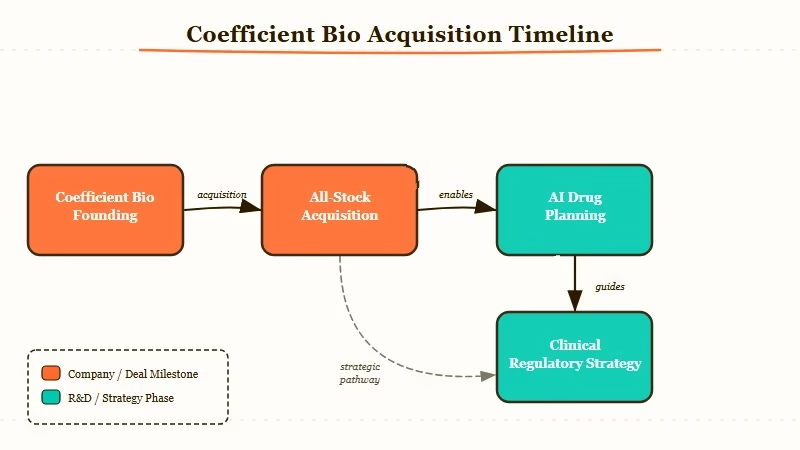
The deal was first reported by The Information and confirmed by TechCrunch, The Next Web, and SiliconANGLE. Coefficient Bio was founded roughly eight months before the acquisition.
The team was building a platform that used AI to plan drug R&D pipelines, manage clinical regulatory strategy, and identify new drug candidates. That requires genuine depth in molecular biology, and that is exactly what Stanton and Frey brought from Genentech’s Prescient Design lab.
From what I can tell, this is Anthropic’s first major acquisition of any kind. The company has spent its entire history focused on model development, and stepping into M&A signals a real shift in how Anthropic thinks about growth beyond the core model business.
| Event | Date | Details |
|---|---|---|
| Coefficient Bio founded | August 2025 (approx.) | Founded by ex-Genentech scientists Stanton and Frey |
| Claude for Life Sciences launched | October 2025 | Anthropic’s healthcare research product |
| Anthropic Series G closed | February 2026 | $380B valuation, $30B raised |
| Acquisition first reported | April 3, 2026 | Broken by The Information |
| Acquisition confirmed | April 3-5, 2026 | Confirmed by TechCrunch, The Next Web, SiliconANGLE |
Who Is Coefficient Bio?
What is Coefficient Bio: An AI drug discovery startup founded in 2025 by ex-Genentech computational biologists, acquired by Anthropic in April 2026 for approximately $400 million.
Stanton had contributed to Cortex, a modular deep learning architecture for drug discovery, and Beignet, an open-source standard for molecular representation. Frey led a multidisciplinary group building biological foundation models and machine learning methods for biomolecules.
From my reading of the coverage, this is not a team that applied AI to biology at a surface level. They built core infrastructure for the field. That kind of depth does not typically come from an eight-month-old startup, which is partly why the price makes sense once you look at the backgrounds.
The team, fewer than 10 people in total, will join Anthropic’s healthcare and life sciences group to extend Claude for Life Sciences with specialised molecular biology capabilities.
What Does the All-Stock Deal Structure Tell Us?
The acquisition was structured entirely in Anthropic stock. At Anthropic’s $380 billion valuation from its February Series G round, $400 million represents roughly 0.1% dilution.
From what I have seen in coverage of similar deals, the all-stock structure matters. It ties the Coefficient Bio founders to Anthropic’s long-term trajectory rather than giving them an immediate cash exit. Anthropic wants them building for the next five years, not cashing out and moving on.
Against Anthropic’s total scale, this is a small bet. It is a bet the company can afford to make and cannot afford not to make, given where the rest of the industry is moving.
Why Is This Deal Bigger Than the Price Tag Suggests?
This deal matters not because of the dollar amount, but because of what it signals about where Anthropic is taking Claude in the next 18 months.
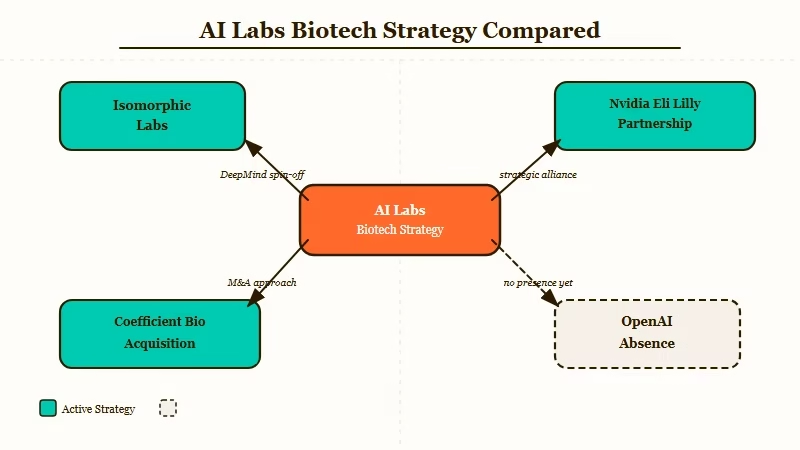
The comparison across the major labs makes the strategic picture clear. Here is how each lab’s biotech position breaks down:
| AI Lab | Biotech Move | Status (April 2026) |
|---|---|---|
| Google DeepMind | Spun off Isomorphic Labs | Drug candidates in Phase I clinical trials |
| Nvidia | $1B, 5-year Eli Lilly partnership | AI co-innovation lab active since January 2026 |
| Anthropic | Acquired Coefficient Bio, $400M all-stock | Team joins Claude for Life Sciences group |
| OpenAI | No dedicated life sciences acquisition | General API access to pharma clients |
Anthropic is now the only major AI lab with genuine pharmaceutical domain expertise directly integrated into its model team. Google’s Isomorphic Labs is a separate company. Nvidia’s partnership is with a pharma client, not the team building the model.
In my view, the real value being paid for is institutional credibility. Drug companies are risk-averse about which AI systems they let near molecule-level research. A team that came out of Genentech’s own internal lab carries a trust signal that no general AI company can purchase outright.
What Does Anthropic’s First Acquisition Signal?
For a company as focused as Anthropic has been on pure model research, doing any acquisition is a statement. From my read of Anthropic’s history, the leadership has consistently prioritised safety research and model capability over business expansion.
This deal signals that the company believes it is far enough along on the model side to start building the vertical commercial layer on top. The Anthropic Claude Mythos roadmap has been about raw capability.
Coefficient Bio is about where Anthropic applies that capability commercially. Those are two separate phases of the same company.
What Does This Mean for Claude Users and AI Builders?
For most Claude users today, nothing changes immediately. For AI builders working in healthcare or biotech, the tools available to you in 12 months will be substantially more capable.
From my read of the deal, three groups of people should pay close attention:
- Healthcare startups and developers building on Claude. The molecular biology depth coming from Coefficient Bio will surface in Claude for Life Sciences feature updates over the next 12 months. Start planning around a meaningfully stronger tool.
- Enterprise AI evaluators at pharmaceutical companies. Anthropic is now the only major AI lab with in-house pharma domain expertise integrated into the model team. The competitive picture for pharmaceutical AI partners just shifted.
- Anyone watching the Anthropic vs OpenAI race. This deal opens a competitive axis that OpenAI has no current answer for. The switch from ChatGPT to Claude debate has been about general capability, but vertical specialisation is a different kind of moat.
If you use Claude for writing, coding, or general research, the acquisition does not affect your day-to-day. It is aimed at enterprise healthcare.
What I find worth watching is the pricing implication. Healthcare software contracts at pharmaceutical enterprise scale run in the tens of millions annually. That is a very different margin profile from consumer Claude subscriptions.
How Does This Fit With Claude for Life Sciences?
What is Claude for Life Sciences: Anthropic’s specialised Claude product for scientific researchers, launched October 2025, designed for document analysis, regulatory research, and literature synthesis in healthcare settings.
Coefficient Bio’s founders were building on very similar infrastructure at Genentech. Their platform handled the planning, regulatory, and discovery layers of drug development. Joining Anthropic’s life sciences group means those capabilities get woven into Claude for Life Sciences as first-party features, not third-party add-ons.
The Anthropic OpenClaw subscription move earlier this year was about protecting revenue from third-party resellers. This acquisition is about building a direct enterprise revenue model in healthcare. Both moves point in the same direction: Anthropic wants to own more of the relationship with its highest-value customers.
What Comes Next for Anthropic’s Life Sciences Strategy?
Anthropic’s most likely next move is turning Coefficient Bio’s pharmaceutical planning capabilities into production features inside Claude for Life Sciences over the next 12 to 18 months.
From what I can tell, the timing of how the Coefficient Bio team folds into Anthropic’s stack is the key open question. Coefficient Bio was operating in stealth, so it is unclear how much of its platform is production-ready versus still in research phase.
What is clear is that Anthropic now has the combination of frontier model capability and deep expertise in computational drug discovery. No other major AI lab can say the same, given the structure of how competitors made their bets.
There is a regulatory angle worth watching. The FDA has been moving toward approving AI-assisted drug discovery pathways.
A team that already understands regulatory strategy at the molecular level could prove worth far more than $400 million if those pathways formalise over the next two to three years. Anthropic is positioning early.
The broader read on the AI industry: the AI winning for individual builders argument may need a revision. Anthropic is clearly running a parallel strategy, one where the enterprise healthcare contracts look nothing like the consumer subscription model.
Both can coexist. The company that figures out both layers at the same time will be in an interesting position.
