
The Verdict: Claude Opus 4.6 wins for coding and user satisfaction (Chatbot Arena ELO 1503, #1 overall). GPT-5.4 wins for general-purpose tasks and computer-use automation (75% OSWorld). Grok 4.20 wins on price and context length for high-volume workloads. There is no single winner. There is only the wrong model for your specific task.
Three frontier models are competing for the same builder audience in 2026. GPT-5.4 shipped with native computer-use that beats human performance. Claude Opus 4.6 held onto the top Chatbot Arena position. Grok 4.20 came in cheaper than both with a 2-million-token context window.
I went through the benchmark data, the pricing, and the real workflow differences between all three. The short version is that each model has a legitimate claim to being the best, in a specific situation. The longer version is below.
How Do Grok 4.20, GPT-5.4, and Claude Opus 4.6 Perform on Key Benchmarks?
Grok 4.20, GPT-5.4, and Claude Opus 4.6 each lead different benchmark categories, with no model dominating across all dimensions in 2026 testing.
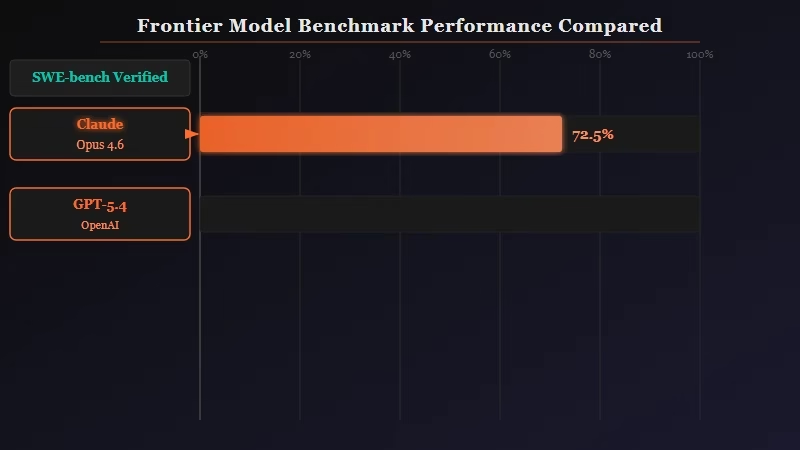
Here is the current benchmark picture across the most relevant dimensions:
| Benchmark | Grok 4.20 | GPT-5.4 | Claude Opus 4.6 | Winner |
|---|---|---|---|---|
| Intelligence Index (overall) | 48 | 57.17 | ~55 | GPT-5.4 |
| SWE-bench Verified (coding) | Not reported | 77.2% | 80.8% | Claude Opus 4.6 |
| SWE-bench Pro (hard coding) | Not reported | 57.7% | ~45% | GPT-5.4 |
| OSWorld (computer use) | Not direct | 75% | 72.7% | GPT-5.4 |
| Chatbot Arena ELO | Not reported | 1463 | 1503 (#1) | Claude Opus 4.6 |
| Context window | 2M tokens | ~1M tokens | 200K (1M beta) | Grok 4.20 |
| Output speed | ~828 tokens/sec | Configurable | Adaptive | Grok 4.20 |
The two numbers worth sitting with are GPT-5.4’s 57.17 Intelligence Index and Claude Opus 4.6’s ELO 1503. GPT-5.4 leads on general reasoning benchmarks. Claude Opus 4.6 leads on the human preference metric where real users rate model outputs. Those are different claims.
For context on what GPT-5.4’s computer-use score actually means in practice, my GPT-5.4 release overview covers the benchmark methodology and what 75% OSWorld translates to in real automation tasks.
How Do the Prices Stack Up?
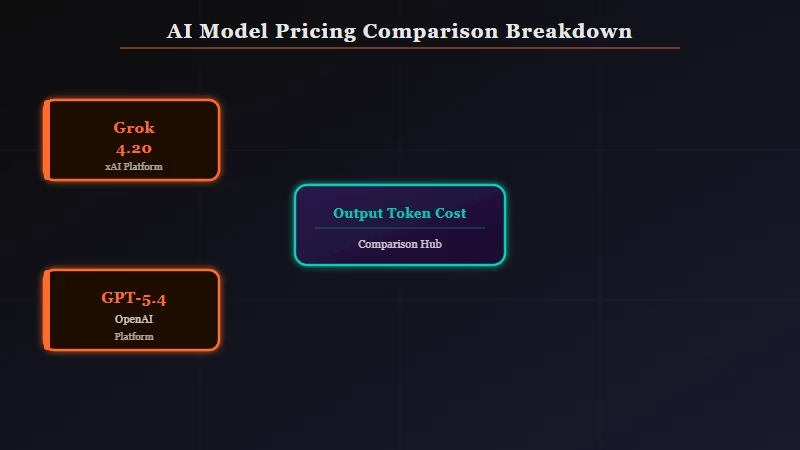
GPT-5.4 costs $2.50/$15 per million tokens, Grok 4.20 costs $2/$6, and Claude Opus 4.6 costs $5/$25, making Claude 2-4x more expensive per token than the alternatives.
| Model | Input (per 1M tokens) | Output (per 1M tokens) | Context | Subscription option |
|---|---|---|---|---|
| Grok 4.20 | $2 | $6 | 2M tokens | $30/month plan |
| GPT-5.4 | $2.50 | $15 | ~1M tokens | ChatGPT Plus / API |
| Claude Opus 4.6 | $5 | $25 | 200K (1M beta) | $100/month Max plan |
The pricing gap between Claude Opus 4.6 and the other two is real. For long output tasks, Claude is up to 4x more expensive per token than GPT-5.4 and more than 4x Grok 4.20 on output. For agentic pipelines running thousands of calls per day, that gap compounds into a meaningful cost difference.
Grok 4.20’s $2/$6 pricing combined with its 2-million-token context makes it the clear choice for cost-sensitive workloads processing large documents. From what I’ve seen in workflow testing, the cost difference matters most at volume, not for occasional use.
What Does Each Model Handle Best in Real Workflows?
GPT-5.4 leads for automation and GUI tasks, Claude Opus 4.6 leads for complex coding and agent orchestration, and Grok 4.20 leads for high-volume context-heavy workloads on a budget.
Here is a concrete comparison scenario: you need to build an AI agent that reads a 200-page PDF, searches the web for current data, and writes a structured report.
With GPT-5.4:
- Loads the PDF within the 1M token context window
- Uses native computer-use to navigate web sources directly
- Returns structured output with 33% fewer factual errors than GPT-5.2
- Best option if the workflow involves real browser or desktop interaction
With Claude Opus 4.6:
- Loads the PDF with extended thinking mode for deeper reasoning passes
- Handles multi-step agent orchestration via Agent Teams feature
- Tops Chatbot Arena for output quality, which matters if the report goes to humans
- Best option if the task is coding-adjacent or the output quality bar is highest
With Grok 4.20:
- Loads the full 200-page PDF with room to spare in its 2M token context
- Returns output faster than the other two
- Costs roughly half per million tokens on input
- Best option if you’re processing this workflow at scale and cost matters more than output polish
For pipelines that chain multiple model calls, the Dynamiq agent builder handles all three model APIs in the same workflow graph, which is worth knowing if you’re testing them comparatively.
Who Should Choose Grok 4.20?
Grok 4.20 is the right pick for developers and teams prioritizing throughput, context length, and cost efficiency over benchmark-leading accuracy.
Choose Grok 4.20 if:
- You are processing large documents or long codebases that exceed 200K tokens
- You are running high-volume API calls where cost per token compounds quickly
- Your use case needs the fastest output speed among the three
- You are price-testing before committing budget to a more expensive model
Skip Grok 4.20 if:
- You need the highest accuracy on complex reasoning or coding tasks
- Human-facing output quality is the primary measure
- Your tasks involve desktop or browser automation (GPT-5.4’s native computer-use is better suited)
Who Should Choose GPT-5.4?
GPT-5.4 is the right pick for automation workflows, computer-use tasks, and general-purpose development where versatility matters more than top-tier coding accuracy.
Choose GPT-5.4 if:
- Your workflow includes GUI-based automation or desktop task execution
- You want the best general-purpose Intelligence Index score across benchmarks
- You need a balance of capability and cost (middle tier between Grok and Claude)
- You are building for a wide range of task types within a single pipeline
Skip GPT-5.4 if:
- Your work is primarily complex software engineering at the SWE-bench Verified level (Claude leads here)
- You are processing massive documents that exceed 1M tokens (Grok’s 2M context handles this better)
Who Should Choose Claude Opus 4.6?
Claude Opus 4.6 is the right pick for production coding, multi-step agent orchestration, and applications where human-rated output quality is the primary success metric.
Choose Claude Opus 4.6 if:
- You are building or debugging complex, multi-file software projects
- Your agents need orchestration across multiple tools and contexts
- Output quality matters enough to justify the 2-4x premium over competitors
- Your users rate responses directly (Chatbot Arena ELO #1 reflects this)
Skip Claude Opus 4.6 if:
- Budget is constrained and you are running at volume
- Your primary task involves desktop or browser automation (GPT-5.4’s native computer-use is purpose-built for this)
- You need a context window beyond 200K tokens (the 1M beta is available but not yet generally released)
The practical tradeoff is this: Claude Opus 4.6 is the best model when the quality bar is absolute. GPT-5.4 is the best model when task variety is wide.
For the evolving picture of what capable agents can actually do in production, why AI agents fail in production covers the failure modes all three models share regardless of benchmark position.
Final Verdict: Grok 4.20 vs GPT-5.4 vs Claude Opus 4.6
The best model in 2026 is the one matched to your specific task: Claude Opus 4.6 for coding quality, GPT-5.4 for automation and breadth, Grok 4.20 for cost and context at scale.
| Criterion | Grok 4.20 | GPT-5.4 | Claude Opus 4.6 |
|---|---|---|---|
| General reasoning | 48 (Intelligence Index) | 57.17 | ~55 |
| Coding accuracy | Not reported | 77.2% SWE-b | 80.8% SWE-b |
| Computer-use | No native support | 75% OSWorld | 72.7% OSWorld |
| Human preference | Not reported | ELO 1463 | ELO 1503 (#1) |
| Context window | 2M tokens | ~1M tokens | 200K (1M beta) |
| Output cost | $6/M tokens | $15/M tokens | $25/M tokens |
| Best for | Volume + context | Automation + breadth | Coding + quality |
From what I’ve seen across these benchmarks, the gap between GPT-5.4 and Claude Opus 4.6 on most dimensions is narrow enough that workflow fit matters more than benchmark position. The outlier is price.
Claude Opus 4.6 costs significantly more per token, and that is only justified when the task genuinely requires it. For most agentic workflows connecting to APIs and automating browser tasks, GPT-5.4 is where I’d start.
For anything where code quality and human satisfaction are the output metrics, Claude Opus 4.6 earns the premium. For cost-sensitive volume work, Grok 4.20 is the underrated option in this comparison.
Frequently Asked Questions
Which is better overall, GPT-5.4, Claude Opus 4.6, or Grok 4.20?
There is no single winner. Claude Opus 4.6 leads on Chatbot Arena (ELO 1503) and coding benchmarks. GPT-5.4 leads on general intelligence scores and computer-use automation. Grok 4.20 leads on price and context length. The best pick depends on your specific task type.
Is Claude Opus 4.6 worth the higher price compared to GPT-5.4?
Claude Opus 4.6 is worth the 2-4x premium per token for production coding, complex agent tasks, and human-facing outputs where quality is the primary measure. For automation, general tasks, or high-volume pipelines, GPT-5.4 or Grok 4.20 deliver competitive performance at lower cost.
Does Grok 4.20 have a hallucination problem compared to GPT-5.4?
No dedicated hallucination benchmarks exist for Grok 4.20 in current testing. GPT-5.4 published a 33% reduction in false individual claims versus GPT-5.2. Claude Opus 4.6’s Chatbot Arena ELO #1 position suggests strong user satisfaction with output accuracy. Grok 4.20 has no comparable published accuracy claim.
Can Grok 4.20 handle longer documents than GPT-5.4?
Grok 4.20 supports a 2-million-token context window, roughly double GPT-5.4’s approximately 1-million-token window. For tasks involving very large codebases, full research archives, or extremely long documents, Grok 4.20 has a clear structural advantage.
Which model should developers use for building AI agents?
GPT-5.4 is strongest for agents involving desktop or browser automation via native computer-use. Claude Opus 4.6 leads for code-heavy agent orchestration and multi-tool pipelines. Grok 4.20 suits high-volume agents where cost per call matters. Most production setups benefit from testing all three on a representative task sample before committing.
