
What Happened: OpenAI released GPT-5.4 on March 29, 2026 with native computer-use capabilities that scored 75% on the OSWorld-Verified benchmark, beating the human average of 72%. The model doubles the context window to 1 million tokens and cuts hallucination rates by 33% vs GPT-5.2. This is the first general-purpose model where operating a computer is a core trained skill.
OpenAI released GPT-5.4 on March 29, 2026, and there is one number worth reading twice: 75%. That is GPT-5.4’s score on OSWorld-Verified, the standard benchmark for navigating real desktop environments through screenshots and keyboard commands.
Humans score 72% on the same test.
The gap just flipped.
This is not a minor model update. From what I’ve seen in the early API docs, computer use is native to GPT-5.4 in the same way text generation is. It was trained to operate software the way you’d train it to write code, not bolted on afterward.
The hallucination reduction is the second headline: 33% fewer false individual claims compared to GPT-5.2. For anyone who has caught GPT confidently stating a wrong date or a fabricated citation, that is a meaningful change.
The model is getting more reliable at the same time it is getting more capable.

What Did OpenAI Release in GPT-5.4?
GPT-5.4 is OpenAI’s first model with native computer-use capabilities, a 1-million-token context window, and an extreme reasoning mode designed for complex multi-step tasks.
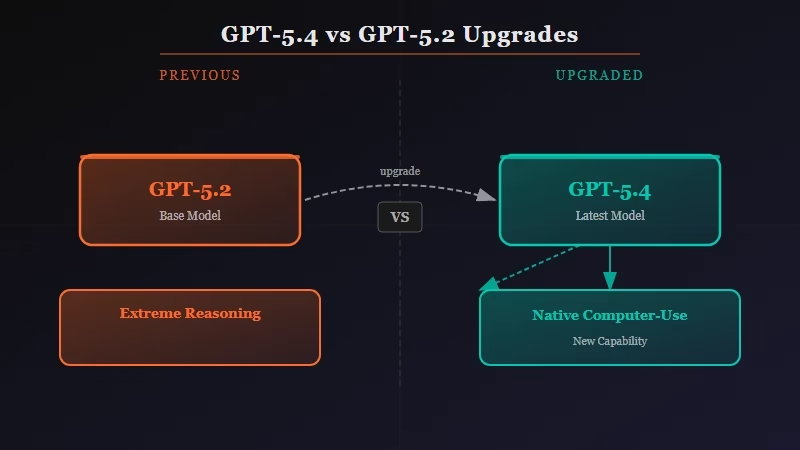
GPT-5.4 ships with six measurable changes from GPT-5.2:
- Native computer-use, trained into the model (75% OSWorld score, vs 47% in GPT-5.2)
- Context window doubled to 1 million tokens
- False individual claims reduced by 33%
- Full-response error rate reduced by 18%
- Tool search overhead cut 47% for multi-tool agent pipelines
- Extreme reasoning mode added for complex tasks
Here is how those changes look side by side:
| Feature | GPT-5.2 | GPT-5.4 |
|---|---|---|
| Computer-use benchmark (OSWorld-Verified) | 47% | 75% (human avg: 72%) |
| Context window | 500K tokens | 1 million tokens |
| False individual claims | Baseline | 33% lower |
| Full-response error rate | Baseline | 18% lower |
| Tool search efficiency (multi-agent) | Standard | 47% fewer tokens |
| Reasoning mode | Standard | Extreme reasoning mode added |
The 1-million-token context window is the change that affects the most existing workflows immediately. You can now load an entire codebase, a full research archive, or thousands of pages of documentation into a single context. No chunking, no retrieval gymnastics, no context-loss workarounds.
The tool search feature is designed for agents running across large tool ecosystems. It reduces the token overhead when the model identifies which tool to call. The 47% token reduction compounds meaningfully across a long agentic session.
Why Does GPT-5.4’s Computer Use Matter So Much?
GPT-5.4’s computer use matters because it transforms the model from a text generator into a software operator, which changes the ceiling of what AI automation can reliably handle.
Before this, getting a model to navigate a desktop app reliably meant stitching together screenshot analysis, HTML parsing, and click commands across multiple tools, with frequent retries on anything that changed on screen. The workflow was brittle. GPT-5.2’s computer-use attempts involved enough retry loops to make them impractical for anything production-critical.
GPT-5.4 processes the screen, decides what to do, and acts. The OSWorld-Verified benchmark tests this on real software environments, not sandboxed demos. A 75% first-try success rate on desktop navigation is the kind of number that moves automation from “interesting experiment” to “deploy it.”
For context on where this sits competitively: Artificial Analysis tracks model benchmark data across providers. GPT-5.4’s OSWorld score is a significant jump past the previous frontier.
The prior state of the art for computer-use capable models sat around 60 to 65%. Crossing 72% means surpassing the human baseline, which is a different category of claim.
What Does GPT-5.4 Mean for People Building With AI in 2026?
GPT-5.4 means AI agents can now reliably automate desktop workflows that previously required human oversight at the GUI layer.
Here is a quick map of which feature actually helps with which use case:
| GPT-5.4 feature | What it unlocks |
|---|---|
| Native computer-use (75% OSWorld) | Automate GUI-based tasks with no API needed |
| 1M-token context | Load full codebases or document archives in one session |
| 33% fewer hallucinations | More reliable research and fact-checking |
| Tool search (47% token savings) | Cheaper, faster multi-agent pipelines |
| Extreme reasoning mode | Better accuracy on complex multi-step logic |
The most immediate impact is for anyone building automation pipelines. Agents that previously needed a human in the loop for any interface-based task can now be automated end to end.
If you’ve been reading about AI agents failing in production, the GUI bottleneck was one of the main culprits. GPT-5.4 removes it.
For everyday ChatGPT users, the hallucination reduction is the more visible near-term improvement. A 33% drop in false individual claims matters most in research, fact-checking, and any use case where the model confidently stating a wrong thing causes a real problem. This is what I’d call a quiet upgrade: you won’t notice it loudly, but you’ll notice fewer corrections needed.
The extreme reasoning mode is worth enabling for anything multi-step and logic-heavy. It uses more compute and runs slower, but from what OpenAI has published, the accuracy improvement on complex tasks is real. The tradeoff is the same as thinking carefully before answering versus guessing quickly.
For those building at the agent level, the building your first AI agent guide is still the right foundation. The tools have changed; the underlying architecture decisions haven’t.
What Comes Next After GPT-5.4?
GPT-5.4 resets the competitive baseline for agentic AI, and counter-releases from Anthropic and Google are likely within 30 to 60 days.
When OpenAI beats human performance on a benchmark this visible, every competitor reads the same headline and checks their roadmap. Anthropic has been developing computer-use in Claude since late 2024.
Google’s Gemini 3.1 series showed strong multimodal reasoning earlier this quarter. Neither company is far from a direct response.
The more interesting question is what happens at the application layer. Most AI workflows today route through APIs, not GUIs.
As computer-use becomes reliable, a new category of automations opens: anything that only exists in a browser or desktop app and has no API. That is a large category.
The context window race is worth watching critically. 1 million tokens is the spec; how much of that the model coherently reasons over in practice is a separate question.
I’d test the practical limits in your specific use case before redesigning a workflow around the full window. For a closer look at agentic AI for solo operators, that piece covers the structural shift behind releases like this one.
