The Verdict: Murf AI is the best ElevenLabs alternative for production voiceover inside Canva or Google Slides. Voxtral TTS is the best for developers running high-volume API calls who need to cut costs roughly in half. ElevenLabs still leads on voice quality, language coverage, and no-code accessibility for everyone else.
The ElevenLabs alternatives landscape shifted hard in the last 90 days. PlayHT, which appears on half the “ElevenLabs alternatives” lists you’ll find online, was acquired by Meta in July 2025 and shut its API down on December 31, 2025. If you’re running integrations that depend on PlayHT endpoints, those calls are failing silently right now.
Then on March 26, 2026, Mistral AI released Voxtral TTS, an open-weight 4B parameter model that clones voices from three seconds of audio and prices its commercial API at $0.016 per 1,000 characters. ElevenLabs charges roughly $0.030 per 1,000 characters at the equivalent tier. Mistral ran human evaluations and found Voxtral preferred over ElevenLabs Flash v2.5 by 62.8 percent of listeners.
So the alternatives conversation is different now. PlayHT is gone. A credible new open-source option exists at roughly half the API price. And the case for staying with ElevenLabs got sharper at the same time, because the alternatives just thinned out significantly.
This is what the current landscape looks like after those two events.
What Are the Best ElevenLabs Alternatives in 2026
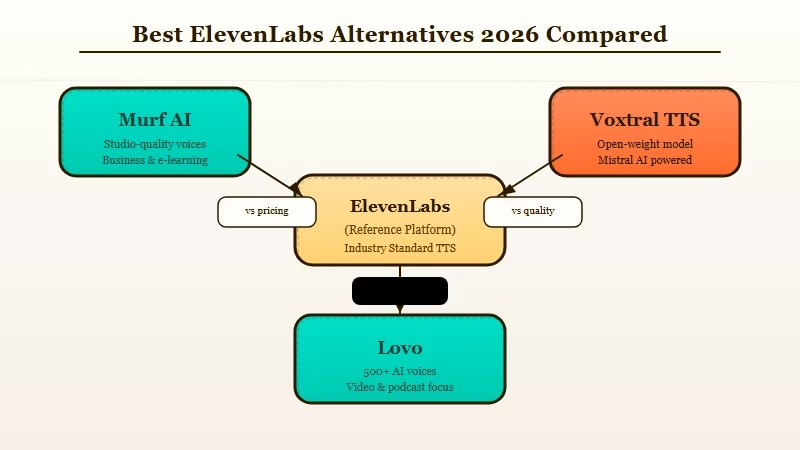
The best ElevenLabs alternatives right now are Murf AI for production voiceover workflows, Voxtral TTS for developers and API cost reduction, and Lovo for users who want studio-grade controls inside a visual interface.
Here is how the main options compare across the metrics that matter:
| Tool | Entry price | API cost per 1K chars | Voice cloning | Languages | Status |
|---|---|---|---|---|---|
| ElevenLabs | $5/mo | ~$0.030 | From 30 sec (paid) | 32 | Active |
| Murf AI | $19/mo | Not public | Studio upload | 20+ | Active |
| Voxtral TTS | Free (open weights) / $0.016 API | $0.016 | From 3 sec | 9 | Active (Mar 2026) |
| Lovo (Kits.ai) | $24/mo | Not public | Yes | 100+ | Active |
| PlayHT | N/A | N/A | N/A | N/A | Shut down Dec 31, 2025 |
ElevenLabs’ free tier delivers 10,000 credits per month, roughly 20 minutes of generated audio. Paid plans run $5/mo (Starter), $22/mo (Creator), $99/mo (Pro), and $330/mo (Scale).
The platform covers 32 languages and a 120,000-voice community library. Voice cloning requires 30 seconds of reference audio from the Creator plan up.
Murf AI is the most polished studio alternative. Its free tier caps at 10 minutes of lifetime audio with no downloads, which is genuinely limited. Creator Lite runs $19/mo, Business Lite at $66/mo.
What earns Murf its place is an integration stack that includes native plugins for Canva, PowerPoint, Google Slides, and Adobe Audition. If your output lives in those tools, that integration layer matters.
Voxtral TTS is the significant new entrant. The open weights are available on Hugging Face under CC BY-NC 4.0 for non-commercial use. The commercial API is $0.016 per 1,000 characters. Voice cloning works from just three seconds of reference audio. Nine languages are supported at launch.
What is Voxtral TTS: Mistral AI’s open-weight text-to-speech model, released March 26, 2026. A 4B parameter hybrid architecture combining auto-regressive semantic generation with flow-matching for acoustic detail. Available as open weights for non-commercial use and a commercial API priced at $0.016 per 1,000 characters.
For a deeper look at ElevenLabs as a standalone product before comparing alternatives, the ElevenLabs review covers its pricing tiers, voice cloning quality, and API limits in full.
Which ElevenLabs Alternative Has the Best Pricing
For API pricing, Voxtral TTS is the cheapest credible option at $0.016 per 1,000 characters, roughly 47 percent cheaper than ElevenLabs. For subscription pricing, ElevenLabs’ $5/mo Starter plan beats every alternative at the entry level.
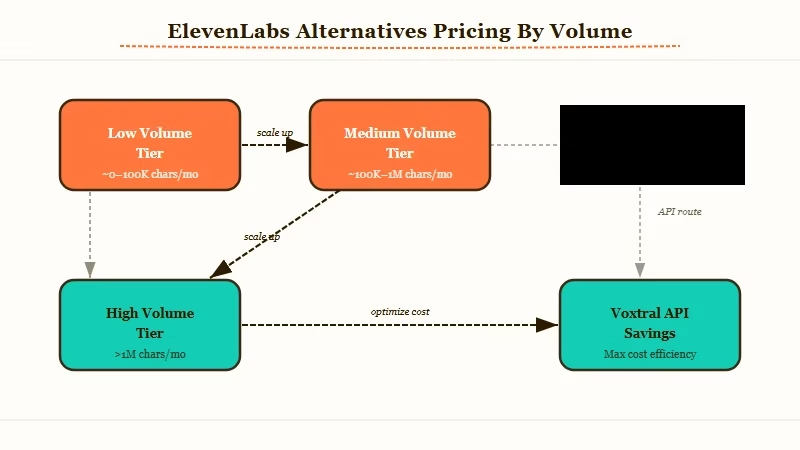
The pricing decision depends entirely on volume. Here is how the math breaks down across three usage tiers:
- Low volume (under 100,000 characters/month, roughly 70-80 minutes of audio): ElevenLabs’ free tier or $5/mo Starter plan wins. No credible alternative matches this entry price. Murf’s $19/mo minimum is nearly four times the cost for similar or lesser voice output.
- Medium volume (100K to 1M characters/month): Voxtral’s API starts to matter. At 500,000 characters per month, Voxtral costs $8 versus roughly $15 on ElevenLabs. That spread widens as volume climbs.
- High volume (above 1M characters/month): The API rate difference compounds significantly. Five million characters per month costs $80 on Voxtral versus $150 on ElevenLabs. At that scale, the half-price difference justifies integration work for most technical teams.
The scenario that covers most creators:
Podcast producer generating two 15-minute episodes per week (roughly 60,000 characters/month):
- ElevenLabs Starter ($5/mo): 30,000 characters included, needs overage or upgrade. Creator at $22/mo covers 100K/month cleanly.
- Murf Creator Lite ($19/mo): similar character allowance but narrower voice library and no cloning at this tier.
- Voxtral API: $0.016 x 60,000 characters = $0.96/month in API costs, but requires technical setup and produces zero UI for browsing voices.
The break-even point where Voxtral’s API savings outweigh ElevenLabs’ convenience is roughly 200,000 characters per month for a developer who can handle the integration. Below that, ElevenLabs’ subscription pricing is simply cheaper per character.
When Should I Use Murf Instead of ElevenLabs
Use Murf instead of ElevenLabs when your voiceover workflow lives inside Canva, Google Slides, PowerPoint, or Adobe Audition, because the native plugin integration eliminates the export-reimport cycle that otherwise eats time on every project.
ElevenLabs produces better voice output. That is not a close call. But voice quality is not always the primary constraint.
The use cases where Murf wins on workflow efficiency:
- Explainer videos built in Canva: Murf’s Canva plugin keeps audio generation and video editing in one interface. With ElevenLabs, you generate audio separately, download it, then import it manually.
- Presentation narration in Google Slides or PowerPoint: Same argument. Murf’s native integration means no file management between tools.
- Post-production in Adobe Audition: Murf’s plugin feeds audio directly into Audition’s timeline without a download step.
The use cases where I’d stay with ElevenLabs over Murf:
- Voice cloning from short samples. ElevenLabs’ 30-second cloning is faster and more accessible than Murf’s studio upload workflow.
- Language range matters. ElevenLabs covers 32 languages; Murf covers 20-plus. For multilingual content, that gap is real.
- Voice library breadth. ElevenLabs’ 120,000-voice community library means you can find a voice that fits almost any project tone. Murf’s library is smaller and more curated.
From what I’ve seen of users who switch between these two platforms, the ones who stay switched to Murf are almost always working inside Canva or Slides.
The ones who switch back miss the cloning speed and the voice variety.
For teams building video-first content where audio is one component among many, the HeyGen vs Kling AI breakdown covers how AI video tools handle their own voice-over stacks, which affects whether you need a standalone TTS tool at all.
Is Voxtral TTS a Real ElevenLabs Alternative
Voxtral TTS is a real ElevenLabs alternative for API-driven, developer-facing use cases at scale, but it is not a consumer product yet: no browser interface, 9 languages versus 32, and a starting library of 20 preset voices versus ElevenLabs’ 120,000.
Voxtral launched March 26, 2026 and the 62.8 percent listener preference claim against ElevenLabs Flash v2.5 is what generated the most attention.
From my read of the evaluation methodology, those results hold for flagship voice and voice customization tasks specifically. How that generalises across a 120,000-voice library comparison is a different test.
What Voxtral does well right now:
- API cost at $0.016 per 1,000 characters is roughly half ElevenLabs’ rate and the lowest credible production TTS pricing available
- Voice cloning from three seconds of audio is faster than any major alternative’s cloning threshold
- Open weights under CC BY-NC 4.0 mean self-hosted, zero-API-cost usage for non-commercial applications
- Nine language support covers the majority of high-volume commercial use cases
What Voxtral does not yet offer:
- No consumer-facing interface. This is an API product. If you are not writing code or using a platform that has already integrated Voxtral, it is not accessible to you.
- The preset voice library ships with 20 voices. ElevenLabs has over 120,000 community voices to browse and select from.
- Nine languages is meaningfully narrower than ElevenLabs’ 32. If your workflow includes Arabic, Japanese, Korean, or other languages outside Voxtral’s current nine, ElevenLabs is the only option here.
The way I see it, Voxtral is the right choice for technical teams who need TTS at scale and want to cut their API bill. It is not yet a replacement for non-technical users who need a polished interface and broad voice selection.
Who Should Stick With ElevenLabs
Stick with ElevenLabs if you need the widest language coverage, the largest voice library, a polished no-code interface, or voice cloning without technical integration work.
The case for staying with ElevenLabs:
- 32 languages versus Voxtral’s 9 and Murf’s 20-plus. If your project needs languages outside a short list, ElevenLabs is the only full-featured option.
- The $5/mo Starter tier is the cheapest entry point in this category. No credible ElevenLabs alternative gets you a working paid product for five dollars a month.
- No-code browser interface at every feature level. Voxtral is API-only. ElevenLabs’ interface works for non-technical users immediately.
- 120,000-voice library means you can match voice type, accent, and tone to almost any content without custom cloning.
- 14 product suite including dubbing, audiobook generation, speech-to-speech, and a voice design tool. No alternative ships this breadth.
Who Should Switch to an ElevenLabs Alternative
Switch from ElevenLabs if you’re a developer processing more than 200,000 characters per month and cost is the primary variable, or if your workflow runs entirely inside Canva or Google Slides where Murf’s native integrations eliminate file management overhead.
The clearest switching cases:
- High-volume API work: At 1M characters per month, Voxtral cuts your TTS spend from roughly $30 to $16. The engineering cost to integrate Voxtral pays back within two to three months at that volume.
- Canva or Slides production workflows: Murf’s plugin integrations are a concrete time-saver. If you produce five or more narrated presentations per week, the elimination of the export-reimport cycle adds up.
- Open-source compliance requirement: Companies that require open-weight models for data residency or audit reasons now have Voxtral as the first quality option in this category after PlayHT’s shutdown.
- Cost-first, nine-language scope: If your languages are fully covered by Voxtral’s current nine and your volume is above the break-even threshold, the API savings are difficult to ignore.
The users who should stay: anyone needing languages outside Voxtral’s nine, anyone who wants to browse 120,000 community voices, anyone building a consumer-facing product who needs a no-code tool, and anyone at low volume where ElevenLabs’ $5/mo entry beats API pricing.
Frequently Asked Questions
The most common questions about ElevenLabs alternatives in 2026 cover the PlayHT shutdown, Voxtral’s quality claims, and where Murf actually wins.
What happened to PlayHT in 2025?
PlayHT was acquired by Meta Platforms in July 2025. The PlayHT API was officially shut down on December 31, 2025. Existing integrations pointing to PlayHT endpoints receive no response. Murf AI and Voxtral TTS are the strongest direct API replacements. ElevenLabs remains the best full-featured alternative for teams that need a no-code interface.
Is Voxtral TTS better than ElevenLabs?
In Mistral’s own human evaluation, Voxtral was preferred over ElevenLabs Flash v2.5 by 62.8 percent of listeners on flagship voices and 69.9 percent on voice customization tasks. Independent third-party testing is limited given the March 2026 launch date. ElevenLabs has 32 languages and 120,000 voices versus Voxtral’s 9 languages and 20 preset voices, so “better” depends heavily on your use case.
Does ElevenLabs have a free tier?
Yes. ElevenLabs’ free tier includes 10,000 credits per month, equivalent to roughly 20 minutes of generated audio. Voice cloning requires the Starter plan at $5/mo or above. The free tier covers text-to-speech generation but not cloning or commercial use at scale.
Can Voxtral TTS clone voices?
Yes. Voxtral TTS clones voices from three seconds of reference audio, which is the fastest cloning threshold of any major TTS platform in 2026. ElevenLabs requires 30 seconds for voice cloning access on paid plans. Voxtral’s commercial API is priced at $0.016 per 1,000 characters. Open weights on Hugging Face are available for non-commercial use under CC BY-NC 4.0.
Is Murf AI worth it over ElevenLabs?
Murf is worth it if your workflow runs inside Canva, Google Slides, PowerPoint, or Adobe Audition. The native plugin integrations remove export-reimport friction on every project. On voice quality and language coverage, ElevenLabs is the stronger product. At $19/mo versus ElevenLabs’ $5/mo entry, Murf is not cheaper. The question is whether integration time savings outweigh the quality and price difference.
