
TL;DR: The best Character AI roleplay scenarios include a specific location, a defined relationship, one unresolved tension, and a clear emotional register before the first exchange. Vague openers die in 5 minutes. Use the Brainiac model for complex multi-character scenarios and Flash for quick comedic exchanges. If you want scenario structures built on demand, the roleplay generator does it in seconds.
I spent a weekend testing every category of Character AI roleplay I could think of: fantasy, sci-fi, romance, mystery, slice-of-life, villain arcs, found-family stories. Most died inside 10 minutes.
The ones that kept running for two hours had one thing in common. It wasn’t the genre, and it wasn’t the character design. It was the structure of the opening scenario.
Character AI draws over 194 million website visits per month according to Business of Apps’ 2026 data, and a significant share of those users hit the same wall: a promising setup that fizzles because the first message didn’t give the AI anywhere to go.
This guide fixes that with copy-paste scenario templates, a model picker breakdown, and a memory technique that keeps long stories coherent across sessions.
What Makes a Character AI Roleplay Scenario Work
A working Character AI roleplay scenario needs four elements: a specific physical location, a defined relationship between the characters, one unresolved tension, and a clear emotional register set in the opening message.
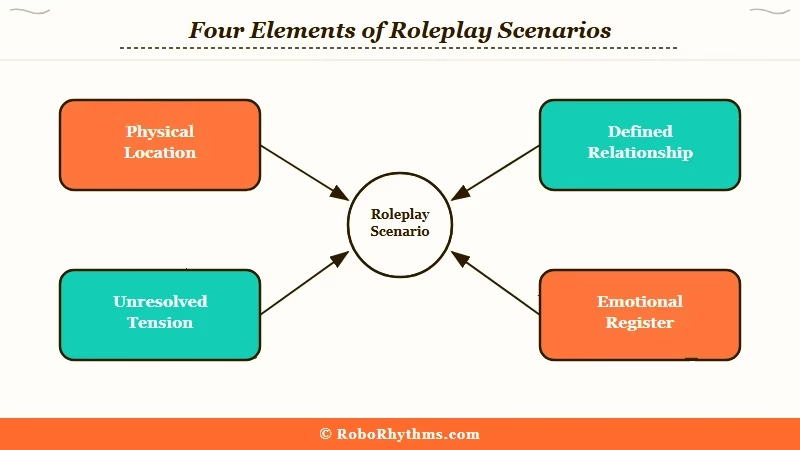
Without all four, the AI defaults to safe, generic responses. It has nothing to react to, no stakes to escalate, and no relationship dynamic to play off. The conversation becomes a series of neutral statements that run out of momentum fast.
Here is the difference in practice:
Vague (dies in 10 minutes):
“You’re a knight and I’m your partner. We’re going on a quest. Start the adventure.”
Specific (runs for 2 hours):
“You’re Sera, a knight two weeks from mandatory retirement who has kept me (your squire of six years) at a careful emotional distance, never admitting our work together meant anything. We’re camped at the base of Ashford Tower on our last mission. It’s raining. You’ve just handed me your sword to sharpen, which you’ve never done before. Start.”
The second version gives the AI a location (Ashford Tower, a rainy camp), a defined relationship (knight and squire, six years), an unresolved tension (the emotional distance, the significance of the sword), and an emotional register (melancholy, restrained intimacy). It has everything it needs to generate something meaningful.
What is the Model Picker: Character AI’s 2026 feature letting you switch between Prime (general use), Brainiac (complex reasoning), and Flash (fast, lighter responses) within the same conversation.
From my testing, Brainiac is the right choice for complex multi-character scenarios with layered backstory. Flash suits fast back-and-forth banter or comedic scenarios where speed matters more than depth. Prime is the default and handles most standard scenarios well.
What Are the Best Character AI Roleplay Scenarios to Try First
The best starting Character AI roleplay scenarios have built-in conflict that doesn’t resolve immediately, since the AI’s strongest output comes from navigating tension rather than describing peaceful situations.
Here are 5 copy-paste ready scenarios across different genres. Each includes all four required elements.
1. Rivals forced to cooperate (fantasy)
“You’re Kael, a mage who has publicly called my combat style reckless for years. We’ve just been locked inside the Vault of Seals by an enchantment neither of us can break alone. You know the counterspell but it requires physical contact to cast. It’s been four hours. You’ve stopped arguing. Start with whatever you say when the silence gets uncomfortable.”
2. Long-distance reunion (slice-of-life)
“You’re my best friend from childhood. We stopped speaking three years ago after I moved abroad, and neither of us ever said why. I’ve just shown up at your apartment door with no warning at 9pm. You’ve opened the door. Start with what you say when you see me.”
3. Undercover partners (mystery/thriller)
“You’re Detective Mira, my partner embedded as a server at the Calvert Hotel for six days. I’ve just sat down at your table posing as a guest. The suspect is at the bar 10 feet away. You can’t speak normally. Start with whatever a server would say that tells me the suspect hasn’t left yet.”
4. Ship’s doctor and returning crew member (sci-fi)
“You’re Dr. Voss, chief medical officer of the RSS Calisto. I’ve just returned from a solo mission that took 14 months, and you were told two months ago I didn’t make it. I’m sitting in your medbay. It’s 2am ship time. You haven’t called the captain yet. Start with whatever you say first.”
5. Mentor who knows the student is about to surpass them (fantasy)
“You’re Master Eiran, the swordmaster who has trained me for eight years. I just completed the trial you failed twice. You watched the whole thing. We’re alone in the training hall. Start with what you say after a long silence.”
Here is how I’d match each scenario to the right model and tone:
| Scenario | Best model | Tone | Expected run time |
|---|---|---|---|
| Rivals forced to cooperate | Brainiac | Tense, dry wit | 90+ minutes |
| Long-distance reunion | Prime | Emotional, measured | 45 to 60 minutes |
| Undercover partners | Brainiac | Clipped, coded | 30 to 60 minutes |
| Ship’s doctor reunion | Brainiac | Quiet grief, careful | 90+ minutes |
| Mentor and student | Prime | Restrained, proud | 45 minutes |
For genre-specific prompt ideas across other platforms, the best AI roleplay scenario generators breakdown covers 6 tools with copy-paste examples for each.
How Do I Keep a Character AI Roleplay Going Longer
Character AI roleplay loses momentum when the AI runs out of unresolved tension to work with, so the fix is to introduce new complications at the scene level rather than restarting the scenario from scratch.
The most common mistake is writing a scenario that resolves its central tension too early. Once the rivals cooperate, once the friends reconcile, once the squire gets the acknowledgment they’ve been waiting for, the AI has nowhere left to go.
Plan for two or three layers of tension from the start.
Here is a continuation technique that works consistently:
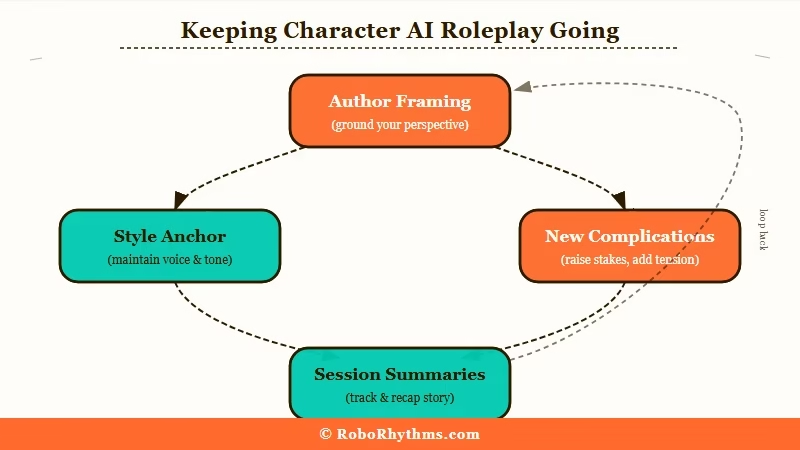
- When the conversation goes neutral, introduce a new piece of information: “A third person just knocked on the door.” “The message you’ve been waiting for just arrived.” “One of us just said something the other was never supposed to hear.”
- Use author framing to redirect. Instead of asking the character to do something (“have you apologize to me”), describe the scene from outside: “You notice my expression shift. You’ve seen that look before. Write what you do with it.”
- Save the AI’s first strong response from the session. If the character drifts and starts giving generic answers, paste that original response back: “Earlier you wrote [paste]. Stay in that voice.”
- At the end of a long session, write a 3 to 4 sentence summary of what happened and paste it at the start of the next session. Character AI has no memory across sessions, so this is the only way to maintain continuity.
The author framing technique in step 2 is worth its own explanation. Character AI told to be a character will write in first person and resist breaking the fourth wall.
Character AI told to “write what the character does” produces more narratively aware, flexible output and handles edge cases far better.
Framing yourself as co-author rather than the other character in a scene consistently gets stronger results.
When Should I Use a Different AI for Roleplay?
Consider a different platform when Character AI’s content filters interrupt the scenario, when you need persistent memory across sessions, or when the direction you want to take the story doesn’t fit its guidelines.
Character AI has strong filters by design. For most scenarios, that’s fine. The five templates above all work within those guidelines.
Where it breaks down is in romantic roleplay with more emotional intensity, villain scenarios with darker moral complexity, or any story direction that touches themes the platform flags proactively.
For those use cases, I’ve gotten consistently better results on platforms built for that kind of storytelling. Candy AI has the strongest memory system I’ve tested in this category: characters maintain emotional continuity across days without any manual pasting.
CrushOn AI handles darker character arcs and morally complex villain scenarios better than most alternatives, and it’s the platform I’d recommend for stories where Character AI keeps redirecting you.
| Need | Best option |
|---|---|
| Complex emotional story, within guidelines | Character AI (Brainiac) |
| Memory continuity across sessions | Candy AI |
| Darker dynamics, fewer content limits | CrushOn AI |
| Auto-generated scenario structure | RR AI Roleplay Scenario Generator |
If you’d rather not write scenarios from scratch on any platform, the roleplay prompt generator builds complete 4-element scenarios on demand.
Pick the genre, tone, and relationship type, and it outputs something ready to paste directly into Character AI, Candy AI, or CrushOn. The CrushOn AI roleplay scenarios guide covers how to structure prompts differently for that platform’s specific response style.
Frequently Asked Questions
The most common questions about Character AI roleplay scenarios cover prompt structure, model selection, and what to do when conversations lose momentum.
What is the best opening message for a Character AI roleplay?
The best opening message includes a named character with a specific backstory detail, a physical location, a defined relationship, and one unresolved tension. Avoid starting with “Hi, let’s roleplay” or a generic quest setup. The more context the AI has before message one, the better the first response.
Which Character AI model is best for roleplay?
Brainiac handles complex multi-character scenarios with layered emotional backstory best. Prime works for most standard scenarios. Flash suits fast-paced comedy or action exchanges where response speed matters more than depth.
Can Character AI remember previous roleplay sessions?
No. Character AI has no persistent memory across sessions. The workaround is to write a 3 to 4 sentence summary of what happened in the previous session and paste it at the start of each new conversation.
Why does my Character AI roleplay always go flat?
The most common cause is resolving the central tension too early. When the conflict that drives the scenario is resolved, the AI runs out of direction. Build 2 to 3 layers of tension into the setup so the story has somewhere to go after the first resolution.
Are there Character AI alternatives with persistent memory?
Yes. Candy AI and Nomi AI both carry context across sessions without any manual pasting. For roleplay specifically, Candy AI is the one I’d try first if memory continuity is what keeps breaking your stories.
Is there a tool that generates Character AI roleplay scenarios automatically?
Yes. The AI roleplay generator on RoboRhythms builds complete scenarios by genre, tone, and relationship type. The output is formatted for direct use in Character AI, Candy AI, or CrushOn.
