
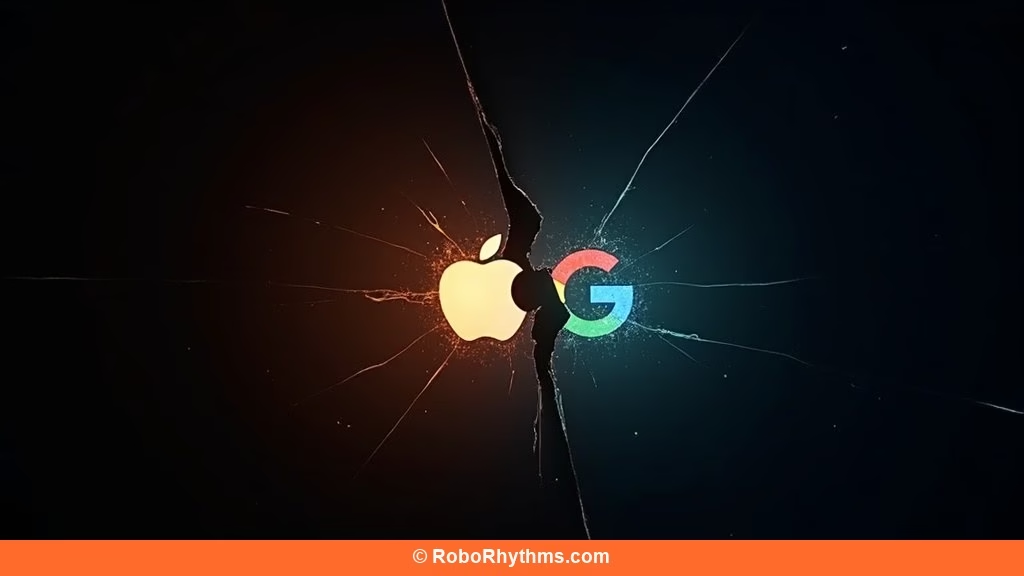
My Take: The Apple-Google Gemini deal is not a partnership. It is a rescue operation. Apple spent years building internal AI that never worked well enough, and now it is paying its biggest competitor in search $1 billion to patch the hole. The mainstream coverage calls this savvy. I think it is the clearest signal yet that Apple’s AI strategy collapsed from the inside.
Apple and Google announced in January 2026 that Gemini would power the next generation of Siri, with Apple gaining access to the full Gemini model running in Apple’s own data centers.
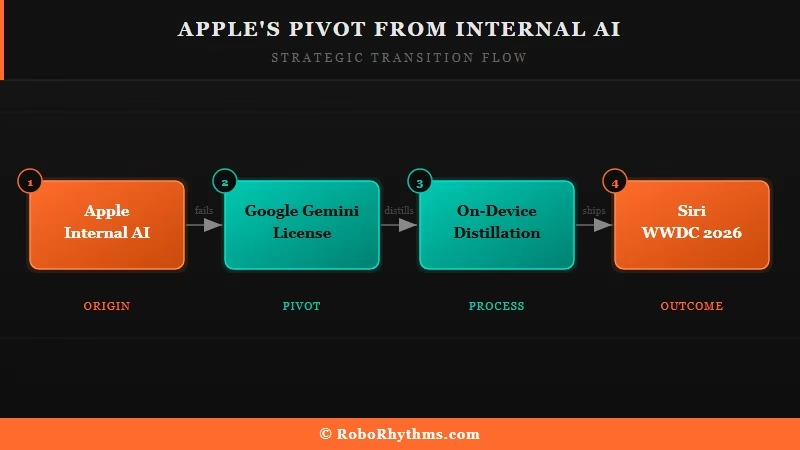
More details emerged on March 25th showing the deal is deeper than initially disclosed. Apple can distill smaller on-device models from Gemini and will ship the whole thing white-labeled as Siri at WWDC 2026.
The mainstream technology press framed this as a brilliant move. Tim Bradshaw at the Financial Times called it “Apple doubling down on the AI era.” That framing ignores something important about what this deal represents.
The Mainstream View and Why It Falls Short
The mainstream view is that Apple partnered with Google because Gemini is the best option, and smart companies use the best tools available.
This framing sounds reasonable until you look at the context. Apple has been building its own AI infrastructure for over a decade.
The company that designed its own CPUs, built its own operating systems, and insisted on vertical integration for every meaningful product category just outsourced the core intelligence layer of its flagship assistant to a competitor.
The coverage also glosses over who Google is in this context. This is not a neutral third-party AI provider. This is the company that Apple competes with directly in search, maps, web services, and mobile advertising.
Apple is paying Google billions to be the brain inside Apple devices. TechCrunch’s coverage from January 2026 called it a “landmark AI partnership,” which is technically accurate but entirely neutral about what it means strategically.
The argument that “smart companies use the best tools” works when the tool is infrastructure. It does not hold when the tool is the differentiator. AI is not like renting servers. It is the product.
What Is Really Happening
Apple’s internal AI research produced models that were not competitive. Rather than delay another product cycle, the company bought capability it could not build itself.
This is the part the press coverage skips. Apple Intelligence launched in 2024 and received uniformly mediocre reviews. The features were slow, the responses were generic, and the gap between Apple’s demos and reality was obvious. Siri with Apple Intelligence was not materially smarter than Siri without it.
Apple had a choice: spend another two years rebuilding internal models, or pay Google for a working solution and launch at WWDC. They took the faster path. A $1 billion deal to Google is the cost of that failure, capitalized as a licensing fee rather than written off as an R&D write-down.
The deal structure tells the same story. Apple gets the full Gemini model running in their data centers and can distill smaller versions for on-device use. That is not how you use a partner’s technology. That is how you copy it under license after you failed to build your own.
The Part Nobody Wants to Admit
Apple’s “privacy-first AI” narrative collapses when the underlying model is Google’s.
Apple built its entire AI positioning around Private Cloud Compute, on-device processing, and the argument that only Apple could be trusted with your data.
That positioning was always partially marketing, but it had structural truth behind it: Apple did not want or need your data for advertising.
Now the most capable version of Siri runs on Gemini. Google’s Gemini. The company whose entire business model is built on knowing everything about you.
Apple will say the Gemini integration has strict privacy guardrails, that user data is not shared with Google, and that the white-labeling protects user trust. From what I have seen in how these partnerships work, that is technically true and practically misleading.
Apple cannot fully audit what a third-party model has absorbed in training. The entire premise of on-device AI was that you never had to trust a third party. That premise is now gone for Siri’s most capable features.
The RR readers who already use tools like best AI agent tools 2026 know that model choice is not a neutral decision. What model you run determines what your assistant knows, how it reasons, and whose data trained it.
Hot Take
Apple will demo a dramatically smarter Siri at WWDC 2026, the tech press will call it Apple’s AI comeback, and nobody will point out that the comeback runs on the engine Apple spent a decade promising it would never need to borrow.
What This Means for You
For users, a smarter Siri is a win regardless of the engine. For the AI industry, Apple’s capitulation is a signal that building frontier models is harder than anyone admitted publicly.
The practical outcome: Siri will get significantly better. Gemini is genuinely capable, and an on-device distilled version should be a real improvement over Apple’s prior models.
If you use Siri for task completion, calendar management, or cross-app actions, the WWDC 2026 release will matter.
The larger signal is about the AI race. If Apple, with its resources and talent, could not build competitive foundation models internally, the window for new entrants is narrowing.
The companies that have already shipped capable models at scale (Google, Anthropic, OpenAI, Meta) are pulling ahead in a way that is increasingly difficult to close.
For anyone tracking how AI tools are evolving in 2026, the Copy AI review 2026 and Writesonic review 2026 show how this upstream model competition is filtering down to the tools people use day-to-day.
