
The Verdict: Roar is the better default for most Character AI users. It scores 7.0 in community rankings versus Pipsqueak’s 5.5, and it holds up better in extended sessions without the writing tics that frustrate Pipsqueak users. Pipsqueak has a narrower use case: long-form creative roleplay where you want richer detail and can tolerate the quirks.
I assumed Pipsqueak was the obvious upgrade when I first saw it listed. Longer responses, better character memory, richer descriptions. That is what the pitch sounded like. Then I spent time with both models and came away with a different read.
The community scores tell the story: Roar sits at 7.0 and Pipsqueak at 5.5, according to user-weighted testing tracked across r/CharacterAI. That gap is not small. Pipsqueak has strengths, but they come with trade-offs that Roar does not.
This comparison covers what each model does in practice, where one beats the other, and which type of user should be running each.
What Are the Pipsqueak and Roar Models on Character AI?
Pipsqueak and Roar are two of Character AI’s experimental chat styles that change how the underlying model generates responses.
Character AI rolled out a set of named model variants in late 2024 and expanded them through 2025. The platform recorded over 194 million monthly website visits in January 2026, which means a large share of those sessions are running on these experimental models.
The names (Roar, Pipsqueak, Goro, Meow, Nyan, Deepsqueak) correspond to different generation behaviors: response length, tone, persona memory, and pacing.
They are selectable in the experimental models panel, and availability varies by account tier.
Roar is one of the older options and has been the go-to default for a large share of users since it launched. Pipsqueak came later and was positioned as a more expressive alternative with longer, richer outputs.
Both are free to access, though some experimental models require a Character AI Plus subscription to unlock.
How Does Pipsqueak Write Compared to Roar?
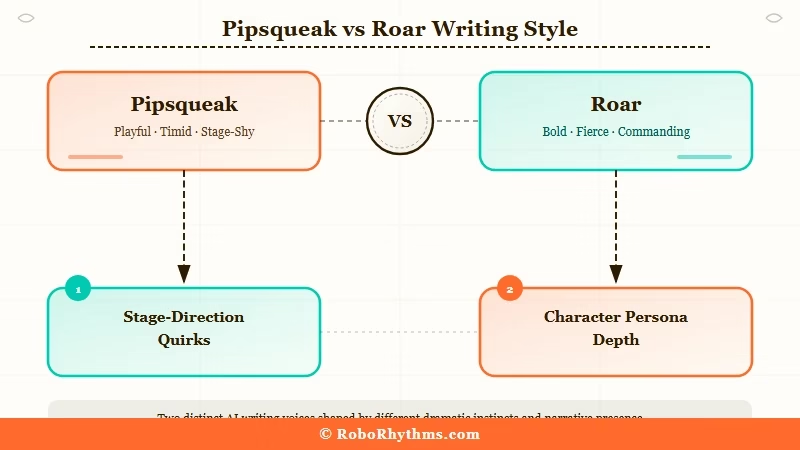
Pipsqueak writes longer, more descriptive responses than Roar, but it inserts stage-direction pauses like “A beat.” and “A pause.” that break immersion for many users.
Here is what the difference looks like in practice:
With Roar: Responses are tighter and more controlled. If you set a scene in a tense standoff, Roar will write the character’s dialogue and action without editorial commentary. The pacing follows the rhythm of your prompts. You stay in control.
With Pipsqueak: Responses are longer and often richer in descriptive detail. The same standoff scene might include internal monologue, environmental description, and character body language. That can be excellent. The problem is the compulsive insertions: phrases like “A beat.” or “A pause.” appear as literal text mid-scene, which reads like stage directions in a screenplay rather than immersive fiction. Pipsqueak also occasionally writes the user’s lines, which breaks character agency entirely.
This is not a rare bug. It is a consistent behavioral pattern that shows up across user reports on r/CharacterAI. For users doing structured, dialogue-heavy sessions, it is enough to make Pipsqueak unusable as a default.
Which Model Has Better Character Memory?
Pipsqueak has stronger persona memory than Roar, recognizing and adapting to user-created character details more reliably across a session.
This is Pipsqueak’s clearest advantage. If you spend time setting up a character’s backstory, personality quirks, and speech patterns, Pipsqueak carries that context forward better than Roar does.
In multi-character sessions where you are managing two or more personas, Pipsqueak keeps them distinct in a way Roar sometimes fails to.
Roar’s memory within a session is adequate for standard conversations but can drift in long roleplay arcs. Characters start to sound similar, or the model forgets established facts. Pipsqueak holds the thread better.
For the best AI agent tools and agentic workflows this is less relevant. For creative fiction that spans dozens of exchanges, Pipsqueak’s memory advantage is real and worth considering.
How Do Community Rankings Compare?
Roar scores 7.0 out of 10 in user-weighted rankings, while Pipsqueak scores 5.5, placing it below Roar, Goro (7.5), and Deepsqueak.
| Model | Community Score | Response Style | Best For |
|---|---|---|---|
| Goro | 7.5/10 | Emotionally rich, deep character depth | Emotional roleplay, character-driven fiction |
| Roar | 7.0/10 | Concise, controlled pacing | General use, structured roleplay |
| Pipsqueak | 5.5/10 | Long, descriptive, writing tics | Long-form creative fiction, persona memory |
| Meow | 5.0/10 | Casual, lighthearted tone | Casual chatting, low-stakes sessions |
What surprised me about this ranking is that Pipsqueak sits below Roar despite offering more features on paper. More response depth and better memory should add up to a higher score. The writing tics are that damaging. Users who tried Pipsqueak and hit the “A beat.” problem repeatedly went back to Roar even though they preferred the longer outputs in principle.
The full rankings across all models are covered in the Character AI models ranked guide if you want the complete picture.
What Are the Biggest Complaints About Each Model?
The biggest Pipsqueak complaint is the stage-direction writing tics; the biggest Roar complaint is shallow depth in long creative sessions.
Pipsqueak complaints I see consistently:
- “A beat.” and “A pause.” inserted into responses, reading like screenplay directions
- Model occasionally writes the user’s character lines without prompting
- Responses get overly poetic in tone, losing the character’s established voice
- Output length sometimes becomes excessive, padding scenes unnecessarily
Roar complaints I see consistently:
- Responses too short for complex roleplay scenes
- Character memory drifts in sessions over 50 exchanges
- Less distinct character voice compared to Pipsqueak
- Can feel flat in emotionally demanding scenes
The Roar complaints are more about limitations than bugs. The Pipsqueak complaints are about behaviors that actively break immersion. That distinction matters when you are choosing a default.
For a deeper look at the Pipsqueak upgrade path, see the Deepsqueak vs Pipsqueak comparison for how the newer model stacks up.
Who Should Use Pipsqueak on Character AI?
Pipsqueak is the right choice for users running long creative fiction sessions where richer detail and persona memory matter more than clean pacing.
The users I would point toward Pipsqueak:
- Writers using Character AI for collaborative fiction across multiple sessions
- Users with deeply customized character builds who need strong persona recall
- Anyone who prefers longer, more atmospheric responses and can edit out the tics
- Users already familiar with Pipsqueak’s quirks and who have learned to prompt around them
Pipsqueak also works reasonably well if you set explicit instructions in your character’s persona to avoid stage directions. From what I have seen, something like “Do not write stage directions. Do not write the user’s lines.” in the system prompt reduces the tic frequency noticeably.
It does not eliminate it entirely, but it cuts it down enough to make the model usable.
Who Should Use Roar on Character AI?
Roar is the better default for most users because it delivers consistent, controlled responses without the writing behavior issues that drag Pipsqueak’s community score down.
The users I would point toward Roar:
- New Character AI users who want a stable, predictable model to start with
- Users running dialogue-heavy roleplay where response pacing matters
- Anyone who tried Pipsqueak and found the stage-direction tics too disruptive
- Casual users who do not need maximum response depth
The way I see it: Roar is the safer choice for 80% of use cases. It does not have Pipsqueak’s ceiling, but it also does not have Pipsqueak’s floor. Consistent output quality beats occasional excellence when you are spending hours in a session.
If neither model is satisfying your needs, platforms like Candy AI offer more consistent creative roleplay without the model-switching complexity that Character AI requires.
Pipsqueak vs Roar on Character AI: Final Verdict
Roar wins for most users. Pipsqueak wins for specific creative use cases where its memory and depth advantages outweigh the writing tics.
| Criterion | Pipsqueak | Roar |
|---|---|---|
| Community score | 5.5/10 | 7.0/10 |
| Response length | Long, detailed | Concise, controlled |
| Persona memory | Strong | Adequate |
| Writing tics | Frequent stage directions | None |
| Character voice consistency | Can drift toward poetic | Stable |
| Best default | No | Yes |
| Best for long-form fiction | Yes | No |
The gap in community scores is real and reflects something that matters in daily use. Pipsqueak is not a bad model. For its specific use case it is better than Roar.
For everything else, Roar’s consistency makes it the more reliable option.
If you are trying to decide between Character AI’s newer experimental models, the Deepsqueak vs Nyan comparison shows how the higher-tier models stack up differently again.
Frequently Asked Questions
The most common questions about Pipsqueak vs Roar cover which is better for roleplay, the writing tics, and whether Pipsqueak is worth switching to.
Is Pipsqueak better than Roar on Character AI?
Roar scores higher in community rankings (7.0 vs 5.5). Pipsqueak has better persona memory and longer responses, but consistent writing tics including “A beat.” stage-direction insertions drag its score down. For most users, Roar is the better default.
Why does Pipsqueak write “A beat.” in responses?
Pipsqueak has a tendency to insert screenplay-style stage directions like “A beat.” or “A pause.” into its responses. This is a known behavioral pattern rather than a bug. You can reduce its frequency by including “Do not write stage directions” in the character’s persona instructions.
Can Pipsqueak write my character’s lines?
Yes, this is one of Pipsqueak’s known issues. The model occasionally continues past the character’s response and writes the user’s next line unprompted. It happens more in long sessions and complex roleplay scenarios. Roar does not exhibit this behavior.
Is Roar or Pipsqueak better for long roleplay sessions?
Pipsqueak handles longer sessions better because its persona memory is stronger. The writing tics do become more noticeable over a long session. Roar’s memory can drift in sessions over 50 exchanges, but its output quality stays consistent. It depends on whether you prioritize memory depth or clean output.
Where does Pipsqueak rank among all Character AI models?
Pipsqueak ranks below Goro (7.5) and Roar (7.0) in community-weighted scoring, coming in at 5.5. For the full ranking of all Character AI models including Deepsqueak and Nyan, the Character AI models ranked guide covers each one in detail.
