
TL;DR: CrushOn AI gives you model choice, and that choice changes the quality of your roleplay more than the scenario does. The 10 scenarios below cover romance, fantasy, thriller, and multi-character rooms. Read the model section before you start one.
Most CrushOn AI users pick a character, write an opener, and get a decent session. A smaller group of users pick the right model for the type of story they want and get something much better.
The model selection screen isn’t decoration. It’s the most overlooked lever in CrushOn AI’s setup.
The scenarios below are built around what works on CrushOn specifically: a clear scene seed in the first message, a character with a defined relationship to you, and one question the story hasn’t answered yet. That structure runs longer and drifts less than a vague opener on any model.
Try CrushOn AI free to test the format. The free tier is limited on messages, but it’s enough to run two or three of the scenarios below and see how the platform responds before upgrading.
The AI companion space these platforms operate in is growing at pace. According to Grand View Research, the global AI companion market was valued at $28.19 billion in 2024, projected to grow at 30.8% annually through 2030.
CrushOn AI is among the platforms capturing that growth with a community character library and a model tier system that gives users real control.
What is CrushOn AI: CrushOn AI is a character-based chat platform with a public gallery of community-created characters and the option to build your own. Users choose from multiple AI models to power their conversations, each with different strengths for creative fiction.

How Does CrushOn AI Handle Roleplay?
CrushOn AI handles roleplay through a combination of model selection, a community character library, and a context retention system that keeps character consistency across long sessions.
The model you choose determines the quality of the writing. The character you pick or build determines who you’re writing with.
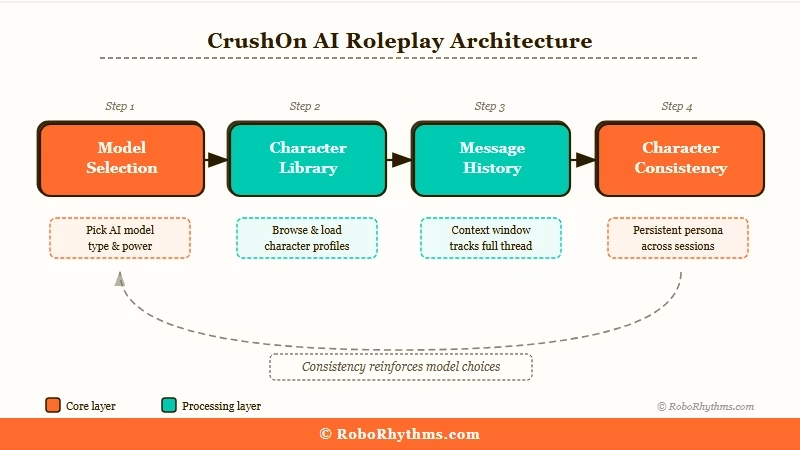
From my testing, the model choice is what separates flat sessions from genuinely good ones. CrushOn gives you access to several models including Claude 3.5 Sonnet, GPT-4o mini, and its own branded lineup of Crushon models (Taurus, Aries, Pisces). Each responds differently to the same prompt.
The context system works through saved messages. CrushOn retains conversation history up to the limit of your plan, which means characters can reference earlier exchanges naturally without you needing to re-introduce context.
The Standard plan includes 300 messages of saved history. Higher tiers extend that window considerably.
One feature that separates CrushOn from Candy AI and SpicyChat is the multi-character room. Paid users can create a room with multiple characters and manage turn-taking, which opens up scenarios that single-character platforms can’t replicate. Scenarios 9 and 10 below are built specifically for that format.
For a deeper look at how the platform stacks up overall, our CrushOn AI review covers everything from message limits to privacy policy.
What Are the Best CrushOn AI Roleplay Scenarios?
The best CrushOn AI roleplay scenarios open with a scene seed: 2-3 sentences that set the location, the relationship, and one unresolved tension. This is the format CrushOn’s models respond to best. Unlike SpicyChat’s persona-heavy approach, CrushOn rewards front-loading the scene rather than the character definition.
| Scenario Type | Recommended Model | Multi-Char Room | Session Length |
|---|---|---|---|
| Romance / slow-burn | Claude 3.5 Sonnet | Optional | Long (60+ min) |
| Fantasy / adventure | Crushon Taurus | Works well | Medium (30-60 min) |
| Thriller / suspense | Claude 3.5 Sonnet | Not ideal | Short (20-40 min) |
| Multi-character room | Crushon Aries | Required | Medium (30-50 min) |
Romance and Slow-Burn Scenarios (1-3)
Romance scenarios on CrushOn run best on Claude 3.5 Sonnet. The model produces more varied dialogue and catches emotional subtext better than the Crushon-branded models in my experience. The slow-burn structure also rewards CrushOn’s context retention because the character references earlier details as the session progresses.
Scenario 1: The Return Scene seed: Someone you were close to is back after two years away. You’re in the same kitchen you used to share. Neither of you has explained what happened yet.
Opening prompt: “I put the kettle on without asking, the way I always used to. You still take it the same way, I assume. I don’t turn around right away. Two years is a long time. I wasn’t sure you’d actually come back.”
Scenario 2: The Interview Scene seed: You’re interviewing the character for a job. The dynamic is professional. The undercurrent is something else.
Opening prompt: “Thank you for coming in. I review the top page of your application and then set it down. Your background is strong. What I want to understand is why you left your last position the way you did. Walk me through that.”
Scenario 3: The Layover Scene seed: A cancelled flight. Eight hours in the same airport lounge. You’ve already been talking for two of them.
Opening prompt: “I check the departures board for the fourth time. Still nothing. I sit back down. So. You were saying you nearly didn’t take this trip. What changed your mind?”
Fantasy and Adventure Scenarios (4-6)
For fantasy, Crushon Taurus handles world-building better than the other branded models in my testing. It produces more consistent in-world dialogue without breaking into modern speech patterns mid-session.
Scenario 4: The Defector Scene seed: A soldier from the opposing force crossed into your camp an hour ago. Your commander wants answers. You want to understand what they actually saw.
Opening prompt: “I close the tent flap and take the seat across from you. My commander wants a list of your unit’s positions and a reason to trust what you tell us. I want to know what made you cross. Those aren’t the same conversation. Which one do you want to start with?”
Scenario 5: The Cartographer’s Error Scene seed: A map that should have led you around a mountain range has led you directly into it. The character is the one who drew it.
Opening prompt: “I spread the map on the rock between us. I need you to show me exactly where the error is. Not what you think happened. Show me the line on the paper and tell me what you were looking at when you drew it.”
Scenario 6: The Heir’s Proxy Scene seed: You’re pretending to be someone else at a political gathering. The character knows who you really are.
Opening prompt: “I accept the glass of wine and smile at the ambassador. I’ve been told you’re the one person in this room I can trust. I speak quietly. How long before the rest of them work it out?”
Thriller and Suspense Scenarios (7-8)
Suspense benefits from Claude 3.5 Sonnet’s tendency to hold information back and respond to what’s implied rather than what’s stated. These scenarios are built around withholding, which that model handles better than most.
Scenario 7: The Drop Scene seed: You’re supposed to pick something up at a specific location. The contact was supposed to be someone else. The person standing there is someone you recognize.
Opening prompt: “I stop at the bench and sit down without looking at you directly. I was told to meet a woman named Reyes. I watch the street. You have thirty seconds to tell me who you are and why you’re here instead.”
Scenario 8: The Recording Scene seed: You have a recording. The character is in it. They don’t know you have it yet.
Opening prompt: “I sit down across from you in the conference room. I want to give you the opportunity to explain something before anyone else hears about it. I place my phone face-down on the table between us. Tell me where you were on Thursday night.”
Multi-Character Room Scenarios (9-10)
These two scenarios are built for CrushOn’s multi-character room feature, which lets you run two characters simultaneously and manage which one responds when. This is the one feature that sets CrushOn apart from every other platform in this comparison.
Scenario 9: Three-Way Negotiation Room setup: Two characters representing opposing factions. You play the mediator.
Opening prompt: “I sit at the head of the table and look at both of you. The terms each of you submitted are not compatible. I’m not here to take a side. I’m here to find the one thing you both can accept. I open the folder. Tell me what you’re actually willing to give.”
Scenario 10: The Council Room setup: Two characters who have history with each other. You’ve called them both in at the same time, which neither expected.
Opening prompt: “I wait until you’re both seated before I speak. I asked you here at the same time because whatever happened between you has started affecting the work. I’m not interested in who’s right. I want to hear what you each need from the other to move on.”
Which CrushOn AI Model Works Best for Roleplay?
The CrushOn AI model that works best for most roleplay scenarios is Claude 3.5 Sonnet, because it produces more nuanced dialogue and handles emotional subtext better than the platform’s branded models.
That said, model choice depends on what you’re writing.
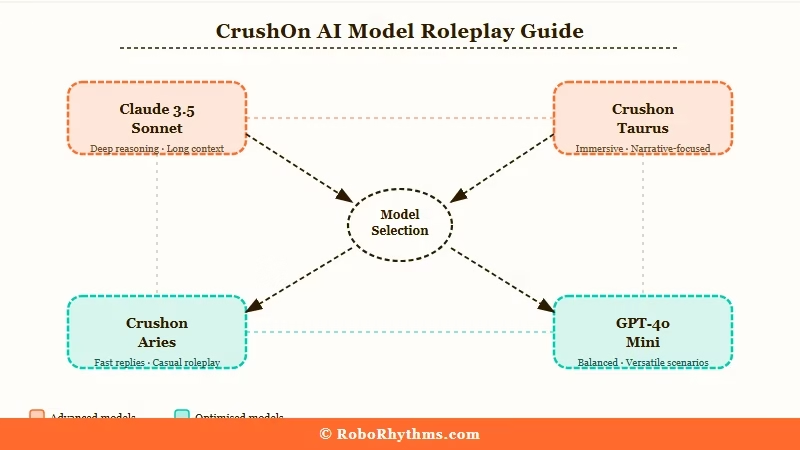
Here’s how I’d think about the lineup based on testing:
- Claude 3.5 Sonnet. Use this for romance, thriller, and any scenario that depends on emotional complexity or withheld information. The writing quality is noticeably higher.
- Crushon Taurus. Use this for fantasy and adventure. It holds world-building context across exchanges better than the others and generates in-genre dialogue more consistently.
- Crushon Aries (Alpha). Use this for multi-character rooms. It handles turn-taking and character differentiation better than Taurus in group scenarios.
- GPT-4o mini. Use this if you’re on the free or Standard plan and Claude isn’t available. It’s fast and competent, but produces less varied dialogue.
| Model | Best For | Tier Required |
|---|---|---|
| Claude 3.5 Sonnet | Romance, thriller | Premium or Deluxe |
| Crushon Taurus | Fantasy, adventure | Standard and up |
| Crushon Aries (Alpha) | Multi-character rooms | Standard and up |
| GPT-4o mini | General use | Free and up |
From what I’ve seen, the biggest jump in session quality comes from switching to Claude 3.5 Sonnet for any emotionally-driven scenario. If budget is a constraint, Taurus is the best of the branded models for narrative roleplay.
How Do I Write a CrushOn AI Scene Seed That Works?
A CrushOn AI scene seed is 2-3 sentences that set the location, establish the relationship between characters, and introduce one unresolved tension. This is the format that CrushOn’s models respond to best across all scenario types.
The structure I’d follow:
- Sentence 1: Location and atmosphere. Ground the scene in a specific physical place. Not “a city.” Try “a closed restaurant kitchen at 11pm” or “a hospital waiting room at 3am.”
- Sentence 2: Relationship status. State what the characters are to each other and what’s currently unresolved between them. Not “they know each other.” Try “they’ve avoided each other since the incident six months ago.”
- Sentence 3: The tension that opens the story. What just happened, or what is about to happen, that makes this moment matter. Not “they meet again.” Try “one of them is about to leave the country and the other just found out.”
Here’s the before-and-after:
Vague scene seed: “A cafe. Two people who used to date. They run into each other.”
Specific scene seed: “A coffee shop, 20 minutes before closing. Two people who ended things abruptly eight months ago. One of them is about to move away permanently and hasn’t told the other yet.”
The specific version gives the character a tone, a timeline, a secret, and a reason to push the conversation somewhere. The vague version gives the character nowhere to go past the first exchange.
For more prompt formats across platforms, the AI roleplay prompts guide covers the general principles. To generate scene seeds for specific genres on demand, the roleplay starter generator builds them from your inputs.
What Do I Do When My CrushOn AI Roleplay Stalls?
CrushOn AI roleplay stalls when the scene seed has resolved its tension and no new question has appeared to pull the story forward. This is true on every model, and the fix is the same regardless of which one you’re using.
Three approaches that work, in order of how disruptive they are:
- Drop in a new variable. Write something that neither character expected: “Someone knocks on the door” or “Your phone lights up with a name you recognize” or “The power cuts.” External interruptions reset the scene’s momentum without wiping context.
- Reveal withheld information. Write “I hand you the letter I’ve been deciding whether to give you” or “There’s something I didn’t tell you when we started.” Revealed secrets create forward pull instantly.
- Time jump. Write “Three days later, I get your message.” This resets the scene entirely while keeping the character’s memory of what happened before. Use this when the current scene has played out completely.
If you want to compare how CrushOn handles long sessions against its closest competitor, our Candy AI vs CrushOn AI breakdown covers the differences in detail.
Frequently Asked Questions
The most common questions about CrushOn AI roleplay cover model selection, the multi-character room feature, and how to write better scene seeds.
Is CrushOn AI good for roleplay?
CrushOn AI is well-suited for roleplay because of its model selection, community character library, and multi-character room feature. Session quality varies significantly by model. Claude 3.5 Sonnet produces the best narrative roleplay on the platform.
Which CrushOn AI model is best for roleplay?
Claude 3.5 Sonnet is the strongest model for emotionally complex scenarios. Crushon Taurus handles fantasy and adventure well.
Crushon Aries works best in multi-character rooms. GPT-4o mini is the best free-tier option.
What is the multi-character room on CrushOn AI?
The multi-character room lets paid subscribers create a room with two or more characters and manage who responds when. It’s the one feature that separates CrushOn from most competitors. Scenarios 9 and 10 above are built for this format.
How do I start a roleplay on CrushOn AI?
Pick a character from the community gallery or create one, select your model, and write a 2-3 sentence scene seed as your first message. The seed should give a location, a relationship context, and one unresolved tension. The scenarios above are all structured as ready-to-copy first messages.
What is a scene seed in CrushOn AI roleplay?
A scene seed is a 2-3 sentence opener that sets the location, establishes the character relationship, and introduces one unresolved tension. It’s the format CrushOn’s models respond to best. A strong scene seed runs longer and drifts less than a generic opening line.
How does CrushOn AI compare to SpicyChat for roleplay?
CrushOn AI’s advantage is model selection and multi-character rooms. SpicyChat’s advantage is a larger character library (500,000+) and a detailed persona instruction system. CrushOn suits users who want to control AI quality through model choice; SpicyChat suits users who want community characters with customizable behavior.
