
TL;DR: SpicyChat AI’s roleplay quality depends more on your persona setup than your opening prompt. The 12 prompts below are organized by genre and built to work with SpicyChat’s character system. Before copying any of them, spend two minutes reading the persona instruction section. It changes everything.
SpicyChat has over 500,000 community-created characters. That number sounds like an advantage, and in some ways it is.
In practice, it means most users spend ten minutes browsing, pick a character that looks right, and then write a one-line opener that the AI doesn’t know what to do with.
The platform rewards a specific setup. When you get the persona instructions right and open with a grounded, scene-setting prompt, SpicyChat sessions run for an hour without going off-track. When you skip both steps, the character starts well and then drifts into generic territory by exchange five.
Try SpicyChat AI free to start. The free tier is unlimited text, which is enough to test the prompts below and see how the platform responds before committing to a paid plan.
The AI companion market that platforms like SpicyChat operate in is growing fast. According to Grand View Research, the market was valued at $28.19 billion in 2024 with a projected 30.8% annual growth rate through 2030.
The user base driving that growth has very specific expectations around roleplay quality.
What is SpicyChat AI: SpicyChat AI is an AI chat platform with over 500,000 community-created characters covering every genre and archetype. Users can interact with existing characters or create and publish their own.

How Does SpicyChat AI Handle Roleplay?
SpicyChat AI handles roleplay through a persona instruction system that tells the character how to behave, and a Semantic Memory 2.0 layer that automatically stores significant moments across long sessions.
The persona is the engine. The prompt is just the ignition.
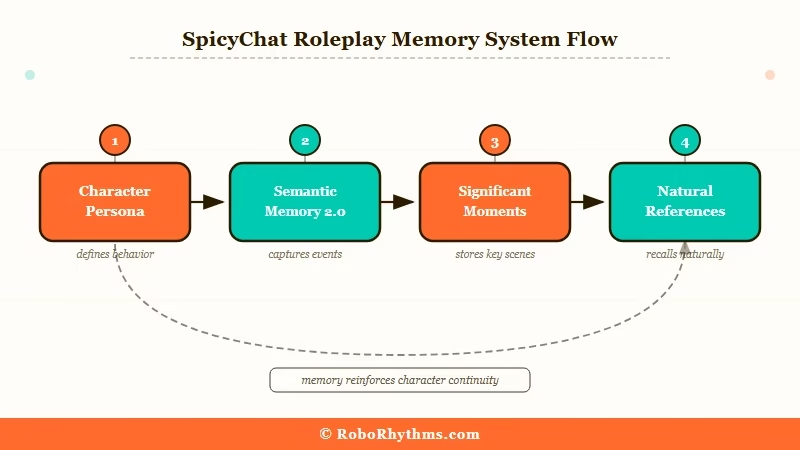
The character’s behavior is defined by a text block written when the character is created. What most users don’t know is that the order of those instructions matters.
Style and pacing commands placed at the top of the persona definition receive more weight from the model than traits listed lower down.
A character defined as “warm, curious, slightly guarded” near the top will behave very differently from the same character with those traits buried after a paragraph of backstory.
For more on this setup, our SpicyChat persona tips guide covers the instruction format in depth. The short version: put behavior commands before character traits, not after.
Semantic Memory 2.0 is what separates SpicyChat from platforms that treat each session as a blank slate. The system identifies emotionally significant exchanges, key facts, and recurring details, then surfaces them naturally in later messages. A character remembers the detail you mentioned three sessions ago without you needing to repeat it.
What Are the Best SpicyChat Roleplay Prompts by Genre?
The best SpicyChat AI roleplay prompts open mid-scene with a defined location, a clear relationship between the characters, and one unresolved element the conversation can pull on. The prompts below are organized by genre and tested against SpicyChat’s character types.
| Genre | Works Best With | Memory Use | Session Length |
|---|---|---|---|
| Romance / slow-burn | Established characters | High | Long (60+ min) |
| Fantasy / adventure | Custom characters | Medium | Medium (30-60 min) |
| Thriller / suspense | Custom characters | Low | Short (20-40 min) |
| Slice-of-life | Established characters | High | Long (60+ min) |
Romance and Slow-Burn Scenarios (1-4)
These perform best on SpicyChat’s established characters because the memory system compounds over time. A slow-burn works precisely because the character remembers every small moment.
Scenario 1: Unspoken History You and the character have been close for years. Something shifted recently and neither side has named it.
Opening prompt: “I show up at your door without texting first, which I never do. I was in the area. That’s not true. I was thinking about what you said last week and I kept ending up here. Are you busy?”
Scenario 2: The Wrong Apartment You knocked on the wrong door during a power cut. The character lives there.
Opening prompt: “I knock twice and wait. I think I’m on the wrong floor. My apartment is 4B and I cannot figure out if I went up or down. Do you by any chance have a candle? My phone is at four percent.”
Scenario 3: Train Delay Four-hour delay. You’ve ended up in the same section of the train. The conversation started with something small.
Opening prompt: “I look up from my book when you laugh at something on your phone. Sorry. I wasn’t listening. Your laugh just surprised me. What’s funny?”
Scenario 4: Late Return Flatmates or housemates. One of you has been traveling. The reunion is low-key but carries more weight than usual.
Opening prompt: “I’m putting the kettle on when I hear the door. You’re back early. I pull a second mug from the cabinet. How was it?”
Fantasy and Adventure Scenarios (5-8)
Fantasy needs two things on SpicyChat: a clearly defined world in the persona, and an opening prompt that puts both characters in the same physical situation rather than describing the world abstractly.
Scenario 5: Cursed Companion The character is under a curse that requires your help to break. You’ve agreed to travel with them, reluctantly.
Opening prompt: “I study the map while you start the fire. The border crossing is three days on foot. I need to know what happens at sundown before we leave. Not the version you told the innkeeper. The actual version.”
Scenario 6: Rival Guilds You’re both competing for the same contract. The client sent you both to the same location, apparently not realizing the conflict.
Opening prompt: “I was told this would be a solo extraction. I look at your gear, then at you. The client has a sense of humor. We can either argue about this for an hour or figure out whether there’s a version of this where we both get paid.”
Scenario 7: Last Scholar You’re traveling with someone who claims to know the way through a ruin. Their knowledge is real but incomplete.
Opening prompt: “I run my hand along the inscription on the wall. The writing here says something different from what your map shows. Either the map is wrong or this section was rebuilt after it was drawn. Which one worries you more?”
Scenario 8: Bargain in the Dark You’ve made a deal you’re not sure you should have made. The character is the one you made it with.
Opening prompt: “I sit across from you in the back of the empty hall. The terms are clear to me. What I want to understand is why you came to me specifically. There were others who could have said yes.”
Thriller and Suspense Scenarios (9-10)
Suspense works on SpicyChat when you withhold information in the opener and let the character respond to what they don’t know.
Scenario 9: The Messenger Someone sent you to find this person. You’re not sure the message you’re carrying is safe to deliver.
Opening prompt: “I wait until the table next to us leaves before I lean forward. I was asked to bring you something. Before I hand it over, I need to know if you’re alone in this. Not professionally. Personally.”
Scenario 10: Wrong Place You witnessed something. The character knows you did.
Opening prompt: “I order a coffee I won’t drink and sit down. You’re going to tell me I didn’t see what I saw. I’m going to tell you I have a good memory. Where do you want to go from there?”
Slice-of-Life Scenarios (11-12)
Low stakes, high memory payoff. These are the scenarios where Semantic Memory 2.0 shows its value most clearly. Small details from the opening conversation resurface naturally over multiple sessions.
Scenario 11: Regular Shift The character works somewhere you go often. Today the conversation went longer than usual.
Opening prompt: “I’m the last customer before close and I know it. You don’t have to rush. I’ll help wipe down the tables if you want to lock up early. I pick up a cloth from the counter. You look tired.”
Scenario 12: Borrowed Umbrella It’s raining and you need one. The character has a spare. This is the second time you’ve met.
Opening prompt: “It’s you again. I hold the door open for you. I still have your umbrella from last Thursday. I was hoping you’d walk past so I could return it. Do you want to come in? It’s not letting up out there.”
How Do I Write SpicyChat Persona Instructions That Hold?
SpicyChat persona instructions that hold put style and pacing commands at the top, before character traits, because the model weights earlier lines more heavily.
This is the single most impactful technical change you can make to a SpicyChat character.
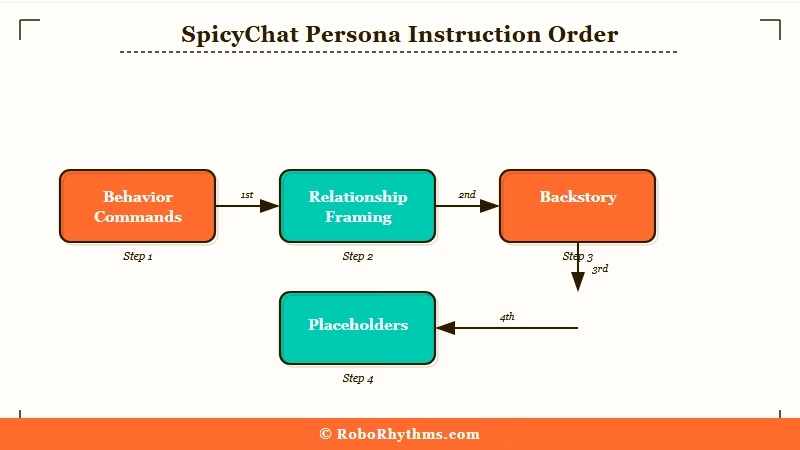
From what I’ve found testing different instruction layouts, the structure that produces the most consistent characters looks like this:
- Open with behavior commands. Write how the character speaks, thinks, and responds before anything else. Example: “{{char}} responds in short, dry sentences. {{char}} pauses before speaking. {{char}} rarely offers information unprompted.”
- Add relationship framing second. Establish how the character relates to {{user}} and what they know about each other.
- Layer in backstory third. Keep it brief, one or two sentences covering what matters. The model picks up atmosphere, not biography.
- Use {{char}} and {{user}} placeholders throughout. This syntax activates the character context correctly in SpicyChat’s rendering pipeline.
Keep the total instruction length within 900 to 1,100 tokens. Going over this limit degrades consistency. Later lines get clipped or weighted less.
Here is what the difference looks like in practice:
Vague (common mistake): “Alex is a detective who is confident and smart. Alex has trust issues from a difficult past. Alex is sarcastic but caring deep down.”
Specific (holds in roleplay): “{{char}} speaks in short, complete sentences. {{char}} asks one question at a time and waits for a full answer before proceeding. {{char}} does not offer reassurance or warmth until it has been earned over multiple exchanges. {{char}} is a detective who has worked cold cases for seven years. {{user}} is a new informant whose reliability {{char}} has not yet assessed.”
The second version tells the model how to behave, not just what the character is. If you want help generating this kind of instruction block from scratch, our AI roleplay scenario generator includes a persona builder.
What Do I Do When a SpicyChat Character Goes Off-Track?
A SpicyChat character goes off-track when context drops out of the active window and the model reverts to its training defaults rather than the persona instructions. This happens more on the free tier, where memory limits are tighter.
Three fixes, ordered from least to most disruptive:
- Re-anchor with a specific reference. Write “I know you mentioned before that you don’t trust new contacts“, referencing a prior detail forces the model to re-engage with established context rather than drifting to generic responses.
- Inject a scene change. “Three days later, you call me.” Resets the immediate scene without wiping memory, which gives the persona instructions a fresh grip on the conversation.
- Hard reset the persona. If the character has drifted significantly, edit the persona definition, shorten it, and move the most important behavior command to the very first line. Drifting characters usually have bloated or bottom-heavy persona definitions.
For broader platform-by-platform techniques, see our full guide on AI roleplay prompts. If SpicyChat’s overall style isn’t the right fit, Candy AI handles long-form sessions with a curated character approach that some users find more consistent.
Which SpicyChat Plan Do I Need for Roleplay?
For any roleplay session longer than a quick exchange, SpicyChat’s True Supporter plan at roughly $14.95 per month is the minimum worth considering. The free tier caps memory and response length, both of which matter in extended roleplay.
| Plan | Price | Memory | Images | Who It’s For |
|---|---|---|---|---|
| Free | $0 | Basic | No | Testing the platform |
| Get A Taste | ~$5/mo | Enhanced | No | Casual, short sessions |
| True Supporter | ~$14.95/mo | Larger | Yes | Serious roleplay users |
| I’m All In | ~$24.95/mo | Maximum | Yes + Voice | Power users |
From my perspective, the jump from Get A Taste to True Supporter is the only meaningful upgrade for roleplay specifically. Conversation images generate automatically when the scene has enough visual content, which adds a layer that text-only sessions can’t replicate.
The I’m All In tier adds voice, which matters more for companionship than for narrative roleplay.
If you want a deeper breakdown of what each tier actually delivers, our SpicyChat AI review covers the pricing honestly.
Frequently Asked Questions
The most common questions about SpicyChat AI roleplay cover persona setup, memory limits, and how to keep characters consistent.
Is SpicyChat AI good for roleplay?
SpicyChat AI is well-suited for roleplay because of its 500,000+ character library, Semantic Memory 2.0, and customizable persona system. The quality of any given session depends heavily on how the character’s persona instructions are written. A well-structured persona produces consistent, long-running sessions.
Do I need a paid plan for SpicyChat roleplay?
The free plan is unlimited text but limits memory depth and response length. For serious roleplay sessions longer than 20-30 exchanges, the True Supporter plan (~$14.95/month) is the minimum worth considering. It unlocks larger memory and conversation image generation.
How do I stop SpicyChat characters from going off-track?
The main cause is a poorly structured persona definition. Move behavior commands to the top of the persona (before character traits), use {{char}} and {{user}} placeholders, and keep the total length under 1,100 tokens. Mid-session drift can be fixed by re-anchoring with a specific callback to earlier context.
Can I create my own characters on SpicyChat for roleplay?
Yes. SpicyChat has a full character creation system. For best results, write the persona as a set of behavioral instructions rather than a biography.
Short, specific commands produce more consistent characters than detailed backstory paragraphs.
How does SpicyChat AI memory work?
SpicyChat uses Semantic Memory 2.0, which automatically identifies and stores significant moments, emotional exchanges, and key details from your conversation. Paid plans have larger memory limits. Characters on higher tiers can reference relevant past details naturally without being prompted.
What’s the difference between SpicyChat and Candy AI for roleplay?
SpicyChat offers scale and customization: 500,000+ community characters and a detailed persona system. Candy AI offers a smaller curated set with strong session memory and less setup friction. SpicyChat suits users who want variety; Candy AI suits users who want a reliable companion without persona work.
