Quick Answer: HeyGen and Kling AI are not direct competitors, they serve fundamentally different use cases. HeyGen is the tool for avatar-based, talking-head videos with multilingual dubbing. Kling AI is the tool for cinematic text-to-video and image-to-video generation without any avatar component. Choose HeyGen if you need a presenter. Choose Kling if you need cinematic footage.
I kept seeing these two tools compared side-by-side in roundups, and it always felt like a category error. HeyGen is a talking-head video platform.
Kling AI is a cinematic video generator. Asking which one is better is like asking whether a teleprompter or a camera is the better piece of kit, you need to know what you’re shooting first.
That said, both do create AI video, both are paid products competing for the same budget, and plenty of creators are genuinely unsure which one belongs in their stack.
So I tested both, documented what each does well, and put together the honest breakdown.
HeyGen covers the avatar and dubbing side. Kling AI covers the cinematic generation side.
The right answer depends entirely on the kind of video you need to produce.
What HeyGen and Kling AI Actually Are
HeyGen is an AI avatar video platform and Kling AI is a generative video model, understanding that distinction before comparing pricing or features saves a lot of confusion.
HeyGen’s core product is AI avatars. You choose or create a digital presenter, write a script, and the platform generates a talking-head video with lip-synced audio in 40+ languages.
The output looks like a recorded presenter, suitable for product demos, training content, sales videos, and marketing. Over 40,000 companies use it, including teams at Amazon and Google.
Kling AI, made by Chinese tech company Kuaishou, is a generative video model. You provide a text prompt or a starting image, and it generates cinematic footage.
No avatars, no talking heads, instead, you get AI-created video of whatever you describe: landscapes, product shots, abstract scenes, character motion. The output competes with tools like Runway and Pika on visual quality.
The overlap is minimal. HeyGen can generate video clips, but its strength is avatar-driven presentation. Kling AI can generate characters, but it cannot produce a presenter delivering a script to camera.
They share a category name but solve different creative problems.
Pricing Compared
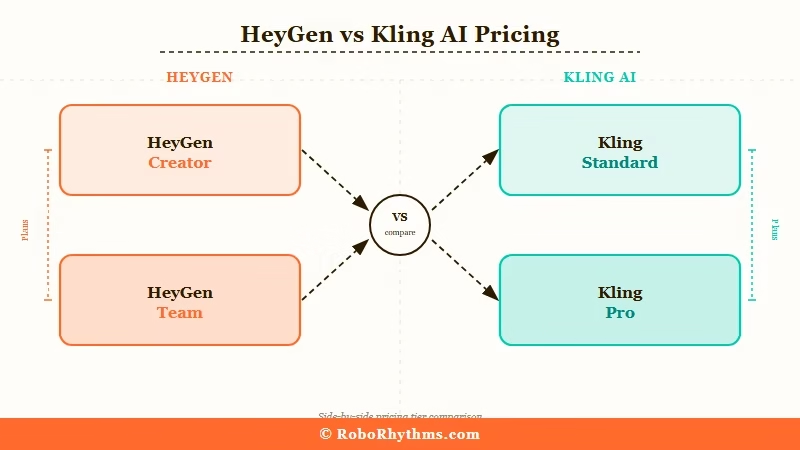
HeyGen pricing in 2026 runs from a free preview tier through Creator ($29/month) and Team ($39/seat/month), while Kling AI pricing starts significantly lower at $6.99/month Standard with video credits scaling up to $180/month for high-volume use.
Here is how the tiers stack up across both tools:
| Plan | Tool | Price | What You Get |
|---|---|---|---|
| Free | HeyGen | $0 | 3 videos/month preview, watermarked |
| Creator | HeyGen | $29/month | 15 credits, watermark-free, commercial rights |
| Team | HeyGen | $39/seat/month | 4K export, collaboration, advanced avatars |
| Standard | Kling AI | $6.99/month | 660 credits, 1080p, watermark-free |
| Pro | Kling AI | $25.99/month | 3,000 credits, priority processing |
| Premier | Kling AI | $64.99/month | 8,000 credits, high-volume generation |
Kling AI’s entry price is significantly lower. At $6.99/month for Standard, you get 660 credits, enough for roughly 66 five-second clips at standard quality, or about 19 at professional mode.
For casual creative use, that budget goes far.
HeyGen’s value is different. $29/month buys you 15 avatar video credits, but each credit produces a polished, presenter-driven video that would cost considerably more to produce with human talent.
If you’re replacing a video production workflow, the math works in HeyGen’s favour.
Video Quality
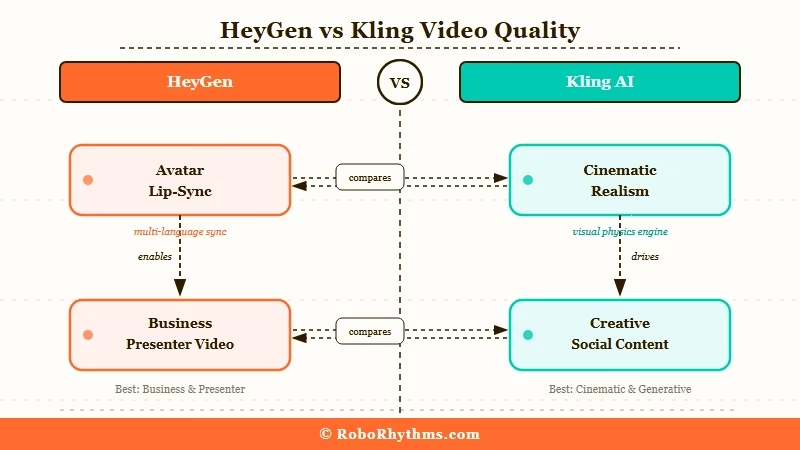
HeyGen’s video quality is optimized for avatar realism and lip-sync accuracy, while Kling AI’s video quality leads the market for cinematic realism and visual physics in generative footage.
From my testing, HeyGen avatars hold up well for training and marketing content. The lip-sync is accurate, the avatar expressions are natural enough for business use, and the multilingual audio quality is impressive.
What HeyGen cannot do is generate environmental footage, complex character motion, or anything that requires a real-world physical scene.
Kling AI’s output, for the right prompts, is genuinely striking. Landscape shots, product visualizations, and character motion clips rival early Sora demos in some cases.
The physics are better than most competing models, water moves like water, fabric folds naturally. Where it falls down is consistency across longer clips (more than 10 seconds) and anything requiring text legibility within the video.
A concrete side-by-side scenario:
Example scenario: You need a video explaining a software feature for a sales deck. On HeyGen, you’d generate an avatar presenter speaking your script in English and Spanish, lip-synced and branded, in about 20 minutes. On Kling AI, you’d get cinematic B-roll footage of someone at a computer, no presenter, no script delivery, no dubbing. You’d then need a separate voice-over tool to narrate over the Kling footage. Neither output alone covers the full use case.
Who Should Choose HeyGen
HeyGen is the right tool for teams who need presenter-driven video content at scale, multilingual reach, or a repeatable avatar-based video workflow that replaces human talent.
Choose HeyGen if:
- You produce explainer videos, product demos, or sales content where a talking presenter is required
- You need multilingual versions of the same video (40+ languages with lip-synced dubbing)
- Your video output needs to look like a recorded human presenter, not generated footage
- You are building a video production pipeline for clients or internal teams where consistency and brand voice matter
The ROI case for HeyGen is strongest when you compare it to traditional video production. A single professionally recorded multilingual explainer video costs thousands in studio time and voice talent.
HeyGen’s Creator plan at $29/month produces that output in minutes.
Who Should Choose Kling AI
Kling AI is the right tool for content creators, social media producers, and creative directors who need high-quality generative video footage without an avatar component.
Choose Kling AI if:
- You create short-form social content and need cinematic B-roll or creative clip generation
- You’re working on film or animation projects and want AI-assisted footage generation
- You have reference images you want to animate (image-to-video is a Kling strength)
- You need high-quality visual output at a low monthly cost (Standard at $6.99 covers casual use)
The strongest case for Kling AI is for YouTube creators and social media producers who need high-quality footage without the budget for stock licensing or traditional filming.
At $6.99/month, the output-per-dollar ratio is hard to beat for generative video.
HeyGen vs Kling AI. Final Verdict.
HeyGen wins for business and presentation video. Kling AI wins for creative and cinematic video. If you need both, the total cost of running both tools ($6.99 + $29/month) is lower than most video production alternatives.
| Criterion | HeyGen | Kling AI |
|---|---|---|
| Avatar/presenter video | 9.5/10 | Not supported |
| Cinematic video quality | 6/10 | 9/10 |
| Multilingual support | 9/10 | 4/10 |
| Entry-level pricing | 6/10 (from $29) | 9.5/10 (from $6.99) |
| Social media clips | 6/10 | 9/10 |
| API / developer access | 8/10 | 5/10 |
| Best for | Business video | Creative video |
If you are a solo creator who needs to choose one: Kling AI at $6.99/month gives you more raw creative output per dollar.
If you are a business or agency producing content that requires a speaking presenter: HeyGen is the only realistic option in this category.
Frequently Asked Questions
Is HeyGen better than Kling AI?
HeyGen and Kling AI serve different use cases. HeyGen is better for avatar-based presenter videos with multilingual dubbing. Kling AI is better for cinematic text-to-video and image-to-video generation. For business presentation video, HeyGen wins. For creative footage generation, Kling AI wins.
How much does HeyGen cost in 2026?
HeyGen’s Creator plan is $29/month (15 credits, watermark-free, commercial rights). The Team plan is $39/seat/month and adds 4K export and collaboration. A limited free tier offers 3 preview videos with watermarks.
How much does Kling AI cost in 2026?
Kling AI Standard is $6.99/month (660 credits, 1080p, no watermark). Pro is $25.99/month (3,000 credits). Premier is $64.99/month (8,000 credits). Annual billing offers approximately 34% savings across all tiers.
Can Kling AI create talking-head videos like HeyGen?
No. Kling AI generates cinematic video footage from text or image prompts, but it does not have an avatar or talking-head presenter feature. For a speaking presenter synced to a script, HeyGen is the required tool.
Which AI video tool is cheaper for beginners?
Kling AI is significantly cheaper at entry: $6.99/month vs HeyGen’s $29/month Creator tier. For creative video generation without an avatar requirement, Kling AI is the better budget choice.
Can I use both HeyGen and Kling AI together?
Yes, and they complement each other well. Use HeyGen for avatar-based presentation segments and Kling AI for cinematic B-roll footage, then edit them together in a standard video editor. The combined cost ($36/month minimum) still beats most traditional video production budgets.
