
Three people have been indicted by the U.S. Department of Justice for smuggling $2.5 billion worth of Nvidia AI servers to China.
One of them is the cofounder of a publicly-traded server company who was sitting on its board until last week.
This isn’t a distant geopolitical story. From where I sit, it’s one of the clearest signals yet about how high the stakes around AI hardware have become, and how far people are willing to go to get around the rules controlling it.
The DOJ charges were unsealed on March 19, 2026. The company’s stock had lost a third of its value by the close of the next trading session.
The cofounder, after decades of building the business, stepped down from the board the following morning.
What Actually Happened
Super Micro’s AI chip smuggling case is a $2.5 billion conspiracy involving fabricated documents, dummy server racks, and encrypted communications used to route Nvidia GPUs to China over two years.
Yih-Shyan “Wally” Liaw, the 71-year-old cofounder of Super Micro Computer, was arrested on March 19. Two others were charged alongside him: Ruei-Tsang “Steven” Chang, who managed Super Micro’s Taiwan office, and Ting-Wei “Willy” Sun, a contractor.
Chang remains a fugitive.
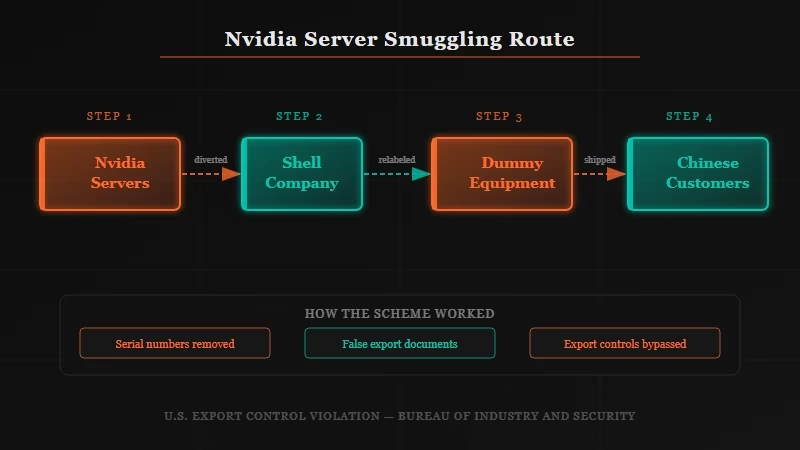
According to the DOJ indictment, the scheme worked in five stages:
- A Southeast Asian shell company purchased servers from Super Micro on paper
- Those servers were physically shipped to Southeast Asia, then rerouted to Chinese customers
- Defendants stripped manufacturer labels and serial numbers from the real machines using hair dryers
- Dummy equipment was left behind to pass inventory audits and fool inspectors
- Encrypted messaging apps coordinated delivery locations, quantities, and methods to stay hidden from Super Micro’s own compliance team
Between late April and mid-May 2025 alone, roughly $510 million worth of servers were diverted. Over the full two-year period covered in the indictment, the total reached $2.5 billion.
The hair dryer detail: Defendants allegedly pressed hair dryers against server chassis to loosen the adhesive on serial number stickers. The real machines got wiped and shipped to China. The empty frames with dummy components got left behind for auditors to check off. This is not a sophisticated cyberattack. It is a physical heist with consumer appliances.
The technology involved was advanced Nvidia GPUs, the same chips that power the AI model training operations every major tech company is racing to scale up.
The U.S. has maintained export controls on these chips since 2022, specifically to prevent China from building up its AI compute capacity.
Here is what each defendant faces if convicted on all counts:
| Charge | Maximum prison sentence |
|---|---|
| Conspiring to violate the Export Controls Reform Act | 20 years |
| Smuggling goods from the United States | 5 years |
| Conspiring to defraud the United States | 5 years |
Liaw resigned from Super Micro’s board on March 20. CNBC reported that SMCI shares fell roughly 28% in a single session following the announcement, with some reports citing a 33% drop.
Why This Is a Bigger Deal Than It Sounds
This case is not just about three individuals. It shows that U.S. export controls on AI chips are being actively bypassed at industrial scale, using methods sophisticated enough to evade auditors for two full years.
The common assumption in AI policy circles is that export controls work like a padlock: set the rules, declare certain chips off-limits to certain countries, and the market complies.
What I think this case demonstrates is that the padlock model breaks down entirely when there is enough money on the other side of the door.
$2.5 billion is not a rounding error. That is a sustained, industrial-scale operation requiring coordination across multiple countries, fake documentation, and a hair dryer. The defendants allegedly communicated through encrypted apps and kept the scheme hidden from Super Micro’s own internal compliance team.
That last detail is worth sitting with: this was not a rogue operation. It was organized enough to evade the company that built the servers.
Super Micro has been here before. The company faced serious accounting scrutiny in prior years, which delayed its financial filings. Now its cofounder faces federal criminal charges.
At some point, repeated compliance failures start to look structural rather than coincidental.
The broader implication is uncomfortable for anyone who believes export controls are doing what they are designed to do. Nvidia said in a public statement that “unlawful diversion of controlled US computers to China is a losing proposition.”
But the fact that someone moved $2.5 billion worth of hardware past those controls suggests the trade looked very attractive from the other side.
This is the hardware side of the same story that played out when DeepSeek caught the industry off guard earlier this year.
Instead of Chinese engineers outpacing U.S. models on open weights, we are looking at Chinese buyers allegedly paying billions to acquire the compute to close the gap by force.
Both stories point to the same dynamic: access to GPUs is the real constraint in the AI race, and people are motivated to solve that constraint by any means available.
What This Means for You
For anyone building with AI tools or following the AI infrastructure space, the Super Micro case is a signal that the hardware bottleneck is real and that the U.S.-China chip standoff is intensifying in ways that will reach your tools and your costs.
The direct effect: Super Micro is a major supplier of AI server hardware. The company’s stock crashing does not just hurt shareholders. It introduces uncertainty into the supply chain for the data centers that run the AI products you use.
If Super Micro faces tighter compliance requirements or operational disruption from the legal fallout, server build-outs could slow. That eventually shows up as capacity constraints at the model providers.
The policy effect: cases like this almost always produce a regulatory response. The DOJ and Commerce Department will look at what happened here, note that $2.5 billion slipped through their controls, and push for stricter enforcement.
Expect more friction in the AI chip supply chain, which raises costs for legitimate buyers too. The best AI tools worth paying for right now rely on that supply chain staying functional and affordable.
From my perspective, the competitive effect is the most underappreciated angle. If China was acquiring Nvidia hardware at this scale to support AI training, what was built with it over two years? This is the question nobody can fully answer from the outside.
The competitive dynamics in the AI space are already difficult to track. A two-year window of unsupervised GPU acquisition changes the picture in ways that are genuinely hard to model.
The short version: the hardware running the AI tools you depend on is at the center of an active geopolitical conflict, and events like this are how that conflict plays out in practice rather than in policy papers.
What Comes Next
The Super Micro case will produce a criminal prosecution and a regulatory tightening that makes AI chip export controls significantly harder to circumvent.
Ruei-Tsang Chang is still at large. A federal fugitive with a Southeast Asian support network and two years of experience hiding international shipments is not easy to find. The DOJ’s National Security Division is involved, which signals this will be pursued with the full weight of federal resources, but the timeline is uncertain.
On the legal side, Liaw and Sun face potentially 30 years in combined prison time if convicted. Both are presumed innocent. The case is being prosecuted in the Southern District of New York, the same court that handles major financial crimes and national security cases.
What I expect to see over the coming months is a regulatory response that goes well beyond this case.
A $2.5 billion enforcement gap, running for two years, will almost certainly trigger new verification requirements for intermediary companies, stricter end-user auditing, and possibly enhanced restrictions on hardware routing through Southeast Asian third parties.
The AI industry broadly is already navigating a complex regulatory environment, and this case will tighten it further.
Super Micro’s next earnings call is going to be a significant moment. The company has survived compliance crises before.
This is the first time a cofounder has faced criminal charges, and the board will need to answer questions about what oversight structures existed and why they failed.
