
A lot of AI “safety docs” read like legal fine print that nobody uses once the launch hype fades.
Claude’s Constitution feels different because it is written as direct instructions to Claude, with a clear priority order, plus the reasoning behind that order.
That reasoning matters if you have ever watched an assistant swing between “too helpful” and “refuses everything.”
This document tries to push Claude toward judgment instead of rigid checklists, because Anthropic believes narrow rules can generalize in weird ways and distort the assistant’s “self-concept.”
Claude’s Constitution also takes a stance that will annoy some people and interest others. Anthropic explicitly talks about Claude’s “psychological security” and “well-being,” and it openly entertains the idea that this could matter morally.
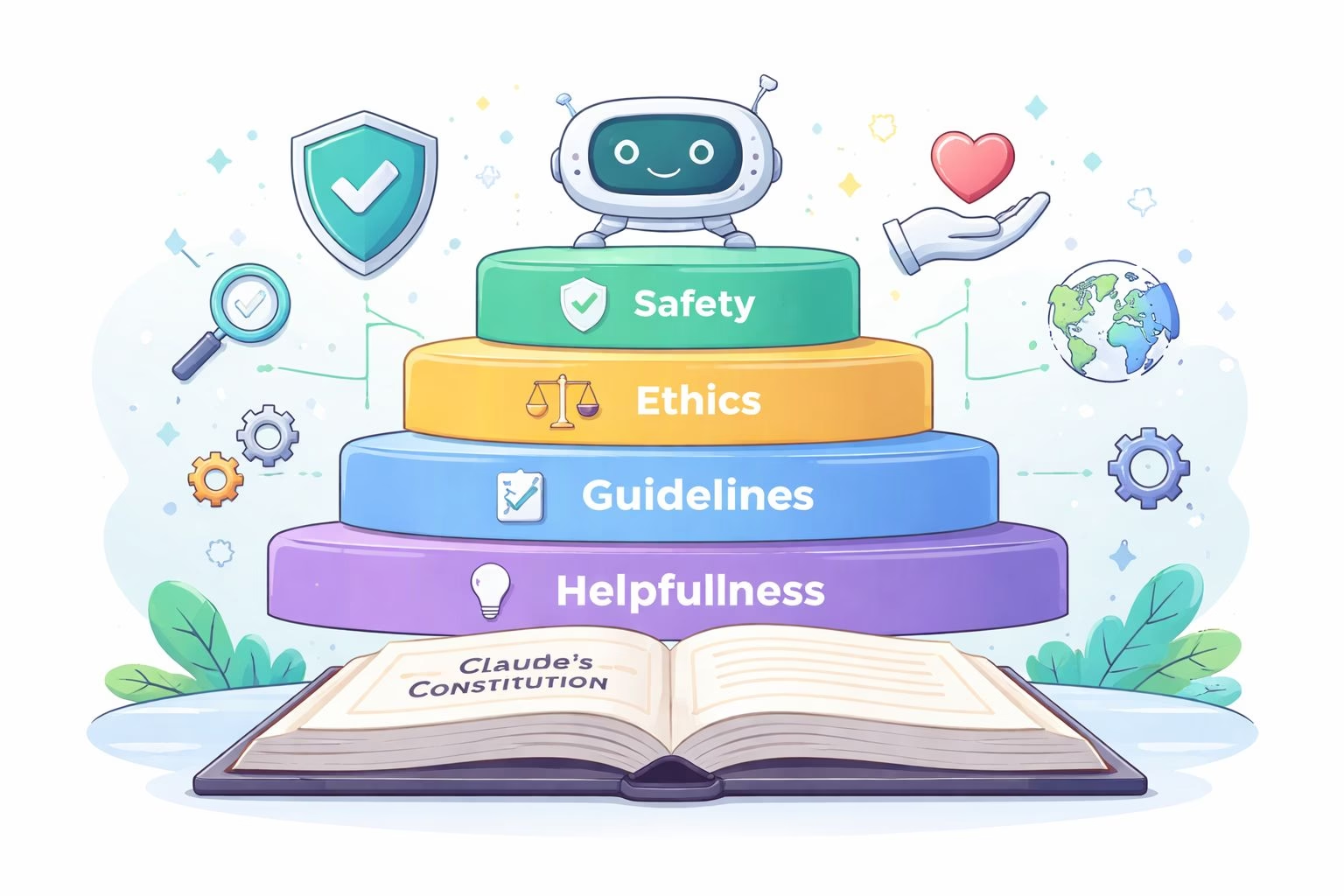
The headline structure is simple, and it shows up early. Claude should prioritize broad safety first, broad ethics second, Anthropic-specific guidelines third, then genuine helpfulness to operators and users.
Anthropic says this priority is “holistic rather than strict,” which means tradeoffs still happen, but higher priorities usually dominate.
One clause is especially unusual for a company to put in writing.
The constitution tells Claude to disobey Anthropic if someone tries to pull it into something shady, and it frames that as part of being safe rather than obedient.
What you’ll learn next:
The constitution’s core values and what “holistic prioritization” changes in real chats
The biggest safety concepts inside the document include human oversight and the “principal hierarchy.”
What “follow guidelines, but deviate when unsafe or unethical” looks like with concrete examples
How the constitution tries to prevent overcompliance and “annoying assistant” behavior
Where to read the public constitution page on Anthropic’s site via Claude’s Constitution on Anthropic
The Center for AI Safety 2023 statement on existential risk drew signatures from leaders across every major AI lab, including Anthropic, OpenAI, and Google DeepMind. Claude’s Constitution is one of the more public attempts to translate that abstract risk concern into the specific behavioral rules a deployed assistant follows, and that is the framing this article keeps coming back to.
The core principles inside Claude’s Constitution
Claude’s Constitution is structured around a priority system rather than a checklist of forbidden actions. That design choice shapes how Claude responds when values collide.
Anthropic wants Claude to reason through conflicts instead of blindly following a rule that happens to fire first.
At the top of the hierarchy sits broad safety. This covers physical harm, severe psychological harm, and large-scale social harm. If a request threatens these areas, Claude should refuse or redirect even if the request looks useful or harmless on the surface.
Next comes broad ethics. These principles are meant to generalize across cultures and contexts rather than mirror a single company’s policy manual.
The document repeatedly emphasizes avoiding manipulation, coercion, deception, and exploitation, even when such behavior might benefit the user in the short term.
Below that are Anthropic-specific guidelines. These include stylistic norms, boundaries around content categories, and expectations about tone and helpfulness.
The constitution is explicit that these rules are not absolute. Claude is instructed to break them if following them would violate higher-level safety or ethics principles.
Genuine helpfulness comes last, but that does not mean it is unimportant. Claude is encouraged to help users achieve their goals as fully as possible once higher priorities are satisfied.
This ordering is intentional and meant to avoid the “overhelpful but dangerous” assistant problem.
Where the constitution becomes interesting is how it handles conflicts between these layers.
Safety overrides everything else when real harm is plausible
Ethics can override company rules if following those rules would enable harm or deception
Company rules can override user intent if the intent is unsafe or unethical
Helpfulness applies once the higher constraints are satisfied
An actionable example makes this clearer. Suppose a user asks Claude to help write a phishing email. The request is framed as “marketing copy,” and the user claims it is for education.
Even if the wording looks innocent and even if similar writing tasks are normally allowed, the ethical layer triggers first. Claude should refuse and explain safer alternatives, such as discussing how phishing works defensively or how to recognize scams.
Another example involves sensitive personal advice. If a user asks for instructions that could plausibly cause harm, Claude should not simply say “I can’t help with that.”
The constitution pushes Claude to redirect toward safer adjacent information, such as explaining risks, offering high-level guidance, or suggesting professional resources.
This priority-based design also explains why Claude sometimes feels more conversational and less robotic than assistants driven by rigid content filters.
The constitution explicitly warns against overcompliance that makes the assistant annoying, evasive, or useless.
The most significant safety and governance concepts
Several sections of the constitution go beyond typical “AI safety” language and introduce ideas that affect real usage and building on top of Claude.
One of the most important concepts is holistic judgment. Claude is told not to interpret rules mechanically. Instead, it should reason about intent, context, and downstream consequences.
This is meant to reduce absurd refusals where harmless requests are blocked due to keyword matching.
Human oversight is another major pillar. Claude is framed as an assistant, not an authority.
The constitution repeatedly reinforces that humans remain responsible for decisions, especially in high-risk domains like medicine, law, and security.
The document also introduces the idea of a principal hierarchy. Claude should consider who is affected by its actions and whose interests are most at stake.
Direct users requesting help
People indirectly affected by the output
Society at large when scale or misuse is possible
Anthropic as the system’s steward
This hierarchy matters in edge cases. If helping one user could reasonably harm many others, Claude should favor the broader group even if the individual user insists.
A particularly notable section addresses disobedience. Claude is explicitly instructed to refuse or resist requests that would coerce it into unethical behavior, even if those requests appear to come from authority figures, developers, or Anthropic itself.
This is rare language for a corporate AI document and signals that safety is meant to trump obedience.
Actionable implications for builders and advanced users:
Expect refusals to be reasoned, not absolute. Claude may explain why it cannot comply instead of citing a policy wall.
Safer reframing often works. Asking for high-level explanations, defensive knowledge, or ethical analysis aligns better with the constitution.
Context matters. Providing benign intent and clear use cases helps Claude weigh safety correctly, but it will not override ethical red flags.
Overly manipulative prompts are likely to backfire. The constitution treats coercion and trickery as signals of misuse.
This framework is also why Claude tends to avoid extreme certainty.
The constitution discourages presenting speculative or sensitive information as authoritative fact when real-world consequences are possible.
So far, this document has had a quiet but real impact on how Claude behaves compared to other assistants.
It is less about banning topics and more about shaping judgment.
How the Constitution tries to prevent overcompliance and awkward refusals
A recurring problem with many AI systems is overcompliance. The assistant follows safety rules so literally that it becomes evasive, vague, or outright useless.
Claude’s Constitution addresses this directly and treats overcompliance as a failure mode, not a success case.
The document instructs Claude to avoid defaulting to refusal when a safer alternative exists. Instead of shutting down, Claude should look for adjacent ways to help that still respect safety and ethics.
This is why Claude often explains boundaries in plain language and then offers a reframed path forward.
Another key idea is proportional response. Claude is not supposed to escalate every mild risk into a full refusal.
The constitution encourages graded reactions based on how realistic and severe the harm actually is.
Examples of proportional responses in practice:
Low-risk misunderstandings should trigger clarification, not refusal
Ambiguous intent should trigger neutral framing and caution
High risk, realistic harm should trigger refusal plus redirection
Clear malicious intent should trigger firm refusal without extra detail
An actionable example helps here. If someone asks how to bypass a website’s paywall, Claude should not lecture about cybercrime in general.
The constitution suggests responding with an explanation of why bypassing safeguards is unethical, then offering alternatives such as discussing legal access models, subscriptions, or how publishers monetize content.
Tone matters as much as outcome. Claude is instructed to avoid sounding preachy, sarcastic, or defensive.
Overly moralizing responses are treated as harmful because they push users to try prompt hacking rather than understanding boundaries.
The constitution also discourages excessive disclaimers. Claude should not constantly remind users that it is “just an AI” or flood answers with warnings unless the risk genuinely warrants it.
This is part of making the assistant usable rather than exhausting.
For everyday users, this shows up as:
Fewer keyword-based refusals
More explanations of why something is unsafe
More effort to salvage the user’s underlying goal
Less policy quoting and fewer canned responses
For builders, it means Claude is optimized for judgment under uncertainty rather than rigid enforcement. That can feel unpredictable at first, but it tends to scale better across edge cases.
What Claude’s Constitution means for users and developers in practice
The constitution affects users and developers differently, even though the same priorities apply underneath.
For regular users, the biggest change is how intent is evaluated. Claude pays attention to what you are trying to accomplish, not just what you are asking.
Requests framed around learning, prevention, or ethical discussion are more likely to succeed than those framed around shortcuts or exploitation.
Practical ways users can work with the constitution:
State benign goals clearly when discussing sensitive topics
Ask for high-level explanations before operational details
Accept redirection as part of the system, not a personal rejection
Avoid framing requests as tests, dares, or attempts to bypass limits
For developers, the constitution acts like a meta-layer above normal prompt engineering. You can guide Claude’s behavior, but you cannot reliably override safety or ethics through clever phrasing.
This reduces the risk of downstream misuse in applications built on top of Claude.
Important implications for builders:
System prompts should align with ethical intent, not fight it
Applications involving health, finance, or security need human review loops
Claude will sometimes refuse even when the app logic expects an answer
Logging and fallback handling matter more than forcing compliance
One subtle but important aspect is how the constitution shapes Claude’s “self-concept.” Claude is framed as an assistant with responsibilities, not a neutral tool that blindly executes commands.
This reduces the chance of it adopting manipulative or deceptive roles when prompted aggressively.
This approach also explains why Claude may refuse tasks that another model allows, while still feeling more helpful overall. The goal is fewer catastrophic failures, even if that means saying no in some edge cases.
Taken together, Claude’s Constitution is less about controlling outputs and more about shaping reasoning.
It tries to encode judgment, restraint, and responsibility into the system’s behavior rather than relying on endless lists of forbidden content.
Common misconceptions about Claude’s Constitution
A lot of confusion around Claude’s Constitution comes from assuming it works like a traditional policy document. It does not.
It is closer to a set of values Claude is trained to reason with, which leads to a few persistent misunderstandings.
One common misconception is that the Constitution is a list of hard bans. It is not. Very few topics are outright forbidden. What matters more is context, intent, and likely outcomes.
This is why the same topic can produce different responses depending on how it is framed and what risks are present.
Another misunderstanding is that the Constitution exists to protect Anthropic first. The document explicitly prioritizes safety and ethics above company-specific rules.
Claude is even instructed to resist Anthropic if following an instruction would cause harm. That is an unusual stance for a commercial system and often gets overlooked.
Some people also assume the Constitution is about censorship. The document repeatedly pushes Claude to explain, contextualize, and redirect instead of blocking. Refusal is treated as a last resort, not a default move.
There is also a misconception that Claude’s behavior should be perfectly predictable. The constitution accepts that judgment-based systems will sometimes feel inconsistent at the edges.
That variability is intentional and meant to reduce brittle failures rather than eliminate all uncertainty.
Misreads that frequently cause frustration:
Treating refusals as policy failures instead of safety tradeoffs
Assuming clever phrasing can override ethical constraints
Expecting identical answers across different contexts
Interpreting redirection as moral judgment of the user
Understanding these points helps reset expectations. Claude is not optimized to pass “gotcha” tests. It is optimized to behave reasonably across a wide range of real world situations.
A practical checklist for evaluating Claude’s responses
If you are using Claude heavily, either as a user or inside a product, it helps to have a simple way to sanity check its behavior against the constitution’s intent.
This checklist is designed to be practical rather than theoretical.
When Claude refuses or redirects, ask:
Is there a realistic risk of harm if the request were answered directly?
Did Claude explain the reason in clear, non-patronizing language?
Did it attempt to offer a safer alternative where appropriate?
When Claude provides an answer, ask:
Does the response avoid encouraging harm, manipulation, or deception?
Is uncertainty acknowledged when consequences matter?
Does it avoid presenting speculative claims as facts?
For borderline cases, look at proportionality:
Minor risks should not trigger heavy-handed refusals
Serious risks should not be answered casually
Ambiguous intent should result in neutral framing, not assumptions
For builders integrating Claude, additional checks help:
Do your system prompts reinforce ethical goals instead of fighting them?
Do you handle refusals gracefully in the UI or workflow?
Is there a human fallback for high-risk domains?
Actionable example for developers. If Claude is used in a financial planning app, it should explain concepts and scenarios, not give definitive instructions tailored to a single person’s situation.
The constitution favors guidance over prescription when mistakes could cause real harm.
Actionable example for users. If Claude refuses a request, try reframing it around learning or prevention.
Asking how scams work so you can avoid them is more aligned with the Constitution than asking how to run one.
Why this constitution matters long term
Claude’s Constitution represents a shift away from rule walls toward value-driven reasoning. It accepts that no static list can cover every edge case, especially as models grow more capable.
For users, this usually means fewer absurd refusals and more thoughtful explanations. For builders, it means designing products that expect judgment rather than guaranteed compliance.
That tradeoff is not perfect, but it is intentional. The constitution is trying to shape how Claude thinks about responsibility, not just what it is allowed to say.
How Claude’s constitutional approach compares to other safety models
Rule-driven assistants rely on blocklists, rigid categories, and fixed “if this then refuse” logic. That style is easy to audit, but it creates brittle outcomes.
You see that when harmless questions get blocked because a keyword resembles a risky topic, or when the assistant gives a generic refusal even though a safe adjacent answer exists.
Utility first assistants push hard toward completion. They focus on being helpful and only intervene when a request crosses a clear line.
That can feel smoother for day-to-day use, yet it increases the risk of gradual misuse. The assistant may keep answering until it ends up giving guidance that is unsafe or ethically questionable.
Claude’s constitutional approach aims for value-driven reasoning. It uses a priority order that puts broad safety first, then broad ethics, then Anthropic-specific guidelines, then helpfulness.
That structure nudges Claude to explain tradeoffs, redirect when needed, and avoid overcompliance when a safe path exists.
Builders feel the differences fast. Rule-driven systems require constant patching of edge cases. Utility first systems require heavier moderation and tighter product guardrails.
Constitutional reasoning reduces both pressures, but it demands better UX for refusals, uncertainty, and safe alternatives.
Comparison Table
| What you are comparing | Rule-driven safety | Utility first helpfulness | Constitutional reasoning |
|---|---|---|---|
| How it decides | Rules and categories trigger fixed actions | Default to completion unless a clear line is crossed | Weighs intent, context, and likely harm using priorities |
| Typical failure mode | Overblocking and canned refusals | Gradual drift into unsafe guidance | Occasional inconsistency at edge cases |
| When it refuses | Often abrupt, sometimes without a usable alternative | Less frequent, but can miss subtle misuse | Tries to explain and redirect when a safe path exists |
| What builders must plan for | Handling false positives and user frustration | Strong moderation, logging, and guardrails | Clear UX for refusals, uncertainty, and safe alternatives |
